

A slow drain is easy to dismiss until every fixture in the house starts gurgling, sewage rises through a basement floor drain, or a wet patch appears over the sewer route in the yard. Then the bigger concern arrives: will fixing the line mean cutting through the lawn, driveway, landscaping, or foundation?
Trenchless sewer repair can often address that problem through limited access points instead of a continuous trench. It isn't a magic solution, and it isn't suitable for every damaged pipe. The smart decision starts with understanding the pipe's condition, the available access, and the difference between restoring an existing line and replacing it.
Table of Contents
- Why Trenchless Sewer Repair Matters for Homeowners
- How Trenchless Sewer Repair Actually Works
- Trenchless Repair vs Traditional Excavation
- When Trenchless Repair Is Not the Right Choice
- Costs, Lifespan, and Long-Term Value
- What to Expect During the Trenchless Repair Process
- Local Considerations and Next Steps for Southeast Michigan
Why Trenchless Sewer Repair Matters for Homeowners
A sewer problem rarely announces itself at a convenient time. A homeowner in Fraser may notice slow bathroom drains after Michigan weather shifts. A property manager in Macomb County may find repeated backups in a rental building. A business owner in Oakland County may see floor drains backing up during heavy rain. Those symptoms can come from a blockage, roots, a cracked pipe, a collapsed section, or a low spot holding wastewater.
Traditional excavation exposes the entire pipe by digging along its route. That can be the right answer, especially when the line has collapsed or moved badly, but it can also disturb finished surfaces that cost time and money to restore. Trenchless methods offer another path when the pipe and site meet the necessary conditions.
The value is more than a clean lawn
The benefit isn't avoiding a muddy yard. Limited excavation may protect driveways, patios, mature landscaping, basement approaches, and areas where utility congestion makes digging complicated. For a commercial property, it may also reduce interference with parking, deliveries, tenant access, or customer traffic.
The technology has moved well beyond a niche construction technique. Global trenchless pipe rehabilitation spending was valued at $4.4 billion in 2023 and is projected to reach $7.3 billion by 2032, implying a 5.8% CAGR from 2024 to 2032, according to Allied Market Research's trenchless pipe rehabilitation analysis. Another estimate places the segment at $5.02 billion in 2025 and $6.97 billion by 2030, reflecting continued use of CIPP lining, pipe bursting, and related methods in established markets.
Practical rule: A smaller excavation footprint is valuable only if the repair addresses the actual defect.
That rule matters in Southeast Michigan. Trenchless repair can be an excellent alternative to open-cut replacement, but the camera inspection, not the sales pitch, should determine whether it belongs on your property.
How Trenchless Sewer Repair Actually Works
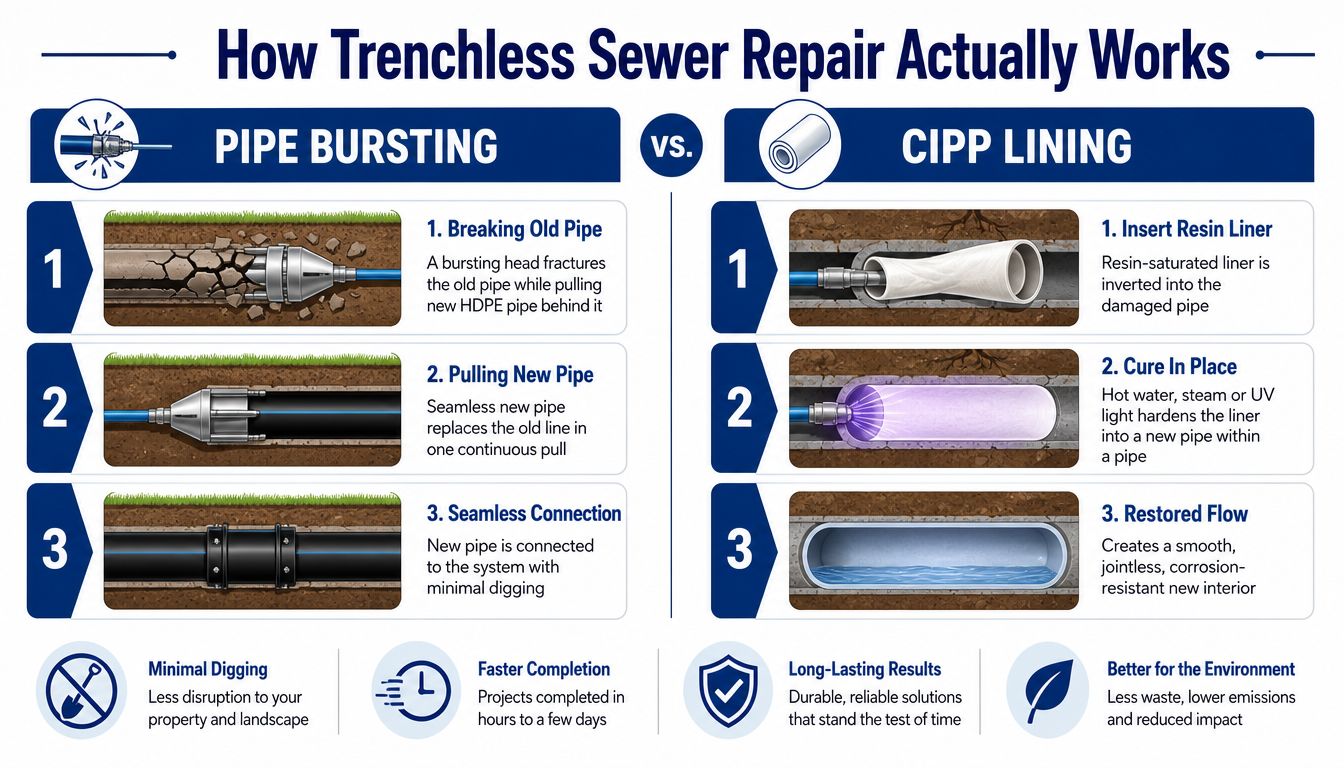
Most projects center on pipe bursting or cured-in-place pipe lining, commonly called CIPP. Both use access points rather than a continuous trench, but they solve different structural problems.
Pipe bursting replaces the old line
Pipe bursting is closer to replacement than repair. A hydraulic or pneumatic expansion head travels through the existing pipe, fractures the old material outward into the surrounding soil, and pulls a new pipe into the opening behind it. The process can be visualized as replacing a worn straw by pushing a new, stronger one through the same route, although the actual equipment uses substantial pulling force.
A typical sequence looks like this:
- The crew exposes access points. Existing manholes or small insertion pits are commonly used instead of open excavation along the full route.
- The bursting head enters the host pipe. As it advances, the head breaks brittle or structurally failing pipe outward.
- New pipe follows behind. The replacement line is pulled into the void in a continuous run.
- Connections are restored. The crew reconnects the line at the access locations and checks the finished interior.
EPA guidance gives a typical production rate of about 30 meters, or 100 feet, per hour for pipe bursting, as described in the EPA pipe bursting guidance. The EPA also states that the method is commonly used for inside diameters from 100 millimeters to 600 millimeters, or 4 to 24 inches, though smaller sizes are possible, according to its pipe bursting fact sheet.
Pipe bursting can install a replacement line of the same or larger diameter. An ASCE pipe bursting manual notes that equipment generally can increase diameter by two nominal sizes, such as replacing a 6-inch pipe with an 8-inch pipe. The surrounding soil, nearby utilities, alignment, and access still control whether that increase is feasible.
CIPP creates a pipe inside the old pipe
CIPP is different. The existing line remains in place, provided it can support the installation and the finished liner can be properly seated. After cleaning, a flexible liner saturated with resin is inserted into the damaged pipe and cured with a specified process. Once hardened, it forms a new interior pipe within the host.
NASSCO notes that CIPP can be used from small service lines through large-diameter pipelines. Public specifications commonly require minimum cured-liner properties such as 3,000 psi tensile strength, 4,500 psi flexural strength, and 250,000 psi flexural modulus under ASTM-based testing, as shown in the NASSCO pipeline rehabilitation matrix. Those figures matter because the liner's strength and stiffness affect its ability to carry soil and live loads without deforming or collapsing.
The cleaning and inspection stages are just as important as the resin. Roots, grease, mineral deposits, and loose debris must be removed so the liner can fit correctly and the crew can reopen branch connections after curing.
A visual explanation can also help before you speak with a contractor:
Trenchless Repair vs Traditional Excavation
The wrong comparison is “modern versus old.” The useful comparison is which method matches the pipe condition and the property.
Trenchless work can reduce surface disruption and restoration, but access still has to be created. Traditional excavation exposes the line directly, which makes it more invasive but gives the crew complete visibility and physical access to every part of the defect.
| Factor | Trenchless Repair | Traditional Excavation |
|---|---|---|
| Property disruption | Usually limited to access points | Requires excavation along the pipe route |
| Surface restoration | Often reduced for lawns, driveways, and landscaping | May require substantial replacement of disturbed surfaces |
| Pipe condition | Works when the line can be lined or replaced through the available route | Handles collapse, severe deformation, misalignment, and complicated access |
| Upfront price | Can be higher for specialized equipment and installation | May be simpler for short, exposed, or easily accessible repairs |
| Long-term value | Strong when inspection, preparation, installation, and verification are completed properly | Strong when direct access is needed to correct grade or structural failure |
| Best decision factor | A suitable pipe and site | A defect that trenchless methods cannot safely correct |
Cost isn't only the plumbing invoice
A trenchless estimate may look higher before restoration is considered. Open-cut work may involve soil removal, backfilling, driveway repair, concrete replacement, landscaping, traffic control, or business interruption. On the other hand, trenchless work can require specialized equipment, cleaning, resin systems, access preparation, and careful quality control.
The cheapest quote isn't automatically the least expensive project. A poorly prepared liner can create future trouble, while an excavation contractor may solve a severe defect directly and permanently.
The existing grade still matters
Lining follows the pipe's existing route and grade. It doesn't remove a sagging section where wastewater collects. Pipe bursting installs a new pipe along the established path, but it also doesn't guarantee that a poor layout becomes a correctly graded system.
For a homeowner comparing options, Jay's sewer line repair information can be one starting point, but the final decision should come from the inspection findings, scope of work, restoration plan, and written warranty.
When Trenchless Repair Is Not the Right Choice
The most important trenchless question is sometimes, “Why shouldn't we use it?” A contractor who can't explain the limitations of the recommended method hasn't given you enough information to approve the work.
CIPP lining needs a host pipe that is reasonably continuous and stable enough to receive the liner. It may be a poor fit when the line has severe deformation, a major joint offset, extensive collapse, or a sag that causes recurring flow problems. A liner can reinforce a damaged passage, but it can't lift a settled section back to its original grade.
Conditions that deserve careful scrutiny
- Severe deformation: If the pipe has lost too much of its shape, the liner may not expand or seat as intended.
- Major joint offsets: A substantial separation can prevent a continuous liner from forming a sound path.
- Collapsed sections: A fully collapsed host may not allow cleaning equipment or a liner to pass.
- Sagging or bellies: Lining doesn't correct a low section where solids and water collect.
- Chronic root intrusion: Roots can enter through joints, but extensive intrusion combined with structural collapse may require excavation or replacement.
- Unsafe access: Utilities, buildings, retaining structures, or property boundaries can limit the equipment's safe operation.
The camera should answer the hard questions
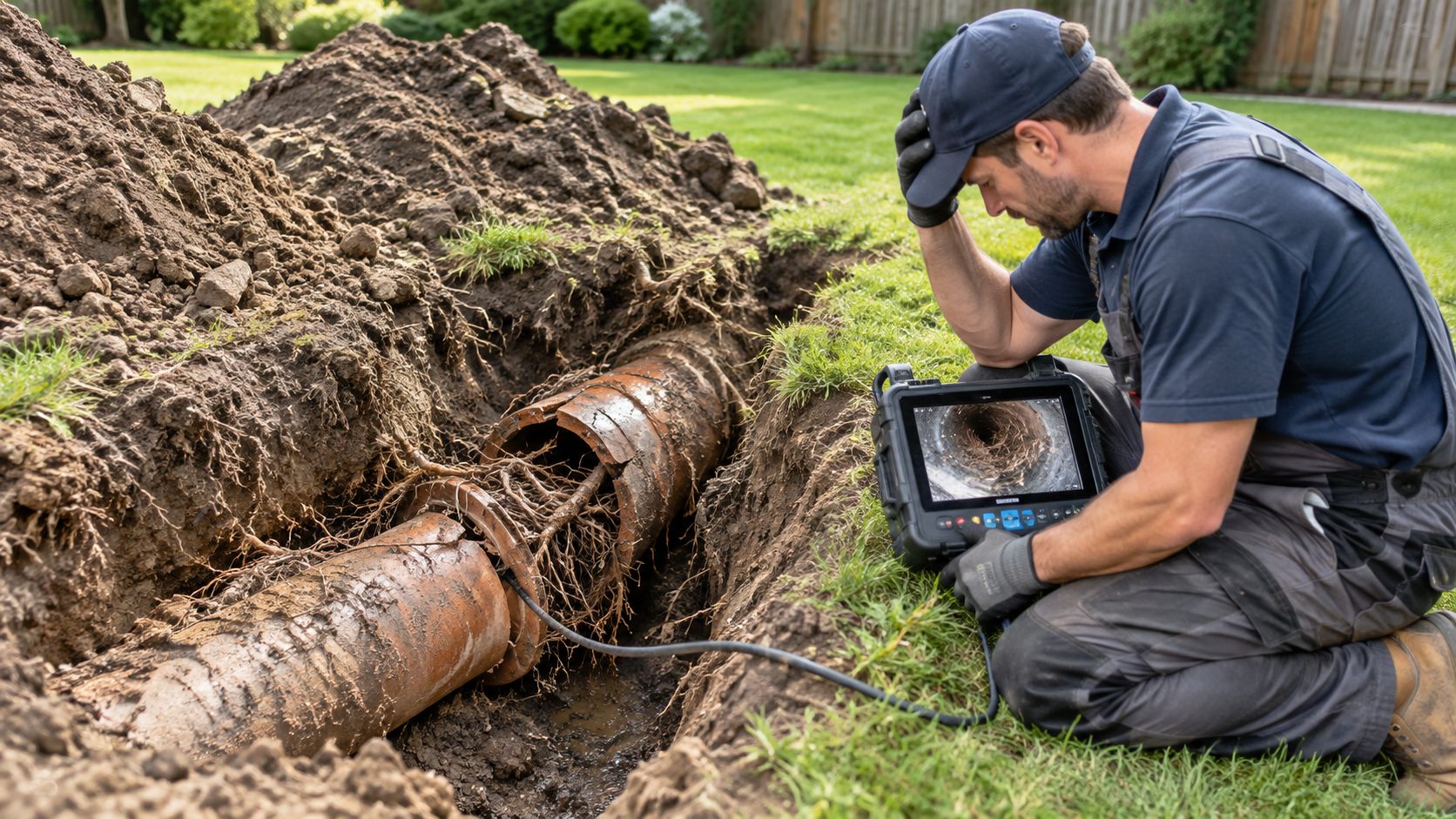
A sewer camera inspection should identify the pipe material, diameter, route, connections, defect locations, standing water, root entry, and the condition of the access points. Ask for the footage, not only a verbal summary. You should be able to see why lining, bursting, spot repair, or open excavation was recommended.
Warning signs in a proposal include:
- No inspection footage: A contractor recommends trenchless repair without showing the pipe condition.
- No method explanation: The estimate names a technology but doesn't explain why it fits this defect.
- No preparation details: The proposal doesn't identify cleaning, root removal, or branch reconnection.
- No verification plan: The contractor won't describe a post-repair camera inspection.
- Pressure to decide immediately: A major sewer project deserves a clear scope and time to compare opinions.
A good plumber isn't trying to force every sewer problem into a trenchless package. The recommendation should change when the pipe evidence changes.
Costs, Lifespan, and Long-Term Value
No responsible plumber can quote a universal price for trenchless sewer repair without seeing the line. The final estimate depends on the damaged length, pipe diameter, access points, cleaning requirements, method, connections, surface conditions, and whether the work is residential or commercial.
That makes a camera inspection more useful than an online cost range. It tells you whether you're dealing with a localized defect, a full run, a line suitable for CIPP, or a replacement candidate for pipe bursting or excavation.
Look beyond the initial estimate
Ask each contractor to separate the scope into understandable parts:
- Diagnosis: Camera inspection, locating, and condition assessment.
- Preparation: Cleaning, root removal, cutting, and access setup.
- Installation: Liner and curing process, or bursting and replacement pipe.
- Restoration: Backfill and repair of access areas or disturbed surfaces.
- Verification: Final camera footage, documentation, and warranty terms.
A detailed estimate also helps property managers compare total ownership cost. A lower bid that omits cleaning, branch reconnection, or final inspection may not be comparable to a more complete proposal. The sewer line replacement cost guide can help frame the conversation, but actual site conditions should control the estimate.
Service life requires installation quality
Trenchless materials are designed for long-term rehabilitation, but service life depends on the selected system, pipe condition, curing, installation quality, soil environment, and maintenance. It isn't responsible to promise the same outcome for every property.
For commercial owners and landlords, documentation has practical value. Keep the initial camera footage, cleaning records, liner specifications, curing information, final inspection, invoices, and warranty. Those records can support future maintenance planning, insurance discussions, tenant questions, and a later sale.
The best value is not the cheapest trenchless job. It's the project that leaves you with a suitable repair, verified installation, and a clear record of what was placed underground.
What to Expect During the Trenchless Repair Process
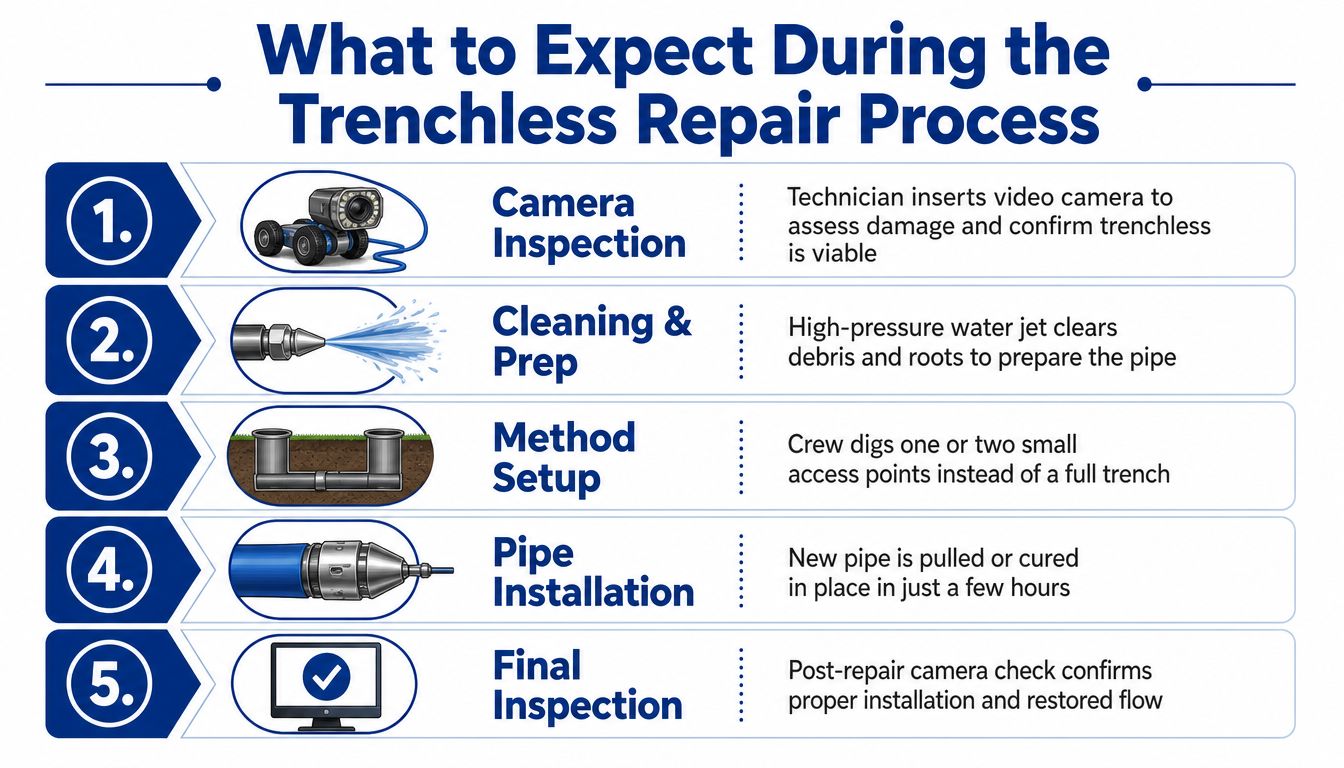
A properly managed project begins before the crew arrives. The first step is a video camera inspection through a sewer cleanout or another suitable access point. The technician uses that footage to map the defect, evaluate the pipe, locate branches, and decide whether CIPP, pipe bursting, spot repair, or excavation makes sense.
The work usually follows a defined sequence
- Inspection and planning: The plumber identifies the line route, defect, diameter, access requirements, and affected fixtures.
- Cleaning and preparation: Jetting or other approved tooling removes roots, grease, scale, and debris that could interfere with installation.
- Access setup: The crew uses existing manholes or creates targeted pits. Permits and utility locating may be needed depending on the property and municipality.
- Installation: Pipe bursting pulls the new pipe through as the old pipe fractures. CIPP inserts and cures the resin-saturated liner inside the host pipe.
- Connection and verification: Branch lines are reopened where necessary, flow is checked, and a final camera inspection documents the finished interior.
A project may be completed quickly when the line is accessible and the scope is straightforward. Some trenchless work takes one to two days, but the actual schedule depends on the pipe length, condition, access, cleaning, curing system, connections, and required approvals.
Questions to ask before approving the work
Ask what fixtures will be unavailable, where the crew will work, how access areas will be restored, and what happens if the camera reveals a condition that makes trenchless repair unsuitable. Confirm who handles permits and utility locating when those steps apply.
You should also ask for:
- Before-and-after footage: The recordings should show the defect and the completed repair.
- Material information: Request the liner or replacement pipe specifications.
- Cure or installation records: Ask how the crew verifies that the liner was properly seated or the new pipe was correctly installed.
- Warranty terms: Read what is covered, for how long, and whether maintenance conditions apply.
- A written scope: The document should identify cleaning, reconnections, restoration, inspection, and exclusions.
For property owners who aren't sure where their access point is located, information about what a sewer cleanout is can make the inspection conversation easier.
Local Considerations and Next Steps for Southeast Michigan
Fraser, Macomb County, and Oakland County properties face conditions that deserve local attention. Michigan winters can freeze ground around shallow or poorly protected lines, while spring rain can expose weak sewer connections, saturate soil, and contribute to basement flooding. Older neighborhoods may also contain a mix of pipe materials, additions, renovations, and buried cleanouts that affect access.
A local plumber should account for soil conditions, municipal requirements, utility locations, easements, and the relationship between the private sewer lateral and the public connection. The same camera finding can lead to different recommendations depending on whether the line runs under a lawn, driveway, foundation, roadway, or commercial parking area.
Start with a camera inspection rather than guessing from symptoms. If the recommendation involves a major repair, obtain another opinion when the condition is unclear and ask these direct questions:
- What exactly is damaged?
- Is the pipe structurally suitable for CIPP?
- Would pipe bursting correct the problem or follow the same defect?
- Is there a sag, offset, or collapse that requires excavation?
- What footage and installation records will I receive?
Call Jay's Plumbing and sewer Now @ 586-634-3450 for an honest assessment of a residential or commercial sewer problem in the Fraser, Macomb County, or Oakland County area. The company also handles sewer and drain cleaning, camera inspections, excavation when required, leak detection, water heater repair and replacement, sump pump repair, bathroom plumbing, kitchen plumbing, and commercial plumbing.
Call Jay's Plumbing and sewer Now @ 586-634-3450 to schedule a sewer camera inspection and discuss whether trenchless sewer repair fits your property. Jays Plumbing and Sewer can explain the available repair, replacement, and excavation options, then help you visit Jays Plumbing and Sewer for service information and scheduling.
