You're standing in the unfinished side yard of a new home in Macomb County, looking at the kitchen range, furnace, and water heater you want connected to natural gas. It's tempting to think the job is running a pipe from the street to the house. In practice, gas service line installation involves the utility, permits, property access, underground conditions, trenching, testing, inspection, and final meter coordination.
That's why a good project starts before anyone digs. Whether you're a homeowner in Fraser, a property manager in Sterling Heights, or a commercial owner in Oakland County, early planning helps prevent surprises caused by easements, soil, weather, appliance load, and utility scheduling. If the work involves an existing line or a suspected problem, review our guide to gas line repair and call Jay's Plumbing and Sewer Now @ 586-634-3450 for practical guidance.
Table of Contents
- Why Gas Service Line Installation Is Bigger Than a Simple Plumbing Call
- Site Assessment and Permitting Before Any Digging Begins
- Trenching Versus Trenchless Gas Line Installation
- Burial Depth Requirements and Pressure Testing Standards
- What Drives Gas Service Line Cost and Timeline Differences
- Hiring a Licensed Gas Line Contractor in Macomb and Oakland County
Why Gas Service Line Installation Is Bigger Than a Simple Plumbing Call
A homeowner may call after buying a house without an active gas connection. A property manager may need service for a remodeled rental. A small business may be adding a commercial kitchen, rooftop equipment, or another gas appliance. In each case, the first question isn't only where the pipe should go. It's who must approve the route, who will connect the utility side, what permits apply, and whether the property is ready for construction.
Several parties share the work
The utility generally controls the connection to its distribution system and the meter process. The municipality may require permits, inspections, or approved plans. The property owner may need to provide access or an easement, while the licensed contractor handles route planning, pipe installation, building penetration, testing, and coordination.
The scale of the existing network explains why utilities use formal procedures. In 2025, U.S. gas distribution systems reported 73,139,039 service connections and an estimated 1,003,891 miles of service lines, compared with 71,559,136 services and 965,329 service-line miles in 2022, according to the Pipeline and Hazardous Materials Safety Administration's gas distribution mileage data. That means the work takes place within a very large, actively managed infrastructure system, not an isolated residential plumbing loop.
The job has a sequence
A typical project moves through these stages:
- Request and site review: The owner explains the intended appliances and property use.
- Route and load planning: The contractor and utility evaluate the safest practical path and required capacity.
- Permitting and utility approvals: Applications, easements, and scheduling are handled before excavation.
- Installation: The pipe is placed, protected, connected, and brought through the building correctly.
- Testing and inspection: The completed line must pass pressure and leakage checks before service is activated.
- Meter coordination: The utility completes its portion and confirms the service is ready.
Southeast Michigan adds practical complications. Michigan winters can freeze ground, heavy rain can soften yards, and older Macomb County neighborhoods may contain mature trees, patched driveways, and crowded underground utilities. A professional looks at the entire path, not just the trench.
Site Assessment and Permitting Before Any Digging Begins
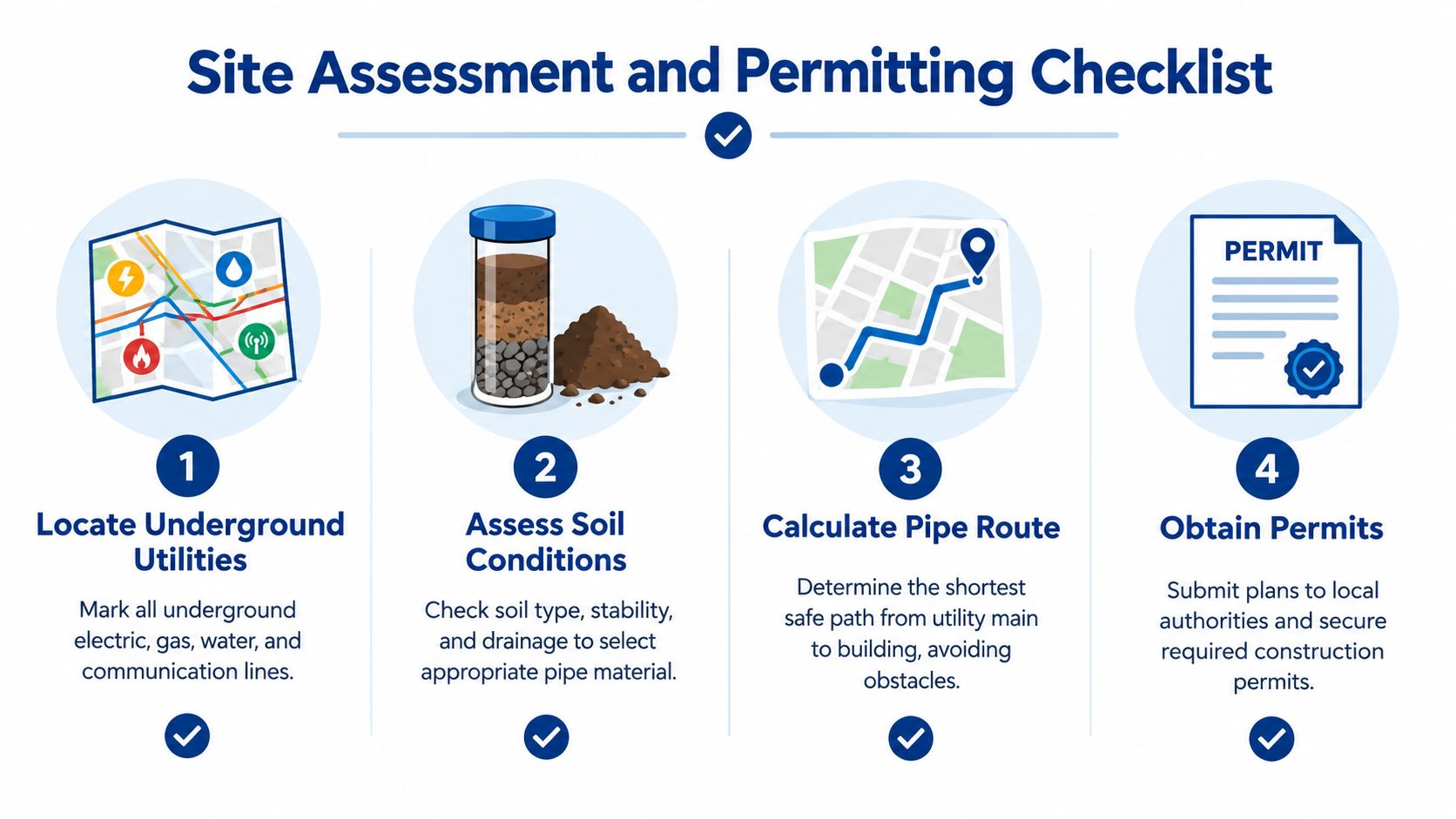
The first site visit should answer practical questions. Where is the utility main? Where will the meter sit? Which appliances will operate at the same time? Can the route avoid existing electric, water, sewer, communication, and irrigation lines? A rushed assessment can create rework, surface damage, or a route that fails inspection.
What the contractor checks
A useful assessment usually includes:
- Underground utility locations: Existing lines must be identified and marked before excavation or boring.
- Building and appliance layout: The meter location, foundation, mechanical room, kitchen, and outdoor appliances affect the route.
- Gas load: Furnaces, water heaters, ranges, fireplaces, grills, and other appliances determine the system capacity required.
- Soil and surface conditions: Clay, loose fill, drainage, tree roots, concrete, asphalt, and landscaping all affect installation choices.
- Foundation penetration: The pipe must enter without creating a path for gas migration or leaving the line vulnerable to corrosion or shearing.
The shortest route isn't automatically the right route. A slightly longer path may avoid a driveway, reduce the number of obstacles, or provide better access for inspection and future maintenance.
Permits and easements affect the schedule
The utility or municipality may require an application, site plan, inspection request, or engineering review. If the line crosses private property, the owner may need to provide an easement. Utility guidance also notes that charges can vary according to service length and anticipated annual gas load, and that easements may be required when the line crosses private property. Those details are summarized in the Eversource gas service FAQ.
Submit information early. The owner should have appliance specifications, the property survey if available, the proposed meter location, ownership details, and access information ready. Utility engineering and construction scheduling can take time, and a permit issue discovered after excavation begins is far more disruptive than one resolved during planning.
Practical rule: Treat the application, easement, permit, and site-readiness work as part of the installation itself. They aren't paperwork separate from the project.
Trenching Versus Trenchless Gas Line Installation
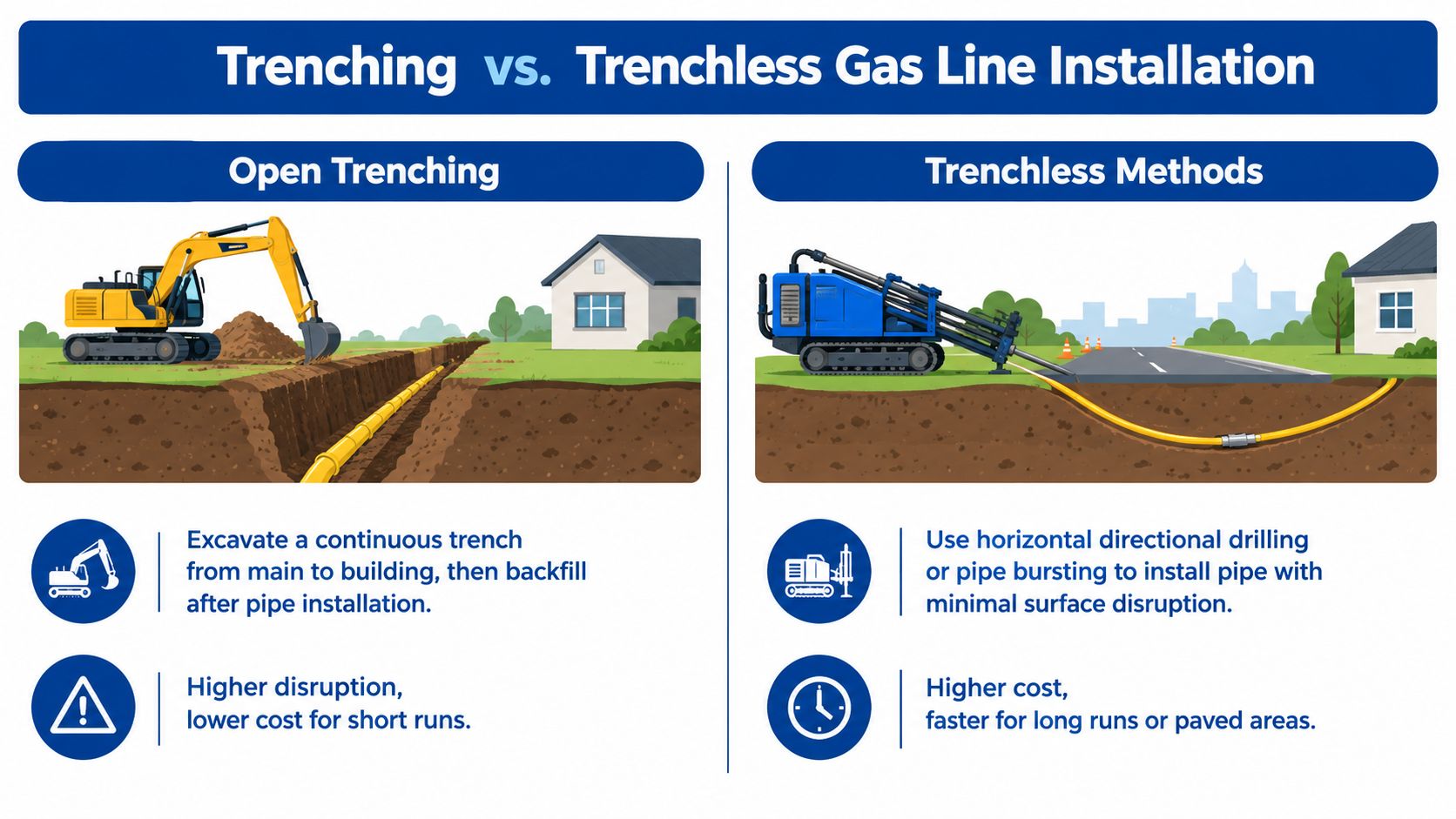
The route determines the installation method. Open trenching exposes the ground along the pipe path. Trenchless installation, often using horizontal directional drilling, creates limited access points and places the pipe underground with less surface excavation.
Neither method wins every job. The right choice depends on the route, surface, soil, utility conflicts, access, and restoration requirements.
Open trenching
Open trenching is often practical for a short, accessible run through an open lawn. The contractor excavates the route, prepares stable support, places the approved pipe, completes the connection, and backfills after inspection requirements are satisfied.
Its advantages include direct visibility and straightforward access. The crew can see the trench conditions, work around known obstacles, and restore the route afterward. The trade-off is surface disruption. Sod, gardens, walkways, driveways, and other improvements may need repair.
Trenchless installation
Directional boring can make sense beneath a driveway, sidewalk, paved access lane, or carefully maintained landscaping. It may also help where a continuous trench would interfere with mature trees or an occupied commercial site.
The method still requires planning. Drilling equipment needs access, underground utilities must be accurately located, and the contractor must account for soil behavior and the entry and exit points. Frozen ground and dense Michigan clay can affect how easily equipment advances and how accurately the bore follows its intended path.
| Method | Often makes sense when | Main trade-off |
|---|---|---|
| Open trenching | The route is short and crosses accessible soil | More visible excavation and restoration |
| Trenchless boring | The route passes beneath paved or sensitive surfaces | Specialized equipment and more complex planning |
| Commercial routing | The site has access, traffic, and operating constraints | Work must be coordinated around occupants and business activity |
A newly poured driveway is a good example. Cutting across it may create unnecessary restoration work, while boring beneath it may preserve the surface. In an older Macomb County neighborhood, however, tree roots and uncertain utility records can make either method complicated. The assessment should compare the total disruption, not just the excavation itself. For related underground work, our discussion of main sewer line repair explains why route conditions and surface restoration matter in buried piping projects.
Burial Depth Requirements and Pressure Testing Standards
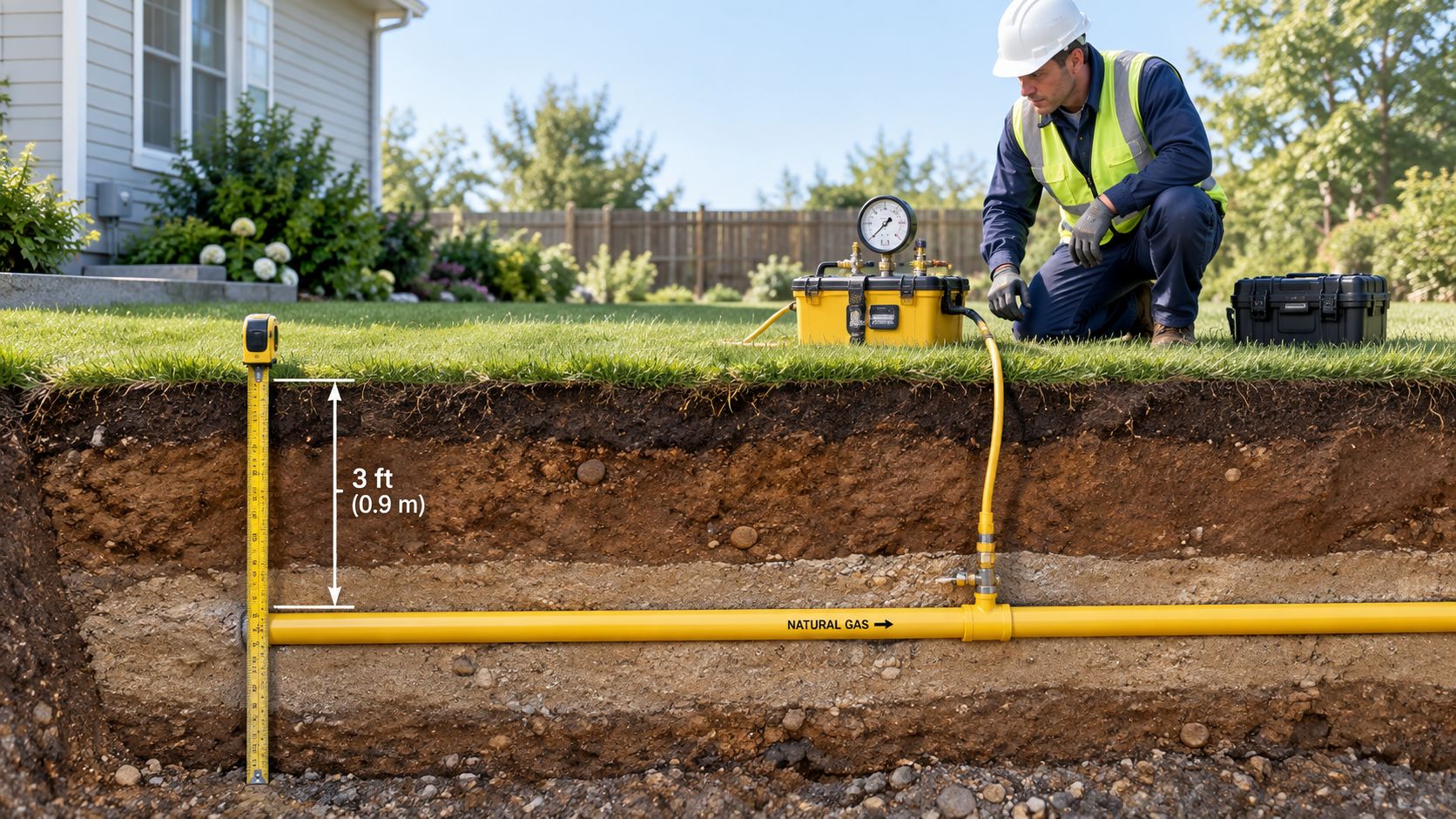
Burial depth protects the service line from ordinary surface activity and expected external loads. Under federal rules, a buried gas service line needs at least 12 inches of cover on private property and 18 inches in streets and roads, as stated in 49 CFR 192.361.
Cover is only part of the requirement
If an underground structure prevents the standard depth, the pipe still has to withstand expected external loads. It must be supported on undisturbed or well-compacted soil, and the backfill can't contain material that could damage the pipe.
At the building, the contractor must avoid putting strain on the pipe. A foundation penetration needs protection from corrosion and shearing, and the wall opening must be sealed so gas can't migrate into the structure. These details matter in older homes where foundations may have irregular masonry, additions, or previous utility penetrations.
Pressure testing verifies the completed line
Before gas service is activated, the installer performs a pressure test and checks the system for leakage. The exact procedure follows the applicable utility, code, and inspection requirements. A Peoples Gas installation guide specifies a 90-pound test, with a 10-minute minimum hold for lines smaller than 2 inches and a 1-hour hold for lines 2 inches or larger. Those requirements appear in the Peoples Gas installation guide.
A Con Edison customer guide also describes testing below-grade piping before the building wall, using air as the test medium, isolating the pressure source, and supporting buried piping during leakage testing and coating inspection. The Con Edison gas service guide provides those procedural details.
A failed test doesn't mean the whole project is abandoned. It means the installer must locate the problem, correct the fitting, coating, support, or pipe issue, and repeat the required testing before approval. This can extend the schedule, which is why careful assembly and inspection preparation save time.
What Drives Gas Service Line Cost and Timeline Differences
Two homes on the same street can have different project experiences. Pipe length matters, but it isn't the only factor. The route may cross a driveway, require an easement, pass through difficult soil, or serve a building with a larger gas load.
The American Gas Association's historical service-line data reports that U.S. service-line mileage grew from 595,000 miles in 1990 to 982,000 miles by 2023, with an average service-line length of 87 feet. That average provides context, not a quote for any individual property. A local estimate still depends on the actual route and system requirements.
The practical cost and schedule factors
| Factor | Impact on cost | Impact on timeline |
|---|---|---|
| Service length | More pipe, excavation, bedding, and labor | More installation and restoration work |
| Anticipated gas load | Larger capacity can affect materials and connections | Engineering review may require more coordination |
| Property layout | Driveways, pavement, trees, and landscaping increase complexity | Access and restoration planning take longer |
| Easements | Documentation and property coordination add project work | Signatures and approvals can delay release |
| Utility scheduling | Utility-side work may involve separate coordination | Meter and main connection dates may control completion |
| Seasonal conditions | Frozen ground or saturated soil can require additional effort | Winter weather and heavy rain can interrupt site work |
Commercial properties often need more coordination because equipment loads, access, tenant operations, and site safety all affect the work plan. A small restaurant, office, or retail building may also need construction staged around business hours.
Homeowners should request an estimate based on the full scope. Ask whether it includes excavation, boring, surface restoration, permits, testing, inspection coordination, utility work, and the meter process. Don't use a generic sewer line replacement cost discussion as a gas-line quote. The systems and approval paths differ, even though both involve underground construction.
Call Jay's Plumbing and Sewer Now @ 586-634-3450 before scheduling excavation if you're unsure whether your project needs a utility application, a permit, an easement, or a route assessment.
Hiring a Licensed Gas Line Contractor in Macomb and Oakland County
Gas work isn't a good project for a handyman or improvised repair. Ask the contractor who will pull the permit, who will coordinate with the utility, how the pipe will be tested, and what the estimate includes. The contractor should be able to explain the route in plain English and identify which work belongs to the utility and which work belongs to the property owner.
Questions worth asking
- Licensing and insurance: Is the company properly licensed for the work, and can it provide current insurance information?
- Utility experience: Has the contractor worked with the utility serving your Fraser, Sterling Heights, Warren, Troy, Rochester Hills, or nearby property?
- Scope: Does the proposal include excavation or boring, protection at the foundation, testing, permits, inspection coordination, and restoration?
- Schedule: Which steps depend on the utility, municipality, weather, or property access?
- Documentation: Will you receive test and inspection information when the work is complete?
Red flags include pressure to skip permits, vague answers about testing, an unusually low quote that excludes restoration, or a request to begin digging before the route is approved. A reliable contractor also protects floors and finished areas, communicates changes, and leaves the site orderly.
Jays Plumbing and Sewer provides gas line services along with residential and commercial plumbing, leak detection, sewer repair, drain cleaning, water heater repair and replacement, pipe repair, sump pump repair, bathroom plumbing, and kitchen plumbing across Macomb and Oakland County. If you're searching for a plumber near me or need an emergency plumber, choose a company that can explain the entire process and tell you when a utility must be involved.
Call Jay's Plumbing and Sewer Now @ 586-634-3450 to arrange a professional assessment for gas service line installation, route planning, testing coordination, or related pipe work. Jays Plumbing and Sewer serves homeowners, property managers, real estate professionals, and commercial customers throughout Macomb and Oakland County. Visit Jays Plumbing and Sewer to request service and discuss your project before excavation begins.
