

A sewer cleanout is a capped access point on the building sewer line that lets plumbers clear blockages, run cameras, and jet the pipe without digging, and cleanouts may be spaced no more than 100 feet apart in some building-sewer requirements. Other code summaries specify cleanouts at 75 feet for horizontal drain piping serving 4-inch pipe or smaller and 100 feet for 5-inch pipe and larger (Gas City plumbing code). You may discover yours on a Sunday morning after a basement floor drain backs up, when a small cap in the lawn suddenly becomes the most useful plumbing fitting on the property.
Table of Contents
- What a Sewer Cleanout Actually Does
- Anatomy of a Sewer Cleanout
- Where to Find the Cleanout on Your Property
- How Cleanouts Are Placed by Code
- Using the Cleanout for Routine Maintenance
- How a Camera Inspection Through the Cleanout Works
- When to Stop and Call a Plumber
- Key Takeaways for Homeowners
What a Sewer Cleanout Actually Does
A sewer cleanout is a capped service opening connected to the building drain or sewer line. It gives a plumber a direct path into the pipe, so the technician can use a drain cable, hydro-jetting hose, or inspection camera without removing a toilet, opening a wall, or digging up the yard. Code and industry references describe cleanouts as purpose-built access fittings, often arranged as a wye or tee, rather than as ordinary pipe caps (National Sewer Authority explanation of sewer cleanout access points).
Consider a Shelby Township homeowner who notices water rising in a basement floor drain when the washing machine empties. A licensed plumber checks the outside cleanout, removes the cap carefully, and feeds a cable toward the street. The fitting doesn't clear the clog by itself. It provides the straight, controlled entry needed to reach the obstruction with the right tool.
The service path inside the pipe
Through that opening, a plumber may:
- Clear a blockage: A cable or auger breaks through accumulated debris, roots, or other material.
- Inspect the line: A waterproof camera shows whether the pipe has cracks, offsets, root intrusion, or a sag.
- Clean the pipe walls: A high-pressure water jet can wash away grease, detergent residue, mineral deposits, and other buildup.
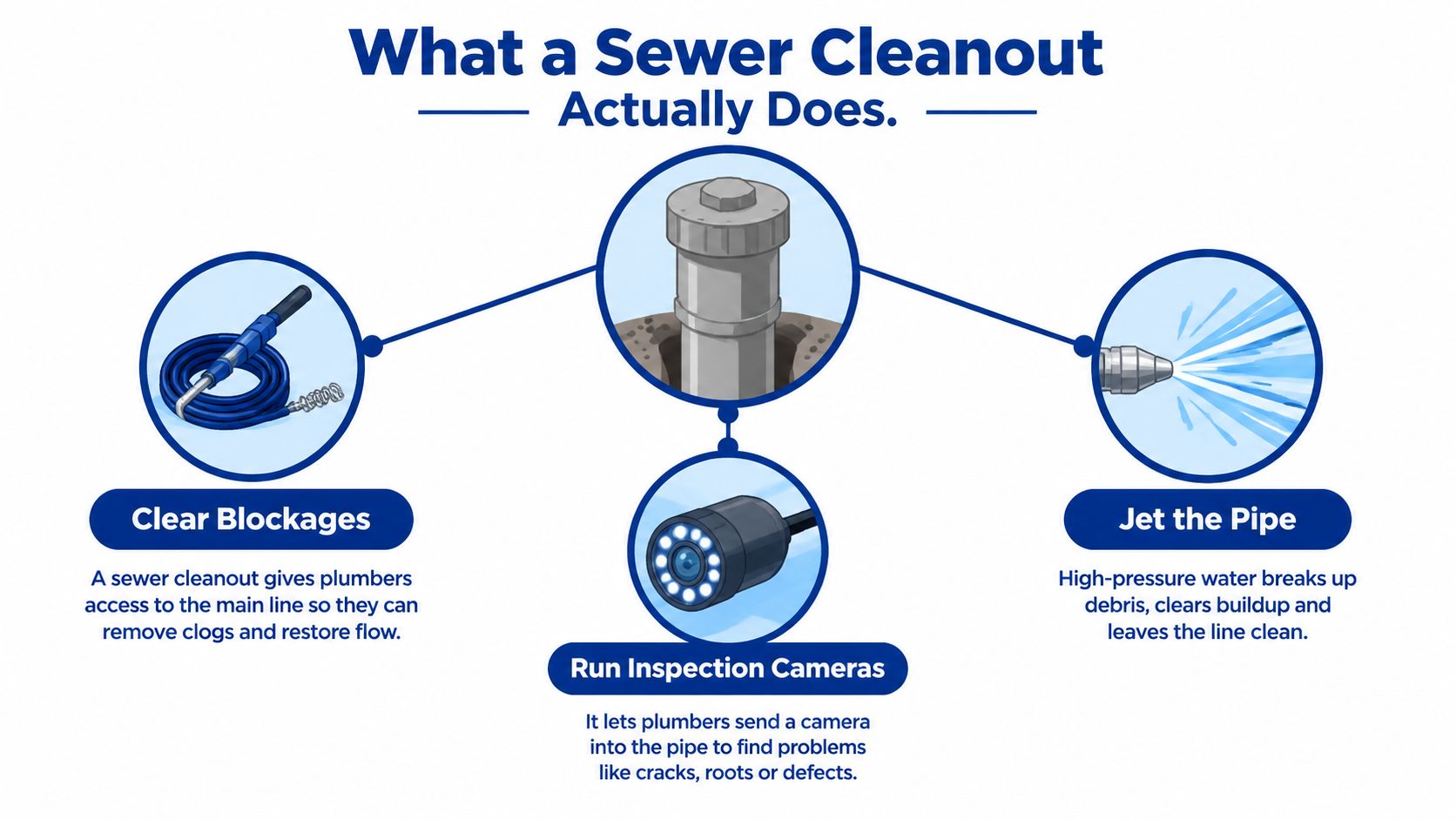
That access can turn a disruptive excavation problem into a targeted service visit. It also gives the plumber a better starting point for deciding whether the line needs cleaning, repair, or replacement.
Practical rule: Find the cleanout before the first backup. Looking for it while wastewater is standing in the basement is much harder.
Anatomy of a Sewer Cleanout
Most residential cleanouts are easy to miss because they blend into the property. Outside, you may see a short white PVC or brass pipe rising slightly above the soil, topped by a threaded cap. In a lawn or garden area, the fitting may sit inside a small round yard box with a lid nearly flush with the grass.
Residential cleanouts are commonly 3 or 4 inches in diameter, and a 4-inch fitting is common near the curb in Macomb and Oakland County neighborhoods. These sizes provide room for service equipment while keeping the fitting compact. A two-way cleanout can give access in both directions, toward the house and toward the street, while a tee or wye configuration creates a smoother route into the horizontal line.
What it isn't
Homeowners often confuse several plumbing components:
| Part | Its job |
|---|---|
| Sewer cleanout | Provides service access to the building drain or sewer line |
| Vent stack | Allows air into the drainage system and usually extends through the roof |
| P-trap | Holds water beneath a fixture to help block sewer gas |
| Manhole | Provides larger access to a public or more complex sewer system |
Think of the cleanout as a service hatch in a long buried pipe. A roof vent is an air chimney, a P-trap is a water seal, and a municipal manhole belongs to the public sewer network rather than the home's private plumbing.
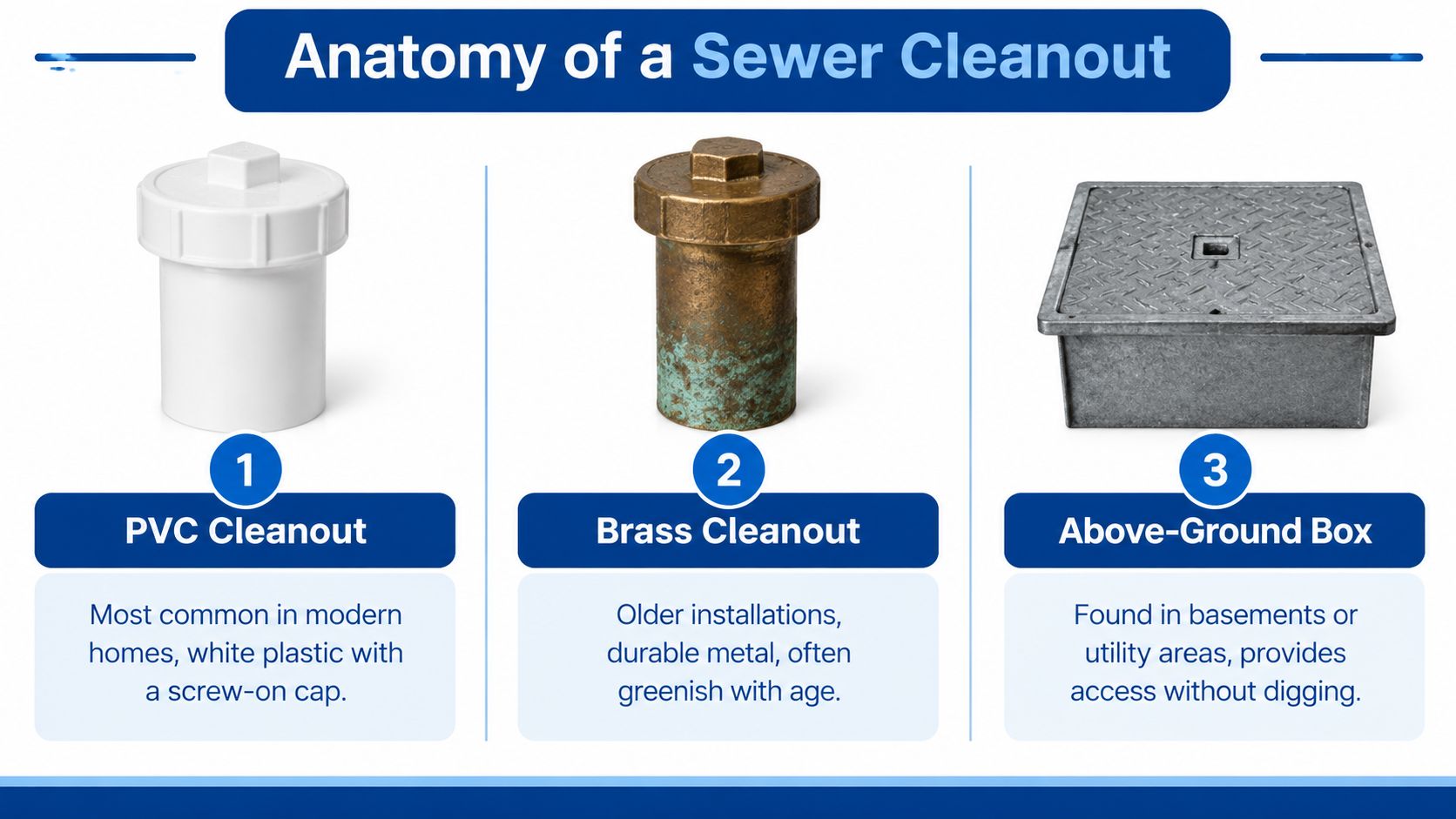
The fitting may be plastic in a newer home or brass and somewhat weathered in an older Warren, Roseville, or Pontiac property. The material matters less than the basic function: the cap marks a deliberate opening into the sewer line.
Where to Find the Cleanout on Your Property
Start outside, near the side of the house where the main drain likely leaves the foundation. Look for a capped pipe close to the exterior wall, often in the lawn between the house and the street. It may be white plastic, dark plastic, brass, or a metal fitting inside a small meter-style box.
A second common location is farther along the sewer path. In newer subdivisions, a property-line cleanout may sit near an easement, driveway edge, walkway, or right-of-way. Some homes have a yard-box installation with a removable lid instead of a pipe standing visibly above the grass.
Check older Southeast Michigan homes
Older bungalows and ranches around Warren, Roseville, and Pontiac may have an indoor cleanout. Check the basement near the floor drain, along the front foundation wall, or near the point where the building sewer heads outside. A slab home may have a round threaded plug set flush with the floor rather than an obvious outdoor riser.
Use this simple search order:
- Walk the foundation: Look for capped fittings near the side or front wall.
- Trace the likely route: Follow the path from the lowest plumbing fixtures toward the street.
- Check the basement or utility area: Look near floor drains and exposed drain piping.
- Inspect yard boxes: Search near the driveway, sidewalk, property line, and sewer-line junction.

Landscaping can hide a cleanout under mulch, soil, shrubs, or replacement sod. In some older homes, the original fitting may be buried, damaged, or missing. If you can't find one, don't start digging blindly. A plumber can trace the line and determine whether an accessible cleanout can be exposed or installed.
How Cleanouts Are Placed by Code
A cleanout must give a plumber a reachable opening and a workable route into the drain. It should not end up beneath a deck, behind finished walls, or under a permanent obstruction. Code guidance generally places access at the upper end of horizontal drainage, along longer runs, and near major changes in direction. The accessibility requirements summarized by UpCodes also address the working space needed around the fitting.
One code summary specifies 30 inches of vertical clearance. It also calls for at least 12 inches of horizontal service space for vertical piping up to 2 inches, with 18 inches for larger vertical piping. These dimensions give a technician room to remove the cap, position a cable or inspection equipment, and work without tearing apart nearby construction.
Spacing has a purpose
Cleanouts divide a drainage run into sections that can be serviced from reachable points. Requirements may limit the distance between access points, and a horizontal drain may need another cleanout where its direction changes by more than 135 degrees, as described in the UpCodes cleanout requirements.
Those rules do not mean every home in Macomb or Oakland County will have the same arrangement. Local adoption, the home's construction date, remodeling, and site conditions all affect what remains in place. Older municipal standards show how access requirements developed over time, including an 1983 ordinance that addressed the foot of vertical soil lines, horizontal line ends, and intervals not exceeding 50 feet (Annawan municipal code).
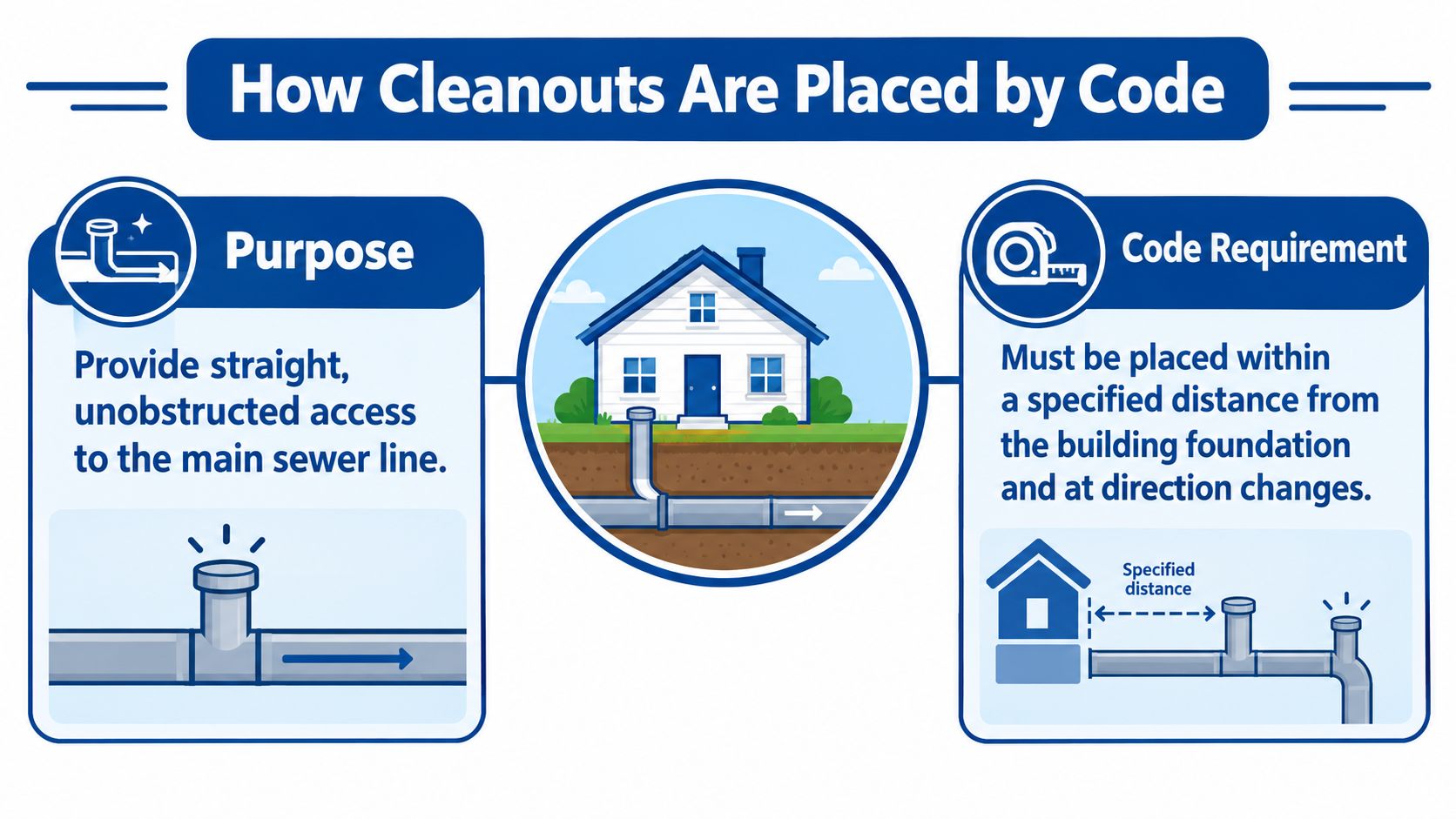
For a homeowner, the practical point is simple: a cleanout should be findable and usable before sewage backs up. If the cap is buried, blocked by landscaping, or missing, do not assume the property is automatically out of compliance. A plumber can inspect the line, locate the original fitting, and explain whether exposing or adding an accessible cleanout is appropriate under local requirements.
Using the Cleanout for Routine Maintenance
A Shelby Township homeowner notices the basement drain gurgling each time the washer empties. The homeowner clears lint and hair near the drain and tries a small auger, but the gurgling returns the next day. That pattern suggests the restriction may be farther along the shared drain, where the outside cleanout becomes the more useful access point.
A professional may inspect the cleanout and use it to determine where the obstruction sits. Standing water in the riser can indicate that the blockage is downstream toward the street. A dry riser may point toward a restriction inside the home or upstream of that fitting. That observation helps guide the next step, but it doesn't replace a camera inspection when the problem keeps returning.
What a homeowner should avoid
You might be comfortable removing an accessible cap when the line isn't backed up, but proceed cautiously. Never force a stuck fitting, and don't open a cap when wastewater is visibly backing up or the line may be under pressure.
- Skip chemical drain cleaners: They may not address a main-line obstruction and can create a hazard during later service.
- Don't force a cable: Resistance can indicate a damaged pipe, not just a stubborn clog.
- Avoid rental jetters: High-pressure equipment can damage compromised piping and requires proper control.
- Stop after a short attempt: A recurring blockage needs diagnosis, not repeated temporary clearing.
For guidance on recurring drain symptoms, review this drain cleaning resource from Jays Plumbing and Sewer. If multiple fixtures are affected, reduce water use and arrange professional service rather than continuing to experiment.
How a Camera Inspection Through the Cleanout Works
A sewer camera gives the plumber a view that a drain cable can't provide. After clearing enough material to create a path, the technician feeds a waterproof push camera through the cleanout while watching a monitor. The camera travels inside the line and shows the pipe's interior in real time.
The footage can reveal:
- Root intrusion: Roots entering through joints or cracks.
- A belly: A low section where water and sediment collect.
- An offset connection: Two pipe sections no longer line up properly.
- A crack or collapse: Structural damage that cleaning alone won't solve.
- Pipe material and condition: Information that helps shape repair decisions.
From video to repair plan
A locator attached to the camera can help the plumber identify the surface position and depth of a defect. That matters when the next step could be a small spot repair, trenchless work, or full sewer replacement. Without the camera, a homeowner may know only that the line clogged. With the camera, the discussion can focus on the actual condition and location of the pipe.
Older clay-tile laterals in Macomb and Oakland County may show root intrusion at their joints, while newer PVC systems can have different issues, including sags or offset couplings. The correct conclusion depends on what the camera shows at the property, not on the home's age alone.
A recorded inspection can also help during a real estate transaction. Buyers, sellers, and agents can use the footage to discuss the sewer line with more clarity, while property managers can keep a useful condition record for a rental or commercial building.
When to Stop and Call a Plumber
A single slow sink often belongs to a branch drain. Several fixtures acting up together point to a shared line, and that distinction matters. If the toilet, tub, basement floor drain, or washing machine drain reacts at the same time, the problem may be beyond the individual fixture.
Stop using water and call a licensed plumber when you notice:
- Wastewater backing into a tub or floor drain: The lowest opening may be receiving flow from a restricted main.
- Gurgling across several fixtures: Air and water may be moving through a partially blocked shared line.
- Sewage odor near the cleanout: The cap or pipe connection may be compromised.
- A stuck or damaged cap: Forcing it can break the fitting or release wastewater.
- A clog that returns within days: Repeated clearing may be masking roots, a belly, or pipe damage.
A cleanout gives access to the sewer, but it doesn't tell you why the sewer stopped flowing.
A licensed Southeast Michigan plumber has the equipment to approach the opening safely, clear the line, and determine whether a camera inspection is warranted. Professional service also helps protect finished basements, landscaping, and the pipe itself from unnecessary damage.
For persistent main-line symptoms, Jays Plumbing and Sewer's sewer repair information explains the kind of diagnostic thinking that should happen before excavation. The same approach applies to residential plumbing, commercial plumbing, and rental properties. Diagnose the line first, then choose the least disruptive repair that addresses the cause.
Key Takeaways for Homeowners
A cleanout is a small fitting, but it gives you useful control over a large, hidden system. Once you know what it looks like and where it may be located, you can point a plumber to the right access point instead of searching through the yard during a backup.
Keep these five points in mind:
- It provides direct access: A capped opening lets a technician clear, inspect, or jet the building sewer without beginning with excavation.
- It can be indoors or outdoors: Check the basement, foundation line, lawn, yard box, driveway edge, and property-line area.
- It isn't another plumbing component: A vent moves air, a trap holds water, and a manhole generally serves the public sewer system.
- Small problems have limits: A careful, short attempt may help with a minor restriction, but multiple affected drains, recurring clogs, sewage odors, and backups call for professional attention.
- A camera replaces guesswork: Video inspection can show whether the line needs cleaning, targeted repair, or replacement.
Keep the cap visible and accessible before Michigan winters, heavy rain, or a basement plumbing emergency makes the search urgent. If you're buying or selling a home in Macomb or Oakland County, a sewer camera inspection can also give you a clearer understanding of an otherwise hidden system. You can review related service considerations in this drain cleaning information before speaking with a plumber.
Call Jay's Plumbing and sewer Now @ 586-634-3450 if you need help locating a buried cleanout, clearing a main sewer blockage, or arranging a camera inspection. Jays Plumbing and Sewer provides residential and commercial drain cleaning, hydro-jetting, sewer repair, and plumbing service across Macomb and Oakland County, and you can also visit Jays Plumbing and Sewer to schedule service or ask a question.
