
When the basement floor drain starts gurgling and the tub won't empty, most homeowners don't need a lecture, they need a straight answer. Around Fraser, Sterling Heights, Warren, Clinton Township, and the rest of Macomb and Oakland County, that usually means the problem is deeper than one sink or one toilet. A main sewer line issue can show up as slow drains all over the house, water backing up at the lowest fixture first, or sewage odors that don't go away with ordinary drain cleaning.
A single slow sink is usually a local clog. Multiple fixtures acting up at the same time point to the line that carries everything out to the street. That's the point where a plumber stops guessing and starts looking for the actual failure mode, because the fix changes depending on whether the pipe is blocked, cracked, offset, bellied, or collapsed.
Table of Contents
- When Multiple Drains Misbehave at Once
- Why Main Sewer Lines Fail in the First Place
- How a Plumber Actually Diagnoses the Main Line
- Choosing Between Spot Repair, Trenchless Options, and Excavation
- Cost, Permits, and Who Actually Owns the Line
- Why a Second Opinion and Post-Repair Verification Matter
- Preventing the Next Backup and Knowing When to Call
When Multiple Drains Misbehave at Once
The call usually starts the same way. A homeowner notices the basement floor drain burping air, then the tub starts draining slow, and before long the first-floor toilet sounds odd when the washing machine runs. That pattern is not a random bad day in the plumbing. It's the kind of whole-house symptom that points straight at the main sewer line.
One drain versus the whole house
A single slow drain usually stays local. Hair in a bathroom sink, grease in a kitchen branch, or a partial clog in a shower trap won't usually affect the rest of the house. When the kitchen sink, shower, toilet, and laundry all start reacting to each other, the problem has moved into the line that carries wastewater out of the building.
A basement floor drain is often the first place to show trouble because it's the lowest opening in the system. If water appears there before it shows up anywhere else, a plumber pays attention. The same goes for toilets bubbling when another fixture runs, or a washing machine pushing water back up into a standpipe. Those are strong clues that the line can't move water away fast enough.
Practical rule: if more than one fixture is involved, stop treating it like a simple drain clog.
For homeowners with a sewage ejector or backup setup, a separate pump issue can sometimes mimic a sewer backup, which is why the equipment path matters too. If that's part of the system, sump and sewage backup pump service can be part of the conversation, but only after the line itself is checked.
The goal is not to diagnose the house from a screen. It's to understand what a licensed plumber is looking for when they show up, so you know why the next step is camera work instead of another round with a plunger.
Why Main Sewer Lines Fail in the First Place
Most main line failures come from a few predictable conditions, not from one dramatic event. Sewer systems are often much older than the homes above them, and one industry summary citing a 2023 Utah State University analysis said about 20% of U.S. sewer and water pipes are already past useful life, representing more than 452,000 miles of aging infrastructure. The same source said tree roots account for more than 50% of sewer blockages (source).
What age, roots, and ground movement do to a line
Older laterals can sag, crack, or separate at the joints. In many Southeast Michigan neighborhoods, that means the original pipe material is still in the ground while the house itself has gone through decades of use. Clay, older cast iron, and fiber-based materials all wear out differently, but they all eventually lose the fight against water, soil pressure, and time.
Tree roots are another common culprit. They don't need a giant opening to get in, just a weak joint or a hairline crack. Once inside, they chase moisture and build into a mass that catches paper, grease, and debris. That's why a homeowner may get temporary relief after drain cleaning, then see the same backup return later.
Michigan winters make this worse. Freeze-thaw movement and wet spring soil can shift the ground around the pipe, and that movement can turn a small offset into a bigger one. A belly, which is a sagging low spot, can trap water and solids until the line acts blocked even when it's not fully clogged.
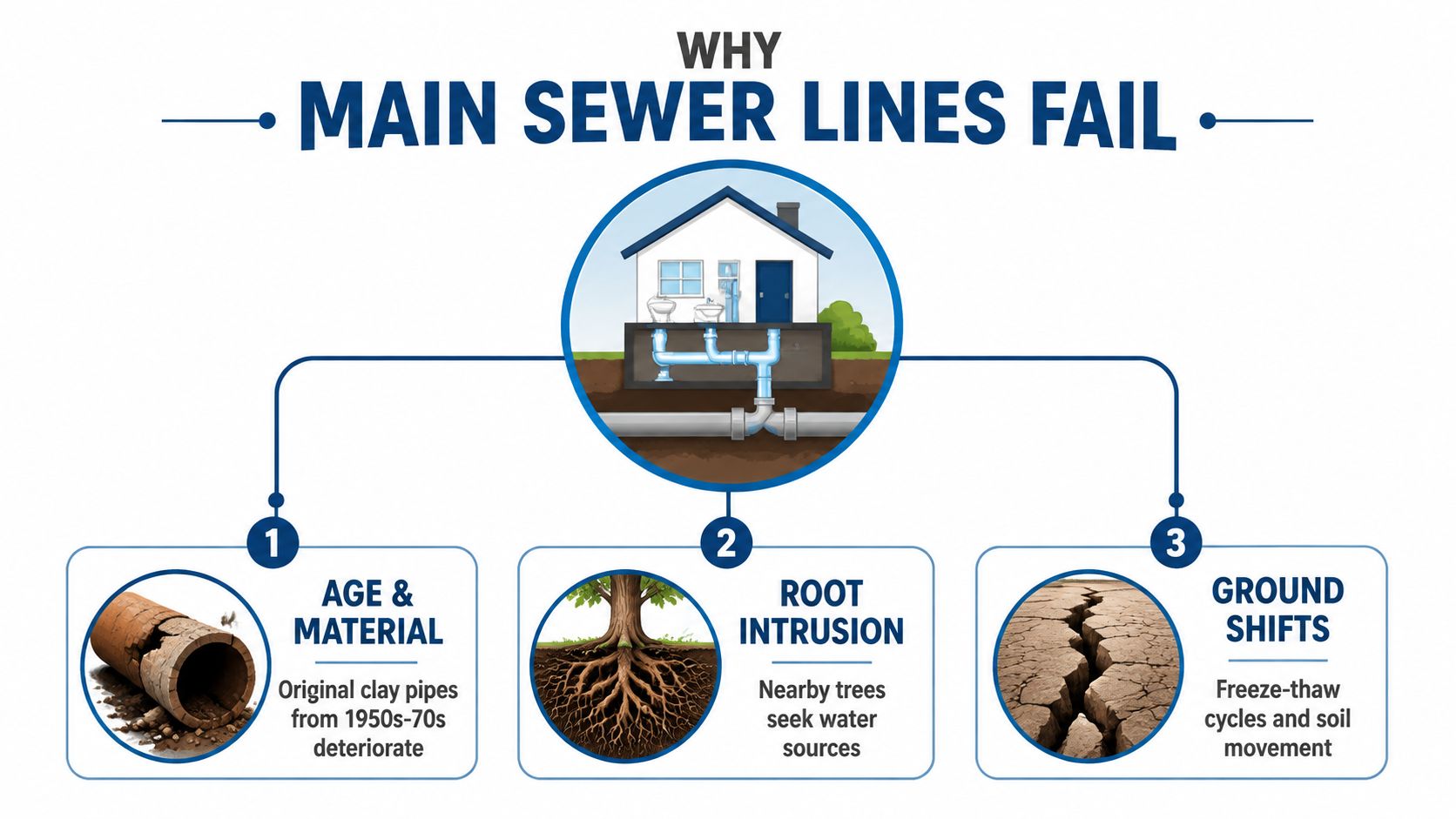
Soil movement doesn't have to be dramatic to matter. A pipe that was fine last fall can start acting up after one hard thaw and a wet season.
How a Plumber Actually Diagnoses the Main Line
A real diagnosis starts with the symptoms, not the shovel. A plumber asks which fixtures are slow, which ones gurgle, whether the problem is constant or intermittent, and whether sewage has ever come up through the floor drain. That conversation points the camera in the right direction and helps separate a branch clog from a line problem.
What the camera is looking for
From there, the job usually moves to the cleanout if one exists. That access point lets the plumber run a sewer camera through the line and record what's there, including the pipe material, slope, joints, and visible damage. The camera is not just hunting for a clog. It's checking whether the line is blocked, cracked, offset, bellied, or collapsed, because each one leads to a different repair.
Cleaning often comes before or during the camera run. High-pressure jetting can remove grease, sediment, and roots that hide the condition of the pipe. EPA collection-system guidance notes that jetting is widely used in gravity sewers, but it's still a preparation step, not a cure for structural defects (EPA rehab guidance).
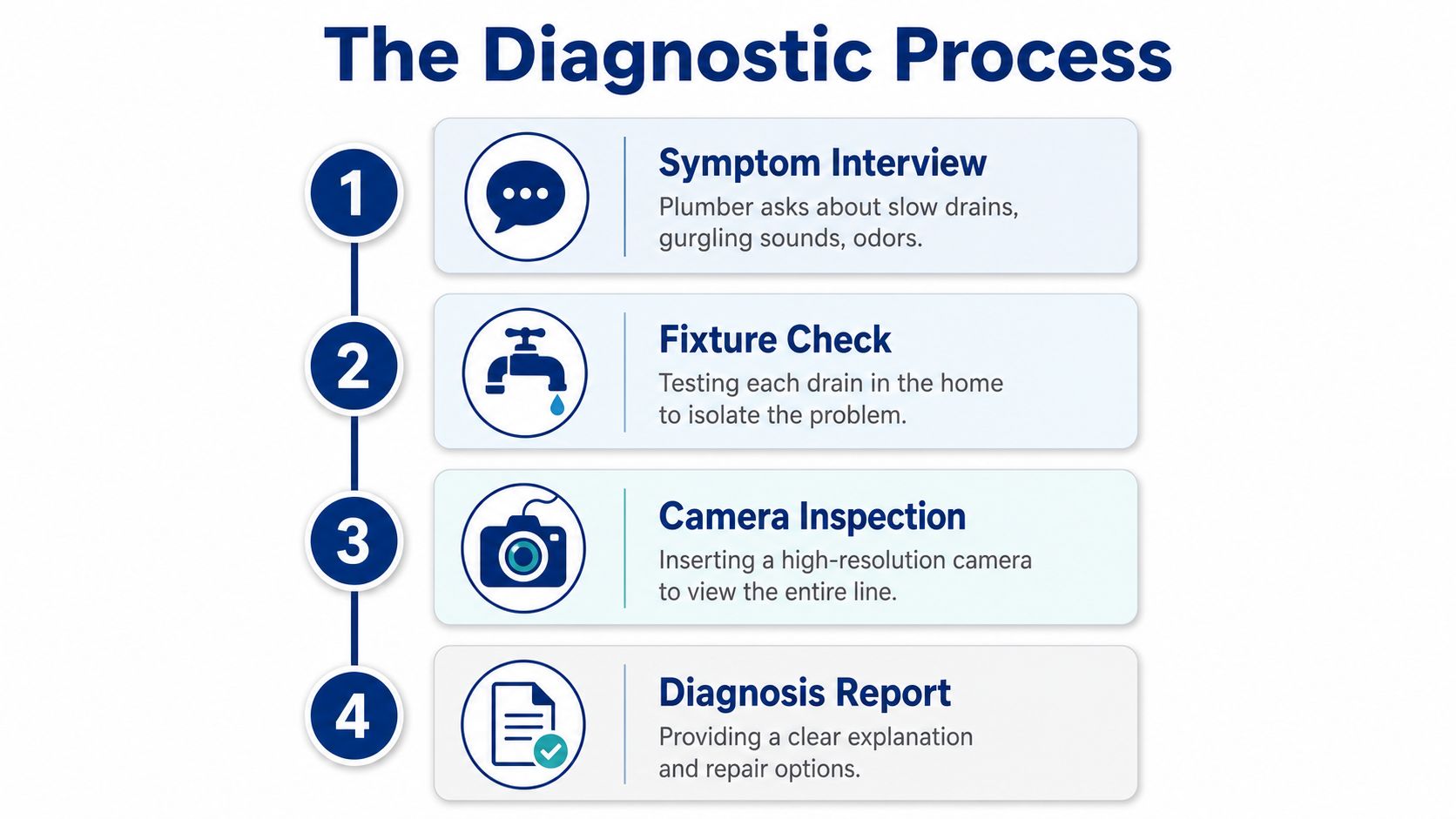
A good plumber documents the problem before talking about repair. That matters because the wrong next step can lead to repeat work. If someone digs without looking at the footage, you can end up paying to open the same yard twice.
Experienced-plumber advice: if the camera wasn't run after cleaning, the diagnosis may still be incomplete.
Choosing Between Spot Repair, Trenchless Options, and Excavation
The camera tells the story first. A short crack with good pipe around it points to a different fix than a long stretch that has sunk, shifted, or broken apart under the yard. The right repair follows the defect in the pipe, not the method a crew prefers to sell.
A spot repair fits a line with one damaged section and healthy pipe on both sides. That usually means a short dig, one focused repair, and then putting the line back together around the problem area. If the footage shows an offset or a local break, this approach can make sense because the rest of the sewer still has enough life left to keep working.
Trenchless repair covers methods like CIPP lining and pipe bursting. EPA and technical review sources identify those as established rehabilitation approaches for wastewater collection systems (EPA trenchless review). NASSCO notes that many CIPP repairs can be completed in 2 to 3 hours including setup, while excavated point repairs often take 1 to 2 days (NASSCO technical guidance). Those methods work best when the pipe still has enough structure for the liner or bursting head to do its job, and when the failure is along a run that can be rehabilitated without opening the whole yard.
Excavation and replacement are the better call when the line is collapsed, badly deformed, or too broken up for a liner to seal properly. A sewer line belly is its own problem, because the pipe has lost slope and holds water. Lining that section does not put the grade back, so the fix often has to be more invasive than a homeowner expects. That is the trade-off. Less digging is attractive, but only if the pipe shape still supports that approach.
| Main Sewer Line Repair Methods Compared | Best For | Typical Time | Surface Disruption |
|---|---|---|---|
| Spot Repair | Isolated break, offset, or short damaged section | Often a short job, depending on access | Localized digging |
| Trenchless Lining or Bursting | Pipe that is still structurally recoverable | Often measured in hours, not days | Less surface disturbance |
| Excavation | Collapse, severe belly, or widespread deterioration | Usually longer and more involved | Highest disruption |
For routine clearing before or around the inspection process, drain cleaning service can be part of the fix, but cleaning alone will not solve structural damage. It can clear grease, roots, and sediment so the pipe can be viewed clearly, yet the repair still has to match what the camera found.
Cost, Permits, and Who Actually Owns the Line
The price swings because the work is not one thing. A foundational benchmark for main sewer line repair is that U.S. homeowners typically spend about $3,319 for sewer line replacement, with published ranges commonly spanning from $225 for minor fixes to as much as $10,000 for complex jobs. Independent cost guides also put linear replacement pricing at roughly $50 to $250 per foot, with an average near $150 per linear foot (Angi cost guide).
What changes the bill
Depth, access, material, and whether the line can be repaired from the surface all affect the total. A short repair with easy access costs differently than a long lateral under a driveway or yard. That's why a camera inspection matters before anyone starts quoting numbers.
Permits matter too. Many municipalities require a permit and inspection before a repaired sewer line gets covered back up, and responsibility often splits at the property line or curb. Portland's guidance is a good example of how the private side and public side can be handled differently, with separate permits for different parts of the work (Portland sewer line guidance).
Practical rule: don't let anyone backfill a repair until the line has been inspected and signed off the way your city requires.
That local responsibility split is why Macomb and Oakland County homeowners need a contractor who understands the administrative side, not just the digging. A camera can show the problem, but it can't move a permit through the city office or tell you who owns the stretch that failed. For a price reference from a local-service context, drain cleaning prices give a sense of how service work and larger sewer work sit in different lanes.
Why a Second Opinion and Post-Repair Verification Matter
A sewer repair that gets judged wrong can turn into a second round of digging, and that is the expensive mistake homeowners feel in the yard and in the bill. A second set of eyes on the camera footage helps when the recommendation is excavation or full replacement, because a belly, an offset, or damaged joints can point to different failure modes even when the symptoms look the same from inside the house. A good read of the line should explain whether the pipe is holding water, has shifted out of alignment, or has failed at the connection.
Verification protects the work
After cleaning, lining, or a joint repair, the line should be checked again. The point is to confirm that the repair matches the defect that was found, not just that the drain sounded better for a day. If the issue was a failed joint, the repair should address that joint and then be verified with a follow-up test, following the sort of field guidance used by NASSCO and WEF for inspecting and confirming sewer work. That extra check is what keeps a small defect from turning into another service call.
Homeowners should expect a plain explanation, not a vague recommendation. If the camera showed a belly, the discussion should be about standing water and low grade. If it showed an offset, the focus should be on alignment and whether the joint can still hold. If it showed root mass, the question is whether cleaning is enough for now or whether the pipe wall is too compromised to keep patching.
A professional job should also leave the site in decent shape, with the work area protected and restored as far as access allows. Around Fraser and the surrounding communities, that kind of follow-through matters because the repair is not just what happens underground, it is also how clearly the homeowner is shown what was fixed and why. That is the practical standard many homeowners want when they are choosing between repair and replacement, and it is how Jays Plumbing and Sewer approaches sewer work in Macomb and Oakland County.
A repair is complete only when the line flows, the defect has been addressed, and the homeowner has seen the problem that was corrected.
Preventing the Next Backup and Knowing When to Call
Keep grease out of the drains. Watch what goes into the garbage disposal. If tree roots have been a repeat issue, periodic jetting can help keep the line open, but it won't change a pipe that's already broken. If you're buying an older home in Warren, Rochester Hills, Royal Oak, or nearby, a camera check before closing can save a lot of surprises later.
Recurring main line trouble is usually structural, not behavioral. If the same slow drains, gurgling toilets, or basement backups keep coming back, stop waiting for the next round to get worse. Call when the pattern starts, because early diagnosis is the difference between a same-day cleaning and a weekend excavation.
Call Jay's Plumbing and Sewer Now @ 586-634-3450 if you're dealing with repeated backups, sewer odors, or a floor drain that won't stay clear. They handle sewer repair, camera inspections, drain cleaning, and emergency plumbing across Fraser, Macomb County, and Oakland County, and they can help you figure out whether you need a repair, replacement, or just a proper second opinion.
If your main sewer line is backing up, don't guess at it from the basement floor. Jay's Plumbing and Sewer handles sewer camera inspections, drain cleaning, repair, and emergency service for homes and businesses across Fraser and the surrounding communities. Visit Jays Plumbing and Sewer to ask for an estimate and get a straightforward look at what's happening under the yard.
