

A basement floor drain gurgles after heavy rain. The bathtub drains slowly, the toilet bubbles when the washing machine runs, and the problem seems to disappear before returning after the next storm. In Macomb County, that pattern can point to trouble in the buried sewer lateral, the pipe carrying wastewater from your home to the municipal connection.
A sewer line inspection gives a plumber a direct look inside that pipe before anyone starts digging. It can locate tree roots, cracks, shifted joints, corrosion, blockages, and other visible defects. It can also show that the line looks sound, which may save you from paying for work you don't need.
For Southeast Michigan homeowners, the inspection matters because older homes may have clay tile, bituminous fiber, cast iron, or other pipe materials affected by mature tree roots, saturated soil, and frost-heave shifts. A camera is a valuable diagnostic tool, but it isn't a complete engineering study. Knowing what it can and can't tell you helps you make a calm, informed decision.
Table of Contents
- What a Sewer Line Inspection Is
- How a Video Camera Inspection Works Step by Step
- What a Sewer Camera Can and Cannot Catch
- Signs It Is Time to Schedule an Inspection
- What Affects the Cost of a Sewer Line Inspection
- How to Prepare and What to Ask Your Plumber
- Why a Licensed Local Plumber Makes the Difference
- Key Takeaways and When to Call Jay's Plumbing and Sewer
What a Sewer Line Inspection Is
A basement backup after spring thaw in Fraser, a sewer concern during a home purchase in Sterling Heights, or several slow-draining apartments in Clinton Township can all justify a closer look at the buried lateral. A standard home inspection does not necessarily show the pipe's condition, and recurring backups after snaking may point to a problem farther downstream.
A sewer line inspection examines the underground pipe from the home to the municipal tap, or to a septic connection where applicable. It does not inspect the toilet, sink, tub, or other fixtures, although fixture behavior can provide useful clues about a main-line issue.
The purpose is diagnosis before excavation
A camera provides a view of the pipe interior, while a transmitter helps the technician mark a defect's approximate location from above ground. The inspection may reveal root intrusion, a shifted joint, a break, or a collapsed section that stops the camera. Those findings help determine whether cleaning, root removal, spot repair, lining, replacement, or no repair makes sense.
For Southeast Michigan homes, the pipe material and ground conditions matter. Older clay tile laterals can have open or offset joints, mature tree roots can enter through small gaps, and frost-heave shifts can change how sections meet. A camera can show visible defects, but it does not measure the line's full carrying capacity or prove that its slope is adequate. Sediment can also reduce the usable opening without presenting as a dramatic break. That is why a camera scope is a diagnostic view, not a complete assessment of every cause of repeat backups.
Industry practice extends beyond an informal look through the pipe. The NASSCO PACP CCTV specification guidance describes standardized, data-coded sewer condition assessment and operating requirements intended to make inspections repeatable and comparable.
Practical rule: A camera inspection should answer a plumbing question, not create pressure to buy a repair.
Home buyers and sellers may use a scope to reduce uncertainty before a transaction. Owners of older homes with clay tile or Orangeburg laterals may want a baseline report, while property managers may need clearer information when multiple units develop similar symptoms.
The result may be a repair recommendation or reassurance. Both are useful when the recommendation matches what the pipe shows.
How a Video Camera Inspection Works Step by Step
The process usually starts with access. A technician looks for the main cleanout, often outside near the house or inside near the basement plumbing. If the home lacks a usable cleanout, access may require pulling a toilet or, in some older layouts, entering through a roof stack. The right entry point allows the camera to travel through the line without creating unnecessary disruption.
The camera head attaches to a flexible push rod. The technician feeds the rod into the sewer while watching a monitor that displays the live view. The equipment records the inspection so the findings can be reviewed with the homeowner rather than relying on a quick verbal description at the end.
Why the locator matters
A sonde, or transmitter in the camera head, allows the technician to track the camera above ground. If the camera stops at a root mass or a separated joint, the technician can mark the approximate position and depth on the lawn, driveway, basement floor, or another accessible surface.
That location information becomes especially useful when repair is being considered. A crew may be able to target a small excavation instead of guessing where the defect sits. It also helps a homeowner compare the camera findings with the property layout, sidewalk, driveway, and municipal connection.
What the technician watches for
The line commonly remains in service during the inspection, although water use may need to be limited. The technician pauses at branch connections and changes in pipe condition, watches how water moves through the line, and notes areas where the camera encounters resistance.
Public specifications show why operating conditions matter. One municipal standard requires cleaning before CCTV work and limits flow to 25 percent of the pipe diameter or volume for reliable viewing, as described in the Los Angeles County CCTV guidelines. Another specification sets different flow limits by pipe size, including 20 percent for six-inch to ten-inch pipe, 25 percent for twelve-inch to twenty-four-inch pipe, and 30 percent for pipe larger than twenty-four inches in the KUB sewer television inspection specification.
A careful technician reviews the joints, the crown and invert of the pipe, connections, visible buildup, and the area near the city tap. Findings may be flagged on the recording in real time, then explained during a walk-through so you understand what needs attention and what can be monitored for now.
What a Sewer Camera Can and Cannot Catch
A camera is excellent at showing visible interior defects. In an older Macomb or Oakland County lateral, it may reveal a root ball entering through a clay tile joint, a crack, an offset connection, corrosion in cast iron, grease, a foreign object, or a full collapse that stops the camera.
It can also show a pronounced belly, where a section of pipe has settled and holds water. That matters because standing water can slow the movement of solids and contribute to recurring backups. A camera may show the symptom clearly, but the inspection still requires professional judgment to determine how much the belly affects the system.
The visual record has limits
A basic scope doesn't measure every condition that affects how a sewer performs. It can't directly calculate the line's flow capacity, verify the exact slope throughout the run, or measure how much wall thickness remains in an aging pipe. If sediment or standing water blocks the view, the camera may not show the pipe surface beneath it.
A clean-looking interior doesn't always mean the line can carry full flow. Partial sags, sediment accumulation, and hydraulic restrictions can remain important even when the camera doesn't show a dramatic break. When repeat backups continue without a clear visual obstruction, a plumber may recommend additional evaluation, such as a flow-based or hydrostatic test, rather than assuming the camera settled the entire question.
The ETRI review of sewer inspection technologies explains the distinction between visual CCTV and newer combinations involving sonar, ground-penetrating radar, and AI-assisted analysis. Those methods can add information about sediment and structural integrity, but they also involve greater equipment and integration demands. For many residential calls, the camera remains the practical first diagnostic step, not the final answer to every possible pipe-performance question.
Match the tool to the problem
Push cameras generally suit laterals and smaller lines, while larger gravity sewers may require different CCTV equipment, according to Water Environment Federation technical guidance on innovative camera inspection. The EPA identifies CCTV as appropriate for sewer lines from 0.1 meters to 1.2 meters, approximately four to forty-eight inches, in its collection-systems fact sheet.
For a homeowner, the practical lesson is simple. Ask what the camera reached, what it could see, and whether the remaining concern involves structure, flow, slope, sediment, or all of these. If visible damage is found, you can review sewer line repair options with the plumber instead of authorizing excavation based on a guess.
Signs It Is Time to Schedule an Inspection
One slow bathroom sink usually points to a fixture drain or a nearby branch line. Several fixtures becoming slow together tell a different story. When the kitchen sink, tub, toilet, and basement drain all change at about the same time, the restriction may be farther downstream in the main sewer line.
Michigan weather can make the pattern easier to notice. Heavy rain, saturated ground after spring snowmelt, and shifting soil can expose a weakness that seemed manageable during dry conditions. A backup that repeatedly follows those events deserves a closer look, even if the line eventually begins draining again.
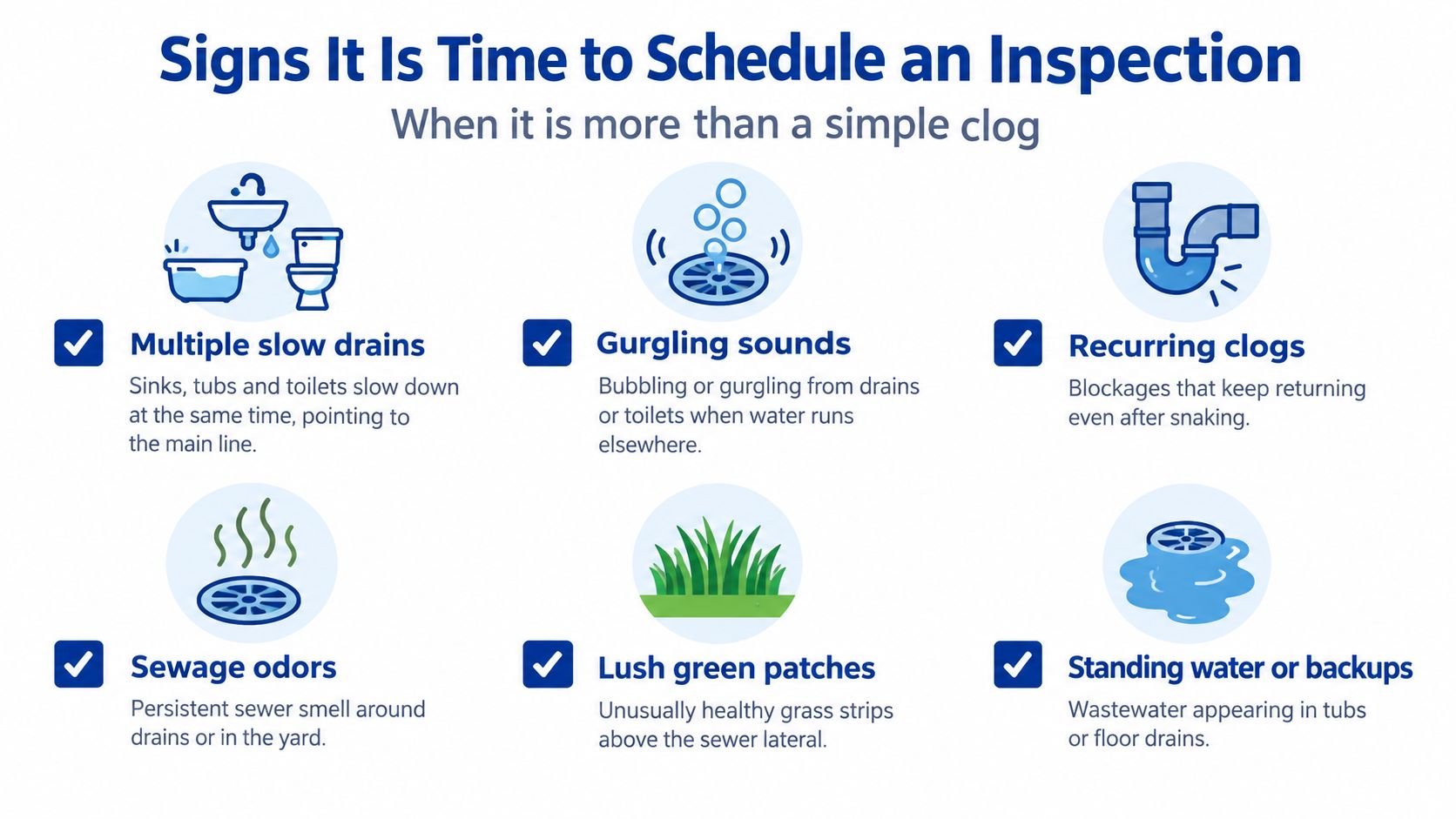
Use this checklist when deciding whether to schedule an inspection:
- Multiple slow drains: Sinks, tubs, and toilets slow down at the same time, suggesting a restriction in the main line.
- Gurgling sounds: Drains or toilets bubble when water runs elsewhere in the house.
- Recurring clogs: Blockages return after snaking or other temporary clearing.
- Sewage odors: A persistent sewer smell appears around a cleanout, basement drain, or yard.
- Lush green patches: A narrow strip of unusually healthy grass follows the likely path of the lateral.
- Standing water or backups: Wastewater appears in a tub, shower, or floor drain.
A history of backups is also a reasonable reason to inspect a resale home, particularly a house built before the mid-1980s with an older clay tile or Orangeburg lateral. Buyers may schedule the scope before closing, while sellers may use it to understand a repair question before listing.
Consider an inspection before adding a bathroom or finishing a basement, too. More fixtures increase the importance of knowing whether the existing line is in usable condition. If you smell sewage, see wastewater, or have an active backup, limit water use and contact an emergency plumber rather than repeatedly forcing water through the system.
What Affects the Cost of a Sewer Line Inspection
Inspection quotes vary because each property presents different access, distance, and pipe conditions. A camera inspection through an accessible main-level cleanout is usually more straightforward than one requiring toilet removal, roof-vent access, or extra time to find an obstructed cleanout.
The length and depth of the sewer lateral also affect the work. A short route from the house to the municipal connection may be easy to track. A longer line running beneath a driveway, sidewalk, or yard requires more camera travel and locating. Greater depth can make it harder to mark a defect accurately at the surface.
Local conditions matter, too. Southeast Michigan homes may have older clay tile laterals, mature tree roots, or frost-heave shifts that move pipe joints. Those conditions can add cleaning, locating, or follow-up work to the visit. They can also explain why a basic camera view does not fully answer questions about capacity, slope, or sediment buildup. A line may look open while still lacking the flow needed during heavy use or thawing.
Cleaning may come before the camera
Roots, grease, sand, mineral deposits, or a heavy obstruction can stop the camera or block its view. The plumber may recommend drain cleaning or high-pressure water jetting before completing the inspection. Cleaning creates visibility, but it does not automatically correct a damaged, shifted, or undersized line.
Professional inspections follow documented practices for camera movement and image quality. Ask whether the operator uses a recorded, standardized process and provides the complete video.
Compare the deliverables, not just the quote
A useful inspection may include:
- Recorded video: You can review the pipe view later or share it with another professional.
- Written findings: Defect descriptions, distances, and recommended next steps are easier to compare in writing.
- Depth and location marks: Locator information connects a finding to the yard, floor, driveway, or sidewalk.
- Access explanation: The report should state how the camera entered and whether the full run was completed.
Two quotes can differ for sound reasons. Ask whether cleaning, locating, recording, reporting, and a homeowner walk-through are included. Also ask whether the camera reached the municipal connection or stopped at an obstruction.
If a backup has already caused property damage, this sewer backup repair cost discussion explains why diagnosis and repair are separate decisions.
How to Prepare and What to Ask Your Plumber
A little preparation keeps the visit focused. The day before, move stored items away from the main cleanout, basement access point, or floor drain area. If you don't know where the cleanout is, look for a capped pipe near the basement wall, crawlspace, or exterior foundation, then tell the technician what you've found rather than trying to force the cap open.
Keep pets secured and make sure the technician can reach the access area. Avoid running the dishwasher, washing machine, or taking a long shower immediately before the appointment. A large surge of water can make it harder to maintain a clear view while the camera is in the line.
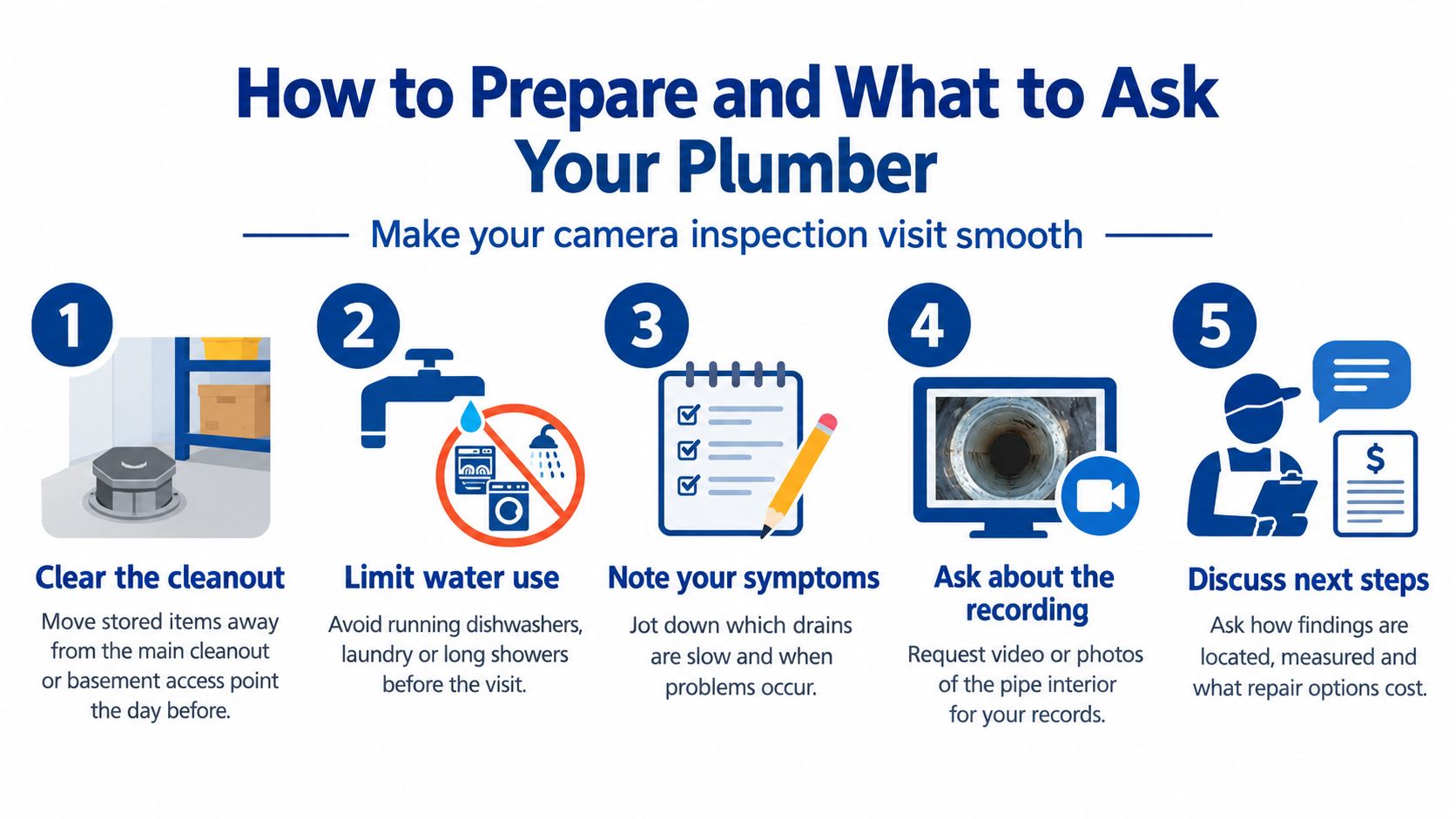
Write down your symptoms before the plumber arrives. Include which fixtures slow down, whether the trouble follows rain or thawing, how often backups occur, and what clearing methods have already been tried.
Questions that improve the report
Ask these questions during the walk-through:
- What pipe material did you find? Clay tile, cast iron, bituminous fiber, and PVC age and behave differently.
- How far did the camera travel? Ask whether it reached the municipal tap or stopped at an obstruction.
- Where is each defect? Request the approximate distance from the access point and the marked depth.
- Does the line appear to hold slope? A visual inspection has limits, but the technician can explain visible bellies, standing water, or flow behavior.
- Is the video included? Keep a copy for future maintenance, a real estate transaction, or a second opinion.
- What should happen next? Ask whether the finding calls for cleaning, monitoring, testing, spot repair, lining, or replacement.
The sewer cleanout guide can help you understand why that access point matters. Take notes while the technician explains the recording. A clear conversation at the property is easier to use later than a rushed memory of technical terms.
Why a Licensed Local Plumber Makes the Difference
A camera operator needs more than equipment. They need to recognize how pipe materials and local conditions interact. Homes built across Macomb and Oakland County may contain vitrified clay tile laterals, bituminous fiber pipe, early Orangeburg, or mid-century cast iron, while newer construction may use PVC.
That history changes the meaning of what appears on the monitor. A small offset joint beneath a sidewalk may reflect soil movement or frost-heave shifting. A root mass at a clay connection may return after a temporary clearing. Sediment pooling near the curb may point to a low section that needs a different response than a simple blockage.
Local experience adds useful context
Mature hardwood trees are common around established neighborhoods in Fraser, Troy, Macomb, Shelby Township, and Sterling Heights. Their roots follow moisture, and an aging joint can offer an entry point. Michigan winters and freeze-thaw movement can also stress older connections, especially where the pipe crosses disturbed soil near a foundation, driveway, or road.
A licensed plumber can also explain when repair work may require additional review or permitting. The inspection itself should remain focused on evidence. The technician should identify what the camera shows, distinguish a confirmed defect from a possibility, and explain what the equipment couldn't verify.
Trust is visible in the paperwork
A useful report doesn't stop at “the line looks fine” or “you need a new sewer.” Look for:
- Timestamped video: The recording connects the recommendation to the actual pipe view.
- Location details: Distances and depths help contractors plan targeted work.
- Material identification: The pipe type provides context for future maintenance.
- Clear limitations: The report should say when water, sediment, or access prevented a complete view.
- Reasoned options: Cleaning, testing, repair, lining, and replacement should be matched to the finding.
Jays Plumbing and Sewer provides camera inspections, sewer and drain cleaning, jetting, repair, and replacement services for residential and commercial properties, with service across Macomb and Oakland County. The company also handles related needs such as leak detection, pipe repair, water heater repair and replacement, sump pump repair, bathroom plumbing, kitchen plumbing, and commercial plumbing.
That broader experience can help when a sewer finding connects to a basement flood, a remodel, a rental property, or a recurring drain problem. A professional should still give you room to consider the options and obtain another opinion when the work is substantial.
Key Takeaways and When to Call Jay's Plumbing and Sewer
A sewer line inspection uses a camera to examine the main pipe between your home and the municipal tap or septic connection. It can show root intrusion, cracks, offset joints, corrosion, blockages, and major bellies without guess-and-check excavation. In Southeast Michigan, clay tile laterals, mature tree roots, and frost-heave shifts deserve particular attention.
A camera shows the pipe wall and visible obstructions, but it does not independently confirm the line's full capacity, precise slope, sediment load, or wall thickness. Those limits matter when backups keep returning, even after the pipe looks open.
Schedule an inspection before buying a home, after repeated backups, or before a remodel adds fixtures. Several slow drains, gurgling fixtures, persistent sewage odors, or wet, unusually green areas along the sewer path also justify a closer look.
Before the appointment, clear the cleanout, keep pets away, limit water use, and record the symptoms. Ask about pipe material, camera reach, defect locations and depths, the recording, and practical next steps.
For active backups or scheduled inspections, call Jay's Plumbing and Sewer at 586-216-5553. The company serves Macomb and Oakland County communities, including Clinton Township, Shelby Township, Sterling Heights, Utica, Rochester Hills, Warren, Fraser, Mount Clemens, Romeo, and Washington, with 24/7 emergency plumbing availability. Related conversations can cover drain cleaning, sewer repair, pipe repair, sump pump service, and residential or commercial plumbing needs.
Call Jay's Plumbing and Sewer at 586-216-5553 to discuss a sewer camera inspection, recurring backup, or cleaning needed before evaluation. Visit Jays Plumbing and Sewer for scheduled and emergency service across Macomb, Oakland, and Wayne counties.
