
Traditional dig-and-replace sewer line replacement costs about $50 to $250 per linear foot, roughly $3,000 to $6,000 for an average household connection, and $7,000 to $25,000 or more for difficult locations such as mid-street connections.
But does the price you're comparing include putting the driveway back, obtaining permits, and replacing the part of the line you own? Those questions can matter as much as the pipe itself.
For homeowners and property managers in Macomb County, Oakland County, and Wayne County, the best starting point isn't a national average. It's a clear picture of what's damaged, where it is, and which costs the written quote includes.
Table of Contents
- Typical Sewer Line Replacement Costs at a Glance
- Trench and Trenchless Replacement Explained
- What Pushes the Price Up or Down
- Camera Findings That Decide Repair or Replacement
- Who Pays and How to Compare Quotes
- Confirm the Scope Before You Dig
- Frequently Asked Questions About Sewer Line Replacement Cost
Typical Sewer Line Replacement Costs at a Glance
An ordinary household connection can land in the low thousands, while difficult access can turn a similar replacement into a much larger project. CostHelper's sewer line cost guide lists approximately $50 to $250 per linear foot for traditional dig-and-replace, $3,000 to $6,000 for an average household connection, and $7,000 to $25,000 or more for difficult work such as a connection in the middle of a street.
Sewer line replacement cost ranges by scenario
These national reference ranges are a budgeting tool, not a Michigan price schedule.
| Scenario | Typical Cost | What Drives It |
|---|---|---|
| Average household connection, open trench | $3,000 to $6,000 | Standard length, moderate depth, open yard access |
| Difficult connection, such as one under the middle of a street | $7,000 to $25,000 or more | Pavement cuts, traffic control, deeper digs |
| Dig-and-replace, priced per linear foot | $50 to $250 per foot | Burial depth, local labor rates, access, restoration |
| Spot repair of one damaged section | Priced for the confirmed damaged section and access needed | Depth and location of the damage, confirmed by camera first |
A spot repair doesn't have a defensible flat price before someone locates the failure. Replacing a short section beneath an open lawn is a different job from reaching the same amount of pipe beneath a driveway.
The total-household and per-foot ranges also aren't interchangeable formulas. A contractor may include excavation in a replacement rate, while another separates it from pipe installation.
How to sanity-check a quote
Start with the measured replacement length, not the distance you estimate by looking across the yard. Multiply that length by the published per-foot range to get a broad comparison, then examine the scope rather than treating the result as a promised price.
Use this sequence:
- Confirm the endpoints. Is the contractor replacing pipe from the house to the public main, or only between identified defects?
- Check the method. A full open trench and a targeted excavation shouldn't be compared as identical jobs.
- Read the inclusions. Look for excavation, connections, inspection, backfill, compaction, and surface restoration.
- Find the exclusions. Unlisted concrete work or street restoration can make an apparently cheaper proposal incomplete.
Practical rule: A useful estimate tells you what will be working when the crew leaves and what will still need finishing.
Local labor, access, and restoration requirements affect quotes in Macomb, Oakland, and Wayne counties. A camera inspection paired with surface locating helps establish the route, approximate depth, measured distance, and condition needed to narrow the price before digging starts.
Trench and Trenchless Replacement Explained
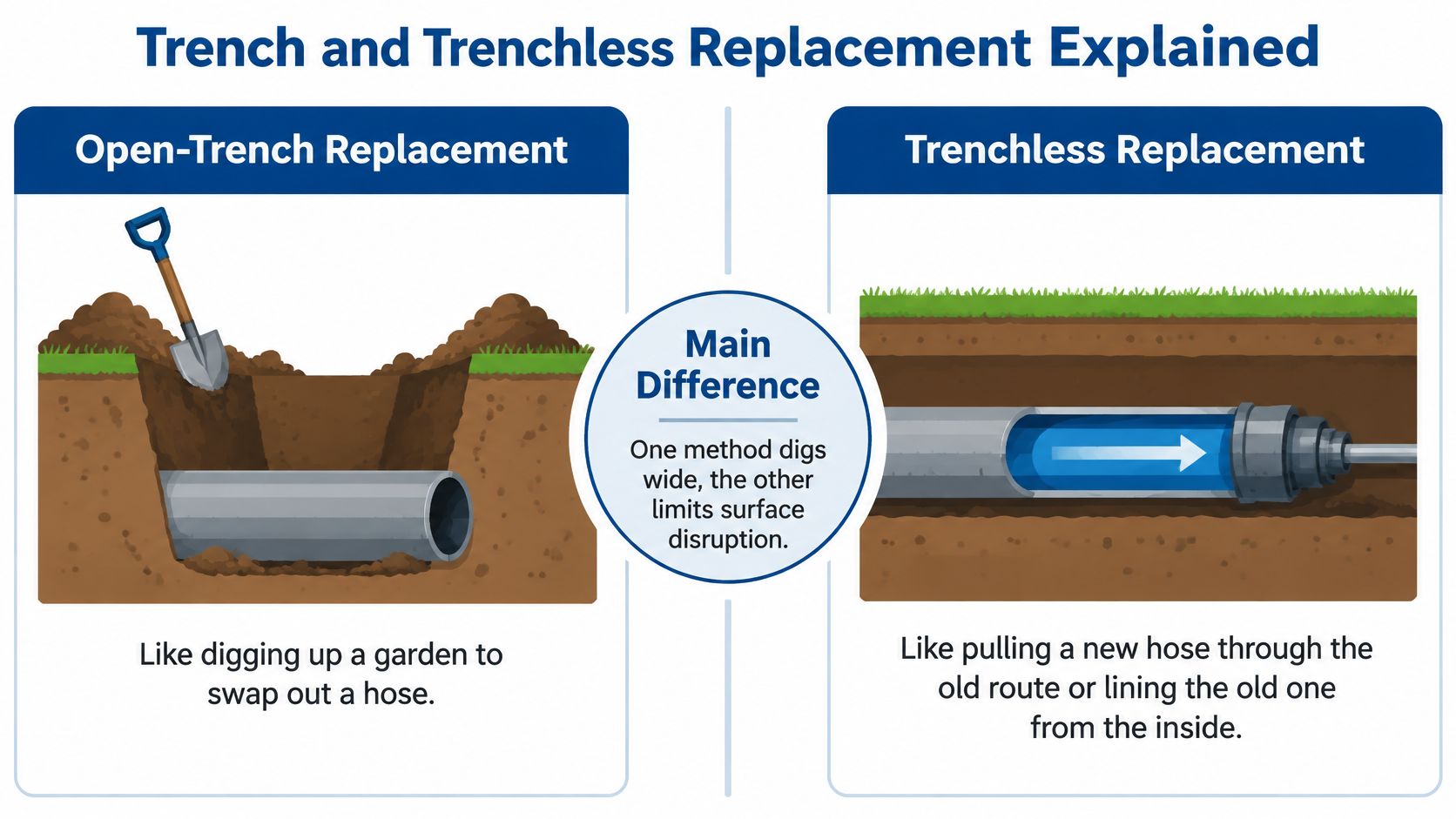
Open-trench replacement is like digging up a garden to swap out a hose. Trenchless work is more like pulling a new hose through the old route or creating a new interior inside the existing hose.
The main difference is how much ground the crew opens, not whether the finished sewer needs proper alignment and reliable connections.
This diagram shows the difference in surface disruption.
What each method actually does
For open-trench replacement, the crew locates and marks the route, excavates, removes failed pipe, and installs new pipe at the correct slope. Backfilling, compaction, and restoration follow inspection and testing.
Pipe bursting breaks the old pipe apart while pulling replacement pipe through its route. Cured-in-place pipe, or CIPP, creates a hardened resin liner inside the existing line.
Sliplining inserts a smaller pipe into the old one, so available interior diameter matters. Modified cross-section lining uses a temporarily reshaped liner that expands into place.
Trenchless and open-trench cost benchmarks
The EPA's collection-system rehabilitation guidance gives the following trenchless benchmarks for an 8-inch sewer main in 1998 dollars, including standard cleaning and before-and-after inspections but excluding major blockages and point repairs.
| Method | Cost per Foot | Best Fit |
|---|---|---|
| Modified cross-section lining | $18 to $50, in 1998 dollars | Sound pipe that needs a new interior surface |
| Cured-in-place pipe (CIPP) | $25 to $65, in 1998 dollars | Leaking or root-intruded pipe with sound alignment |
| Pipe bursting | $40 to $80, in 1998 dollars | Pipe that can be broken apart and replaced along the same route |
| Sliplining | $80 to $170, in 1998 dollars | Pipe with enough diameter and straight alignment for a liner |
| Open-trench replacement | $50 to $250, current published reference | Collapsed, badly offset, or otherwise unsuitable pipe |
The open-trench row uses the published household reference above, not the historical EPA dataset. Don't compare these columns as today's competing bids. They describe different periods and project scales.
Soil, nearby utilities, pipe geometry, and service connections determine whether bursting is practical. Lining won't correct a badly sagging route, and a severe collapse may require excavation.
We offer sewer line service, trenchless pipe service, and camera inspection. Our camera-guided trenchless pipe service can unblock a sewer using specialized tooling without digging up the pipe, and it's often considered where damage makes excavation impractical or digging could cause further damage.
That doesn't mean every damaged sewer qualifies for no-dig replacement. Our trenchless pipe replacement guide explains why the condition and route must be evaluated before choosing a method.
What Pushes the Price Up or Down
Length establishes the amount of work. Depth and access often determine how difficult that work becomes. The relevant distance is the actual replacement route, which may include bends and a connection beyond the edge of your property.
Historical projects in the EPA's pipe-bursting fact sheet included Washington pilot work at approximately $24 per foot and a Virginia replacement at $250 per foot. These aren't current residential quotes, but the spread demonstrates why one per-foot number can't describe every sewer project.
Length, depth, and access
A longer replacement needs more pipe, labor, and potentially more restoration. The inspection record should distinguish the distance to a defect from the total length proposed for replacement.
Depth changes equipment needs and worker protection. A deeper trench can require additional shoring, soil handling, and groundwater control.
Access can be just as consequential in established Fraser, Sterling Heights, and Troy neighborhoods. Consider what sits above and beside the line:
- Driveways and sidewalks. Cutting the surface is only part of the job; the proposal must address rebuilding it.
- Fences, decks, and narrow side yards. Equipment may need a different approach or temporary removal of an obstruction.
- Mature trees and landscaping. Protecting roots and restoring planting areas can influence the method.
- Nearby utilities. Crews need utility locating and a safe excavation plan, not just a sewer camera image.
Material and connections
Older properties may have clay, cast iron, or Orangeburg pipe. Newer replacement work commonly uses plastic piping, but the existing material helps determine whether cleaning, lining, bursting, or excavation is appropriate.
Diameter and branch connections matter too. A shared route or additional building connection requires a more detailed plan than an uninterrupted household lateral.
Roots may need removal before the camera can show the pipe wall clearly. Cleaning improves visibility, but it doesn't seal an open joint or correct displacement.
The cheapest pipe material won't necessarily produce the cheapest completed job. Reaching the line and restoring the property can outweigh the material savings.
Our excavation services include trenching, targeted digs, and full sewer line replacement. The right scope should follow the failure, not automatically cover the entire yard.
Ask for a record of total inspected length, visible material, diameter, defect locations, and surface landmarks. Depth should be checked with locating equipment, because a camera image alone doesn't measure burial depth.
If sewage has already entered the building, separate the permanent repair from the immediate response described in our sewer backup repair cost guide.
Camera Findings That Decide Repair or Replacement
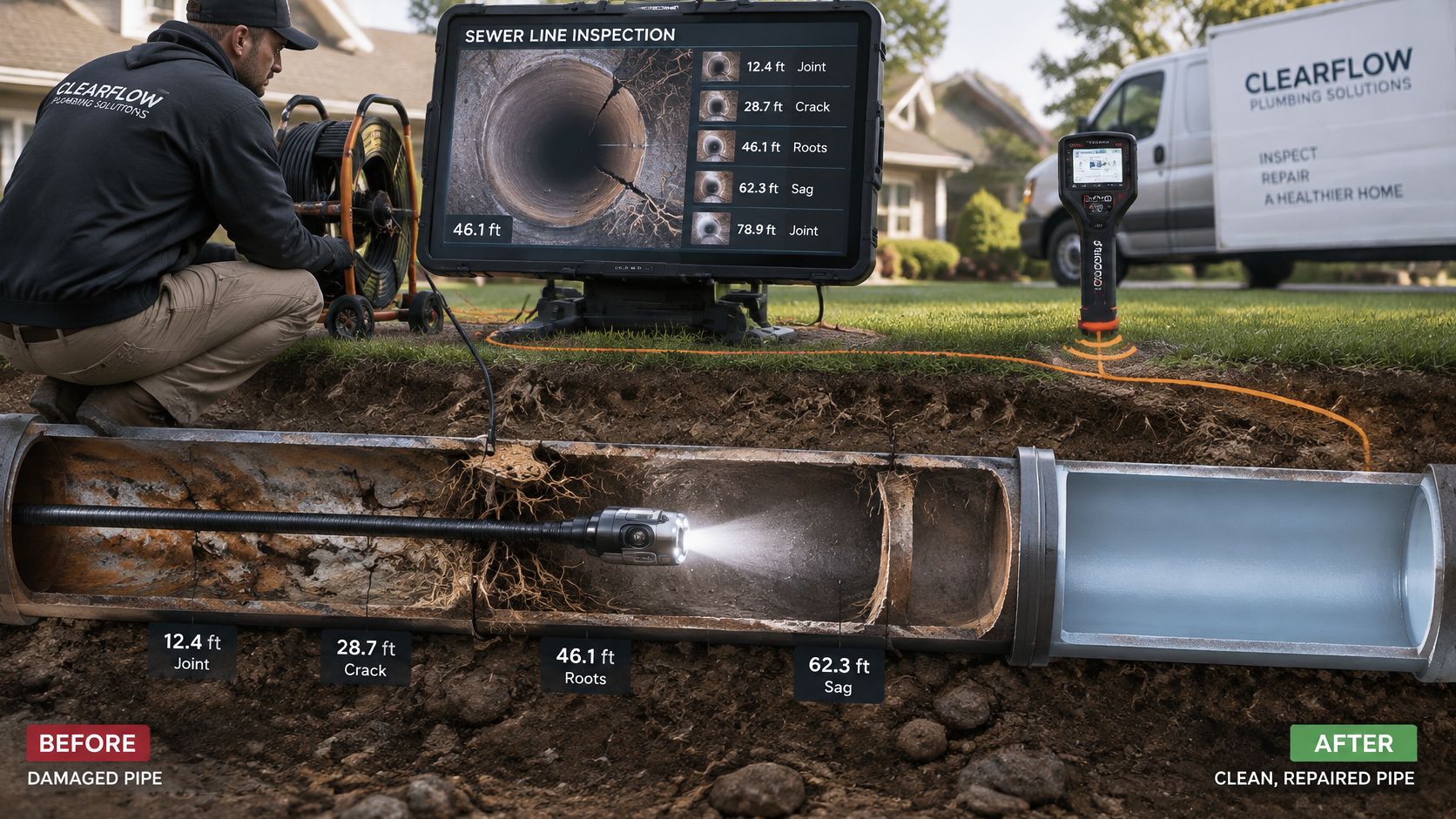
A camera report can support a spot repair, trenchless work, or replacement. The difference is whether the defect is isolated or spread along the run, and whether the pipe remains sound enough to repair.
A sewer camera records the pipe's interior as it moves through the line. The technician checks joints, cracks, roots, standing water, and changes in shape. Locators help match defects to points above ground.
Clear the obstruction before judging the pipe
Roots or sludge can block the camera's view of the pipe beyond the clog. Cleaning may be needed before the full condition can be assessed.
Jays Plumbing and Sewer uses sewer cameras and hydro-jetting to clear main sewer line clogs caused by roots, buildup, or structural issues. Jetting removes material; it does not rebuild crushed pipe or correct a sag.
A drain cleaning for an average-sized home typically costs $200 to $500. The price depends on how far down the clog is, the equipment needed, such as hydro-jetting instead of a cable machine, and whether a camera inspection is added.
Roots can enter through openings at joints. Soil movement may separate joints, while a low section can continue to collect solids even after cleaning restores flow.
Camera findings and the usual repair or replacement path
| Camera Finding | What It Usually Means | Likely Path |
|---|---|---|
| Roots at joints, pipe otherwise intact | Roots entering through a joint | Hydro-jetting and root removal, then a recheck; spot repair or lining if the pipe remains sound |
| One cracked, offset, or separated joint | A localized failure | Targeted repair or a short excavation |
| Cracks or wear along a long run | Deterioration across multiple sections | Trenchless work if the pipe's condition allows; otherwise, open-trench replacement |
| Collapse, crushed, or badly sagging pipe | Structural failure | Replacement of the affected run |
For example, slow drains that worsen during spring rain may trace to roots at one joint, with sound pipe elsewhere. Cleaning and a localized repair may then make more sense than replacing the whole lateral. If removing roots reveals deterioration along the run, repeated cleaning may only postpone a larger repair.
This video provides additional context for a sewer inspection discussion.
Ask to see the footage and have the defect locations marked. The explanation should show whether the problem is isolated or widespread, and how the proposed work addresses the cause. A video camera sewer inspection helps identify the pipe's condition before choosing repair or replacement. Jays Plumbing and Sewer can repair a sewer line before it causes major problems; the recommendation should follow the camera findings, not age alone.
Who Pays and How to Compare Quotes
The quoted pipe price isn't necessarily your total financial exposure. Permits, traffic control, concrete repair, landscaping, testing, and cleanup can sit outside the number that first catches your attention.
Angi's sewer replacement cost guide reports labor of approximately $45 to $200 per hour, excavation at about $50 to $200 per linear foot, and trenching that may add approximately $4 to $12 per foot beyond replacement pricing. These are broad cost categories, not charges you should automatically stack together, because contractors package their work differently.
Establish ownership and coverage first
A line passing beneath a sidewalk or street doesn't automatically become the city's responsibility. In many communities, the property owner remains responsible for the lateral to the public main, according to FeeGuides' sewer replacement guide, which also notes that standard homeowners insurance commonly excludes deterioration, root intrusion, and ordinary sewer-line failure.
Municipal assistance programs aren't uniform. For example, the Stevens Point lateral replacement program covers its qualifying right-of-way section through a utility-bill program but excludes the private section between the right-of-way and the house.
That example isn't a Michigan entitlement. Contact your city or township's public works department to confirm the ownership boundary and whether any assistance applies to your address.
Ask your insurance agent to distinguish repairing the buried line from covering damage inside the building. Those can involve different policy provisions, endorsements, exclusions, and deductibles.
Compare the same completed job
Before authorizing excavation:
- Get the diagnosis in writing. Keep the camera findings and an explanation of why the proposed repair fits them.
- Confirm responsibility. Establish who owns the damaged section and who authorizes work in an easement or right-of-way.
- Define the installation. Each proposal should state length, diameter, material, approximate depth, and connection points.
- Separate the extras. Identify permits, traffic control, driveway or sidewalk work, landscaping, testing, and cleanup.
- Compare viable alternatives. Consider localized repair, trenchless rehabilitation, and open-trench replacement where technically appropriate.
- Read the exclusions. Ask how unforeseen defects, groundwater, additional point repairs, and changes in scope will be priced and approved.
Before signing: Make sure the agreement says whether restoration means rough backfill, finished grading, or a completed lawn or pavement surface.
At Jays Plumbing and Sewer, we offer a second opinion before main sewer excavation and repair. We price by the job and provide the price upfront in writing before work begins; a service-call fee applies for coming to the property.
For a camera-based diagnosis or quote discussion, call 586-634-3450. This is general homeowner information, not legal or permit advice, and requirements can differ across Fraser, Sterling Heights, Clinton Township, Troy, Macomb, and Shelby Township.
Confirm the Scope Before You Dig
A camera inspection can help establish whether the sewer line needs a targeted repair or full replacement. Before scheduling excavation, gather previous drain-service invoices, any earlier camera footage, and information about the home's age, additions, and plumbing layout.
For buyers and sellers, that record can clarify whether a reported defect is still unresolved or was addressed in an earlier repair. Property managers and small businesses can use it to plan access and service interruptions.
Signs that deserve a plumbing assessment
- Several slow fixtures. Bathroom and kitchen drains slowing at the same time can point to a shared drainage problem.
- Gurgling toilets or sewer odors. Have the cause diagnosed rather than relying on repeated chemical drain treatments.
- Persistent wet areas in the yard. A plumber can investigate whether the cause is a sewer concern or another buried-water problem.
- Water entering floor drains. Stop unnecessary water use and call for emergency service if sewage is backing up.
Frozen ground can make winter excavation harder. Freeze-thaw movement and heavy spring rain can also complicate drainage problems. Basement flooding alone does not establish that the sewer needs replacement; a sump pump issue or another drainage correction may be responsible.
Ask for the right service
When searching for a “plumber near me,” describe the symptoms and ask what inspection is appropriate. Sewer problems call for a different diagnosis than frozen pipes, ordinary pipe repairs, garbage disposal problems, or water heater repair or replacement.
Jays Plumbing and Sewer serves Fraser, Sterling Heights, Clinton Township, Troy, Macomb, Shelby Township, and nearby communities across Macomb and Oakland County. Call 586-634-3450 to discuss a camera inspection, a second opinion on a main sewer line, or a written estimate. The company charges a fee for coming to the job and provides the price in writing before work begins.
Frequently Asked Questions About Sewer Line Replacement Cost
How long does a sewer line replacement take?
The schedule depends on the replacement length, access, weather, permits, and restoration. Ask for separate expectations for restoring sewer use and completing the yard or pavement, because those milestones may occur at different times.
Does a clog mean I need a new pipe?
No. If cleaning removes the obstruction and the camera shows a sound pipe, replacement may not be necessary. Repeated blockages deserve further investigation, but the reason for the recurrence matters more than the number of previous service calls.
Is a camera inspection worth the cost?
It helps identify the condition, route, and extent of visible damage before you authorize digging. Combined with locating equipment, it gives the plumber information needed to compare targeted repair with a larger replacement, although a blockage may need clearing before the inspection can continue.
Can one damaged section be replaced without redoing the whole line?
Often, yes, when the surrounding pipe is sound and the defect is localized. The recommendation should also address why that section failed, because sealing a joint won't correct unstable support or a broader alignment problem.
Why do two quotes for the same house differ so much?
Contractors may be proposing different lengths, methods, restoration standards, or allowances for unknown conditions. Put the written proposals side by side and compare the completed result, including exclusions, rather than choosing from the headline totals alone.
Jays Plumbing and Sewer offers camera inspections, sewer repair, trenchless pipe service, and excavation, with written upfront pricing to help you understand your sewer line replacement cost. Call Jay's Plumbing and Sewer at 586-634-3450 for a second opinion or estimate, or visit Jays Plumbing and Sewer to discuss the right next step for your property.
