

An accessible pipe leak usually costs about $150 to $350 to repair, plus roughly $100 to locate the leak. Main-line and concealed leaks cost considerably more, especially when reaching the pipe requires excavation or opening finished surfaces.
If you've spotted a damp cabinet, heard a toilet running, or noticed a water bill that doesn't match your household use, the repair price is only part of the picture. A leak can create two bills: the plumber's invoice and the ongoing cost of wasted water and damage. In Macomb, Oakland, and Wayne counties, knowing where the leak is and whether water is still spreading helps you choose the right response.
Table of Contents
- Typical Leak Repair Costs at a Glance
- What Pushes a Leak Repair Price Up or Down
- What a Leak Adds to Your Water Bill Each Year
- When Timing Changes the Bill
- When Water Damage Turns a Small Leak Expensive
- How to Keep Leak Repair Costs Under Control
- Call for a Written Leak Estimate Before Work Starts
Typical Leak Repair Costs at a Glance
National cost estimates are useful for planning, but they aren't a quote for a particular home. If you're searching for a plumber near me in Macomb, Oakland, or Wayne County, your local price will depend on the leak's location, access, materials, and timing. A faucet leak in Fraser, for example, is a different job from a buried service-line leak in Troy.
The table moves from common, accessible repairs to more involved work. The ranges describe plumbing repair or leak detection, not necessarily the cost to restore drywall, flooring, cabinets, or other finishes.
| Leak type | Typical repair range | Add-on costs to plan for |
|---|---|---|
| Visible fixture leak, such as a faucet, toilet, or supply line | Often near the low end of $150 to $350 | Parts and labor; confirm in a written quote |
| Accessible pipe leak, such as under a sink or on exposed pipe | $150 to $350 | Leak location about $100 |
| Minor valve or short pipe section | About $150 | Access and nearby restoration |
| Main water line | $354 to $1,696, average about $1,025 | Excavation and restoration; up to $3,960 for severe corrosion |
| Under-slab or concealed leak | $500 to $4,000 | Detection $125 to $400; drywall, flooring, and cabinet restoration |
The HomeAdvisor slab-leak repair estimate puts under-slab detection at $125 to $400 and reports repair costs commonly between $500 and $4,000. Its general plumbing cost guide places leaking-pipe repairs around $150 to $350, with diagnosis potentially adding about $100. Main-line figures are a separate category, not a substitute for a site-specific estimate.
Use the row that best matches where water appears to be coming from, then ask for a written quote naming the suspected source and repair method. Our jobs are priced by the job, not by the hour, and we quote the price upfront before work starts. That lets you review the proposed scope before deciding.
What Pushes a Leak Repair Price Up or Down
Leaks can start when corrosion weakens older steel or copper lines, freezing damages pipes in cold basements or crawl spaces, water pressure stresses a connection, or a fixture's washer or valve wears out. The cause matters because replacing one failed fitting may be enough for a localized problem, while a damaged or corroded section may call for more extensive work.
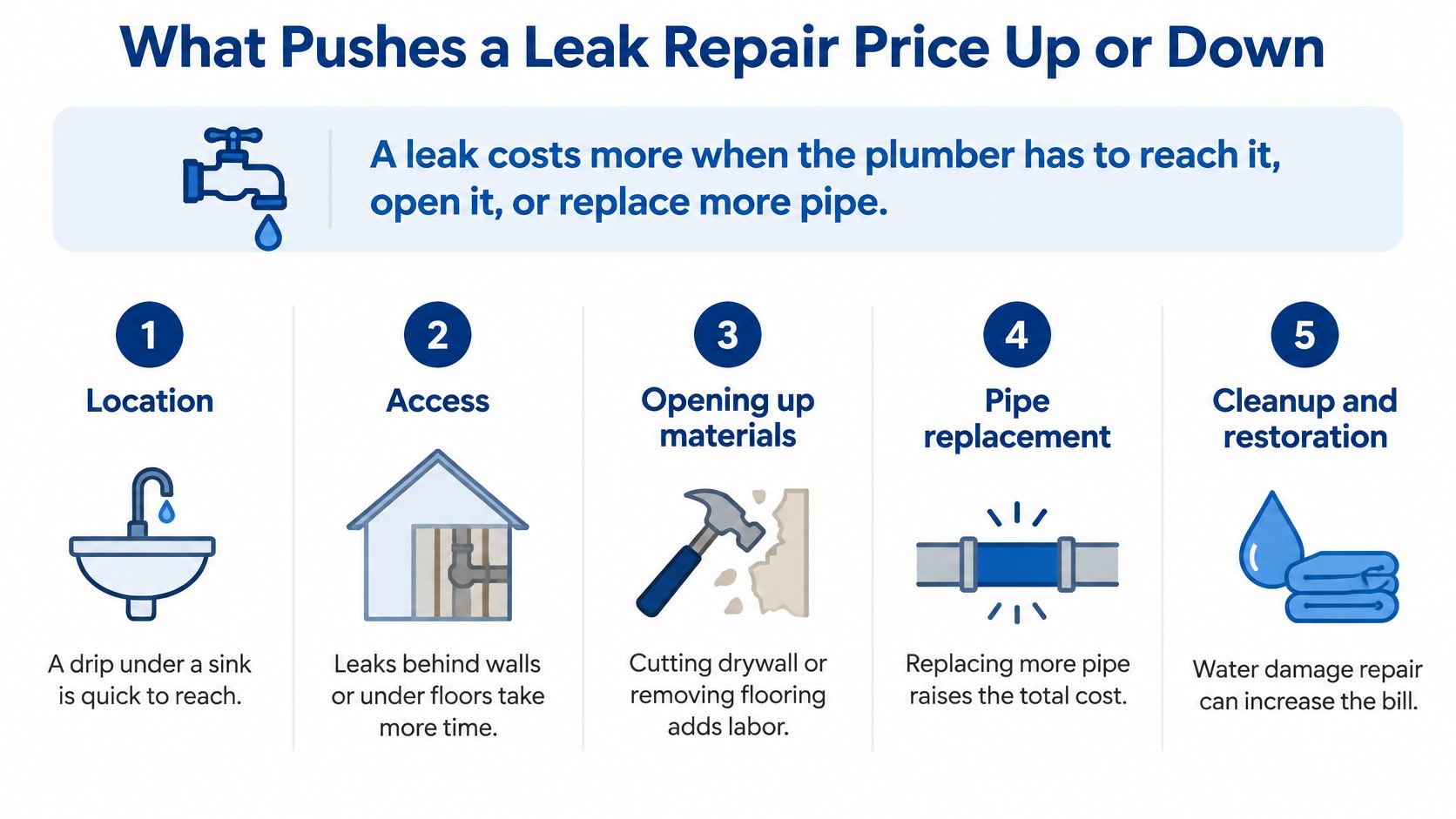
A leak costs more when the plumber has to reach it, open it, or replace more pipe.
Location. A drip under a sink is usually easier to reach than a leak inside a wall, beneath finished flooring, or under a slab. Hidden leaks can also require a diagnostic step before repair begins.
Pipe material and condition. Copper and PEX use different fittings and repair methods. If a line is badly corroded or repeatedly failing, replacing more of it may make better long-term sense than patching the same area again.
Access and excavation. Tight basements, crawl spaces, finished walls, driveways, and sidewalks can add labor. A buried service-line leak in Fraser or Sterling Heights, for example, may require excavation that a branch-line repair doesn't.
Timing and scope. Emergency work may cost more than a scheduled visit. The number of fittings, amount of pipe, and any needed access work also affect the total.
Main water-line repairs average about $1,025, with a reported range of $354 to $1,696. Minor valve or short-section work may be about $150, while a severely corroded or extensively damaged line can reach $3,960, according to the HomeAdvisor water-main repair estimate. A careful plumber first identifies whether the leak is on a branch line, the building's service line, or a utility-owned section, since those are different repair scopes.
A complete estimate should name the leak location, pipe material, access work, and why repair or replacement is recommended. For a concealed problem, ask how the leak will be located; leak detection and its costs are worth discussing before walls or floors are opened. We can also repair a sewer line before it causes major problems, but a sewer issue needs its own diagnosis.
What a Leak Adds to Your Water Bill Each Year
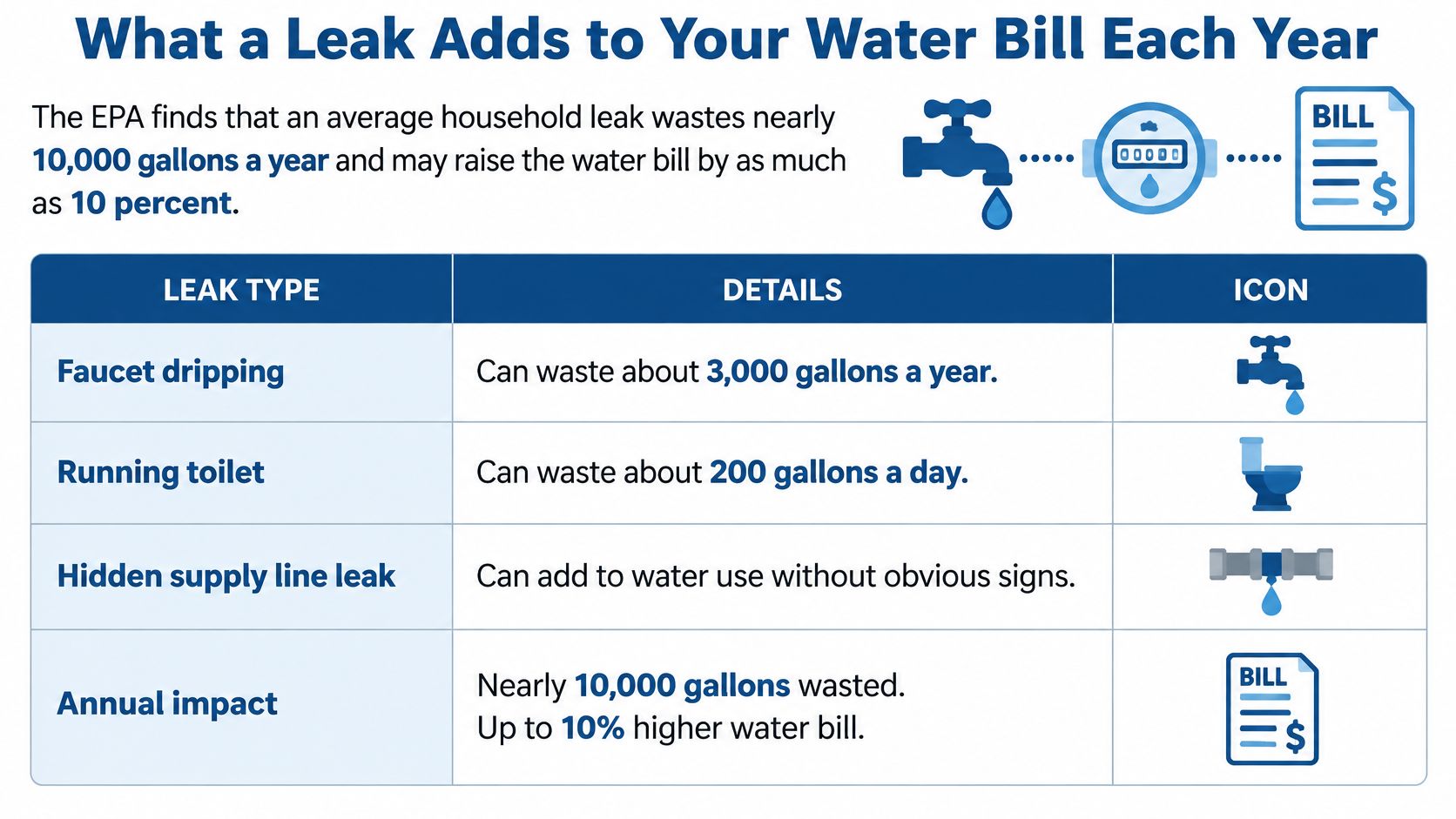
The U.S. Environmental Protection Agency estimates that household leaks waste nearly 10,000 gallons of water per year on average and may increase a household water bill by as much as 10%. A small drip can keep adding to the bill even when it never leaves a puddle, as the EPA's Fix a Leak Week release explains.
| Leak source | Water wasted | Estimated yearly cost |
|---|---|---|
| Average household leak | Nearly 10,000 gallons per year | Depends on local water and sewer rates |
| Faucet dripping once per second | More than 3,000 gallons per year | Depends on local water and sewer rates |
| Showerhead dripping 10 times per minute | More than 500 gallons per year | Depends on local water and sewer rates |
| Toilet leaking at 0.5 gallons per minute | About 21,600 gallons per month | About $2,100 per year at $8.25 per 1,000 gallons |
| Irrigation leak at 1 gallon per minute | About 43,200 gallons per month | About $4,300 per year |
The toilet and irrigation examples are EPA commercial-guidance benchmarks, not a prediction of every home's bill. The guidance uses an assumed combined water and wastewater rate, while actual charges in Macomb, Oakland, and Wayne counties depend on the local rate and the leak's flow. A faucet or showerhead figure shows wasted volume, not a universal dollar amount.
A practical break-even check is to add the leak's ongoing water and sewer cost to the likely damage risk, then compare that total with the repair price. If your meter keeps moving while household use is off, a hidden leak is worth investigating. That's especially useful for property managers checking a unit between occupants or a small business watching an unexplained utility increase.
When Timing Changes the Bill
Call right away if water is spreading, sewage is backing up, or you can't stop the flow. A slow drip that stops when its fixture valve closes is usually a different situation from a burst pipe or a leak near electrical equipment.
Jay's Plumbing and Sewer offers 24/7 emergency service for burst pipes, sewer backups, and no hot water. Emergency or after-hours service may include an additional fee, and we tell customers the cost upfront before starting work. For more on emergency plumber costs, ask what the proposed visit includes before approving work.
Call promptly for:
- A burst or actively spraying pipe.
- Sewage backing up into a floor drain.
- Water near an electrical panel or outlets.
- Water spreading into a finished basement.
- A leak you can't shut off.
Schedule a visit for: a dripping faucet, a running toilet, or a slow leak under a sink that stops when the valve closes, especially if the floor remains dry and the meter is stable. A planned visit can avoid an after-hours charge when the leak is contained. During a deep freeze, however, a split pipe in a cold basement or crawl space in Clinton Township, Shelby Township, or Troy can make a winter leak more urgent. The first-hour steps that limit damage are listed in the cost-control routine below.
When Water Damage Turns a Small Leak Expensive
In a Macomb County home, a slow leak under a bathroom sink can soak the subfloor over several weeks. The plumbing repair may be modest, but a damaged cabinet base, flooring, and drywall can turn the job into a restoration project.
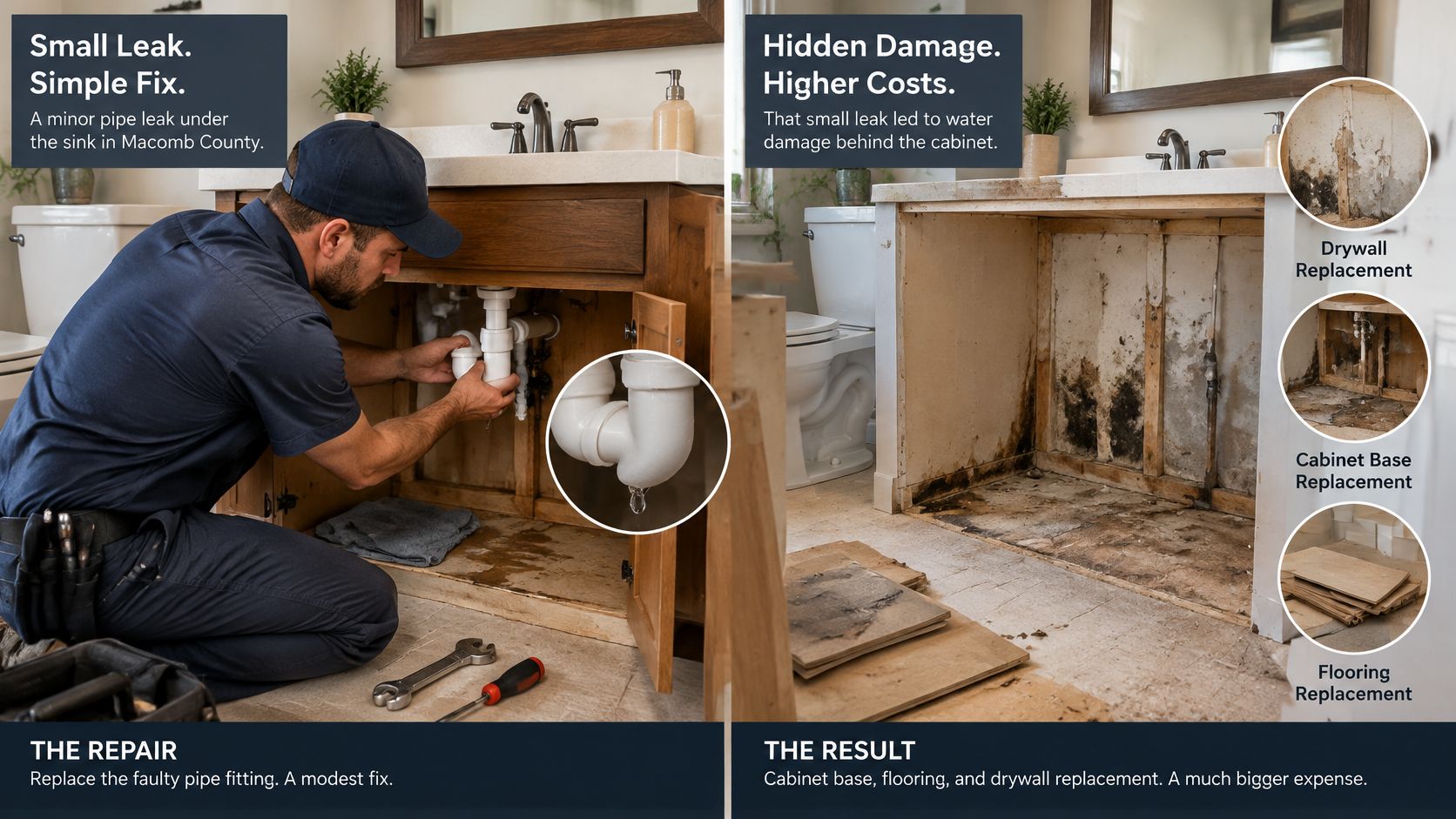
A basic residential leak may cost roughly $150 to $850 to repair, while a concealed pipe or slab leak can exceed $600 to $5,000 before restoration. The water-leak repair cost overview reports restoration averages around $3,867, insured water-damage claims above $15,000, and severe losses exceeding $50,000. Those figures describe broader damage costs, not a typical plumbing invoice.
Coverage depends on the policy and circumstances. Sudden, accidental damage such as a burst pipe is generally more likely to be covered than gradual leakage, deterioration, or neglected maintenance. Contact your insurer to ask how your policy handles leak detection and resulting water damage before assuming either is covered.
Before anyone opens a wall or floor, get the source and proposed scope in writing.
Use a simple recordkeeping routine: shut off the water, photograph the source and surrounding damage, note when you found the leak and when you shut it off, and keep the plumber's written findings. Ask whether leak detection and restoration are priced separately. For a ceiling stain that may trace back to bathroom plumbing, a leaking bathroom ceiling needs a source check before cosmetic repair.
The same distinction matters to landlords, property managers, and small-business owners. Tenant displacement, damaged contents, mold, or structural remediation can add costs that aren't shown on a plumbing quote. The lowest quote isn't necessarily the least expensive option if it skips leak localization, moisture assessment, or useful documentation.
If water reaches finishes, the cleanup can become a separate project from the pipe repair.
How to Keep Leak Repair Costs Under Control
Use this routine to limit water loss, make the repair easier to assess, and keep a clear record of what happened.
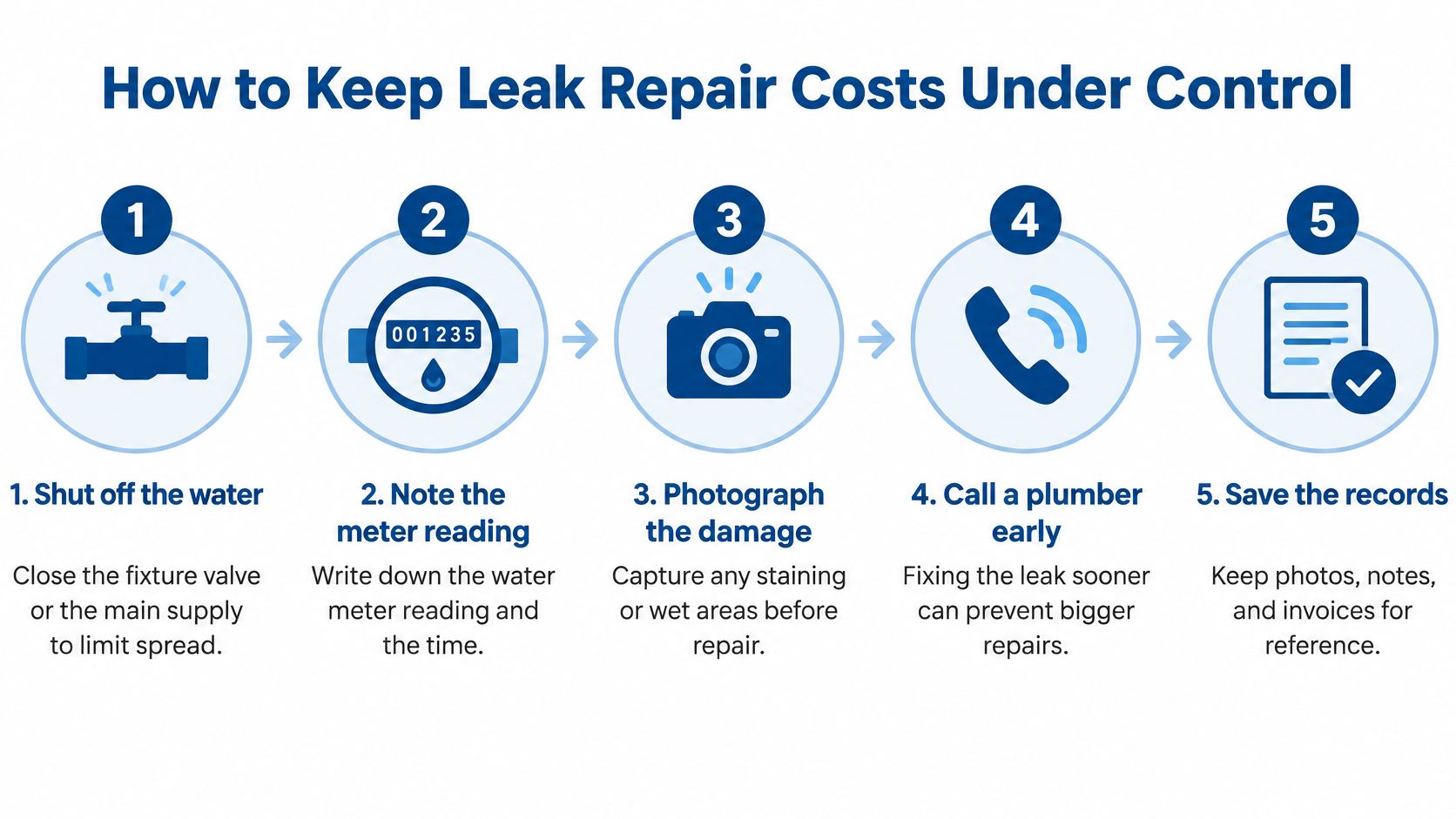
Shut off the water. Close the fixture valve if it stops the leak; otherwise, use the main supply shutoff if you can reach it safely. Stopping the flow limits additional wetting while you arrange help.
Record the meter reading and time. Note the reading before and after the water is off, and photograph any staining or wet surfaces. These details can help show whether water use continues and document the condition before work begins.
Clear access. Move stored items away from the sink, pipe, or utility area. A plumber who can reach the suspected leak may not need to remove extra items or open more of the area than necessary.
Ask for a written estimate. Make sure it identifies the suspected leak location, repair method, and parts. Compare what each estimate includes, not just the total; a low number that leaves out locating the leak or access work may not represent the whole job.
Discuss the lasting repair. If a section is corroded, ask whether replacing that section is more appropriate than another small patch. A thorough faucet inspection may check for leaks, worn washers, cartridge issues, or mineral buildup before the cause is repaired or replaced.
Prepare for cold weather. Have older supply lines, the water heater, and sump pump checked before cold conditions arrive, and insulate exposed pipes in unheated spaces. This can help reduce the risk of freeze-related pipe damage and basement water problems.
You can reasonably clear the cabinet, catch drips, and close a fixture valve. Don't open pressurized supply lines or gas lines, or attempt main-line work, unless you're qualified to do so. Those repairs should be handled by a licensed plumber.
Call for a Written Leak Estimate Before Work Starts
Call a plumber if water is coming from inside a wall, under a floor, or beneath a slab; if the leak may involve a main or sewer line; if your water bill has risen without an obvious reason; or if you cannot isolate the leak. A plumber can identify the likely source and explain whether the job involves a fixture, a supply pipe, or a larger system.
Jays Plumbing and Sewer serves Macomb and Oakland County, including Fraser, Sterling Heights, Clinton Township, Troy, Macomb, and Shelby Township. Leak detection and pipe repair sit alongside water heater repair, drain cleaning, and sump pump repair, with commercial plumbing available for property managers and small businesses. Ask about emergency availability and the estimate policy when you call.
A written estimate should do more than give one total. It fixes the repair price before work starts and gives you a baseline for the water and damage the leak is adding while you decide. Jays Plumbing and Sewer charges a fee for coming out to the job, quotes a price upfront before any work is started, and charges by the job rather than the hour. Ask how the call-out fee fits into the final price.
A few questions can make the estimate easier to compare:
- Where do you believe the leak is coming from?
- What does the proposed repair include?
- How is leak detection priced?
- What happens if the leak is inside a wall or beneath flooring?
Get the scope in writing, including the suspected leak location, repair method, and parts, so you can compare what each proposal covers rather than only the total. Call Jays Plumbing and Sewer at 586-634-3450 to request an estimate or emergency help, or visit jaysplumbingandsewer.com to review the services before you call.
If a leak is driving up your water use or putting a finished area at risk, call 586-634-3450 to discuss leak detection and repair, including emergency plumbing needs.
