Grease doesn't need to block your sink today to cause trouble next month. According to Raleigh's municipal stormwater guidance citing the U.S. Environmental Protection Agency, fats, oils, and grease from restaurants, homes, and industrial sources account for approximately 47% of sewer blockages and overflows. That's the pattern to understand if you want to know how to keep drains clear. Hot grease moves easily at first, then it cools, sticks to pipe walls, and catches food bits until the opening gets smaller and smaller.
You don't fix that pattern with a stronger chemical after a backup. You fix it by controlling what enters the pipe, catching the first slowdown early, and checking the main line when symptoms involve more than one fixture. That approach works for residential plumbing and commercial plumbing, and it fits Michigan homes where a slow line can turn into a basement problem after heavy rain or a thaw.
Table of Contents
- A Drain Care Calendar You Can Actually Keep
- The Household Routine and the Grease and Wipe Myths
- Slow Drains That Need a Camera or Jetting
- Kitchen and Building Lines That Need a Schedule
- Frequently Asked Drain Questions
- Call Before a Slow Drain Becomes a Backup
A Drain Care Calendar You Can Actually Keep
A post-holiday kitchen in Sterling Heights or Clinton Township can look fine at the sink while grease from dinner is already cooling farther down the line. The water leaves, so the drain gets marked as clear. Inside the pipe, pan fat, sauce, and shortening have started coating the wall where the next meal's scraps can stick.
I would treat drain cleaning as a calendar, not a rescue product. Short habits at the sink and toilet prevent most buildup, while a few seasonal checks catch problems in the basement and yard before wastewater backs up.
Why Repetition Beats Emergency Clearing
East Peoria's wastewater guidance reports that more than 80% of wastewater blockages are attributed to grease or grease combined with other materials, and its prevention program reduced stoppages by 78% between 2005 and 2019 and reduced overflows by 59% during the same period. A city result isn't a promise for one house, but it shows the order that works. Control what enters the system first. Then you'll need emergency clearing less often.
That order matters for a homeowner in Fraser, a landlord in Troy, or a small business in Shelby Township. A single cleaning can reopen a pipe. It can't change the daily habits that narrowed it.
The Calendar in Plain Terms
Start with the mealtime and strainer rows today. They're free, they take seconds, and they protect both kitchen plumbing and the larger building drain.
Drain care calendar for homes and small buildings
| Task | Where | How often | Why it matters |
|---|---|---|---|
| Scrape cooled grease into a sealed container | Kitchen sink and disposal | Every greasy meal | Stops fats from cooling on pipe walls |
| Empty strainers into the trash | Kitchen and bathroom sinks | Daily or when full | Keeps food and hair out of the line |
| Flush only waste and toilet paper | Every toilet | Every use | Wipes and other solids catch at bends |
| Clear hair from the stopper | Showers and tubs | Weekly | Stops hair and soap from matting |
| Check floor drains and the cleanout | Basement and yard | Each fall and after heavy rain | Catches odor or standing water before a backup |
| Camera inspection of the main line | Homes with trees or repeat slowdowns | About once a year, or when clogs return | Finds roots, grease, or defects a snake misses |
The fall check deserves a spot on your phone calendar. Look at the basement floor drain for standing water, dampness, or a sewer smell, then check the outdoor cleanout if you can access it safely from outside. Heavy Michigan rain and spring thaw are also good times to look again, especially in homes that have had basement flooding or sump pump repair issues.
A clean strainer today is cheaper than a cable machine next month.
Save jetting for clogs that return after basic habits are in place. If one shower slows because hair is matted at the stopper, clear the stopper. If several fixtures slow together, that's no longer a calendar task. That's a sign the building line needs professional attention.
Property managers should put the same rules in writing for tenants and staff. A note by the kitchen sink about grease containers, plus a bathroom bin near every toilet, prevents arguments later about what was flushed. It also gives you a simple record to point to when you schedule inspections for vulnerable lines.
The Household Routine and the Grease and Wipe Myths
Most homes don't need a complicated product routine. They need a short sequence that everyone follows the same way, every time someone cooks, showers, or uses the toilet.
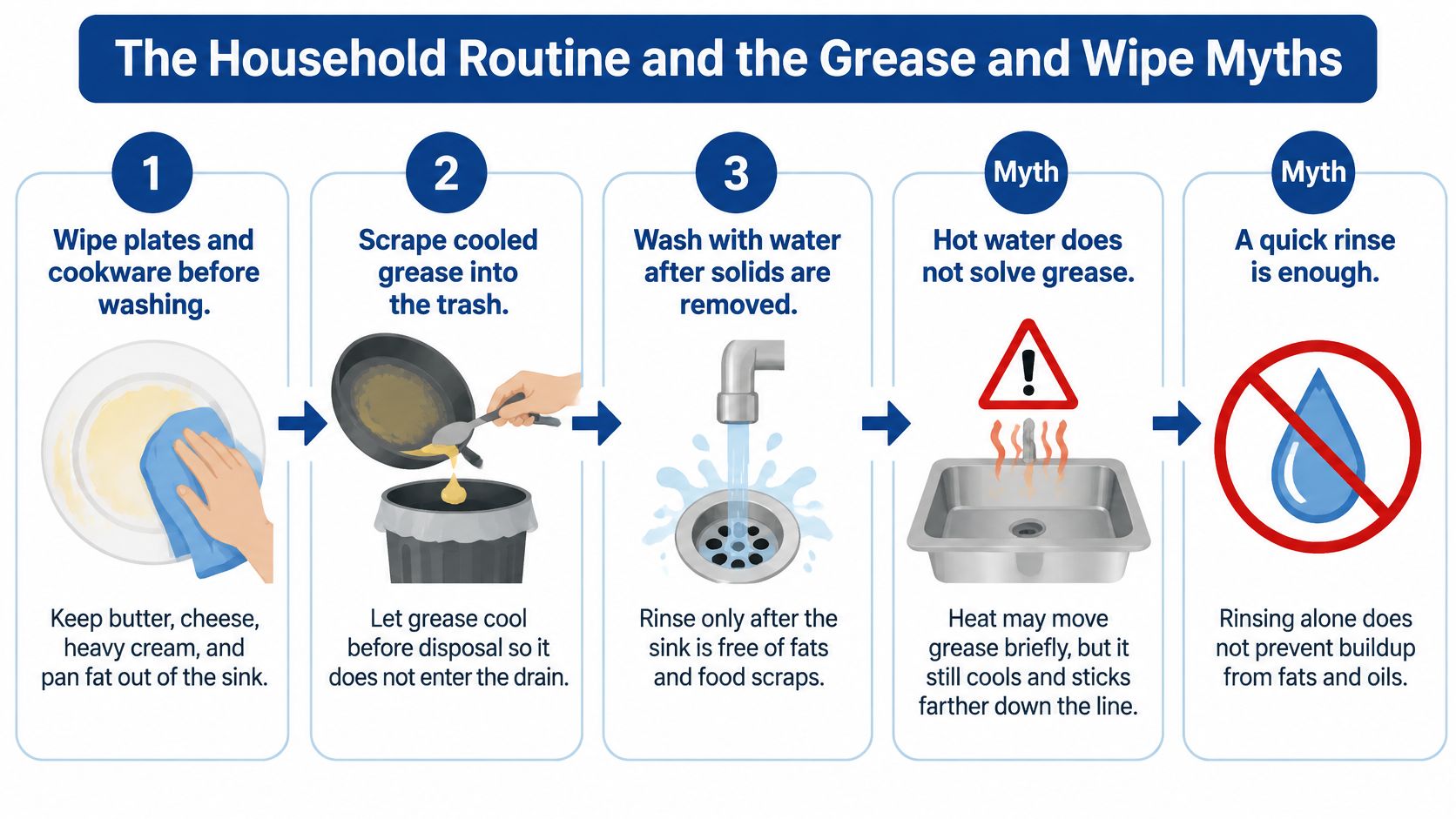
This visual puts the kitchen steps and the two common myths side by side.
Six Steps That Prevent Most Household Clogs
- Wipe before you wash. Scrape plates and wipe cookware with a paper towel or scraper so butter, cheese, heavy cream, and pan fat go into the trash before the dish reaches water. Let liquid grease cool, pour it into a lidded container, and throw it away or take it to an approved recycling drop-off. If you're unsure whether a small amount matters, our guide on whether you can dump grease down the drain explains why the answer stays no.
- Seat a strainer and empty it. Use a mesh strainer in kitchen and bathroom sinks and a hair catcher in showers. Empty them into the trash, not back into the sink. A strainer you don't clean just becomes a lid that slows water and tempts someone to remove it.
- Stop adding water when a fixture slows. Don't run the dishwasher, laundry, or shower to test whether a slow drain will catch up. Extra water gives a partial blockage more volume to push back toward the lowest opening.
- Skip the hot-water chase. Hot water and soap can make the sink basin look clean while grease keeps moving until it cools and sticks farther away. Huntsville's Save the Drains guidance makes the same point in plain terms, rinsing may make a drain look clean without eliminating grease from the plumbing.
- Use mechanical clearing first for one fixture. Plunge a toilet, remove a shower stopper, or feed a small hand snake into one slow sink. Don't pour a chemical opener and call it maintenance.
- Escalate when it returns. If the same fixture slows again within a few weeks, or a second fixture joins it, stop repeating the same fix and book a camera inspection.
The U.S. Environmental Protection Agency septic care guidance advises against chemical drain openers for clogged drains and recommends boiling water or a drain snake instead. I'd be careful with boiling water as a default. If you don't know whether the pipe under the floor is plastic, glued, older, or already damaged, warm water and mechanical removal are the safer first move.
This short video shows the basic mechanical approach homeowners ask about most often.
Hot Water Moves Grease and Wipes Stay Wipes
Hot water doesn't dissolve grease out of existence. It keeps grease liquid long enough to travel. Once that grease reaches a cooler section of pipe, it can coat the wall and grab coffee grounds, rice, hair, and other solids. You traded a greasy trap you could reach for a greasy section you can't see.
A garbage disposal creates a similar misunderstanding. It chops food smaller, but it doesn't make fat safe for a sewer. Finely chopped scraps can release grease sooner and spread it through the line. If you need garbage disposal repair, fix the unit, but still scrape and wipe before you use it.
Wipes belong in the trash even when the package says flushable. Baby wipes, cleaning wipes, cosmetic wipes, and biodegradable wipes can all leave the bowl and still settle in a low-flow lateral, an apartment stack, or a private sewer in Fraser or Troy. Once they sit, fats and hair bind them into a mass that's much harder to clear than toilet paper.
Bathroom rule: If it isn't human waste or toilet paper, put it in the bin.
Septic homes should also limit disposal use because ground food adds fats and solids to the tank. A clear trap under one sink isn't proof the building drain is clear. A drain that needs the same opener every month isn't maintained. It's telling you something is still in the line.
Slow Drains That Need a Camera or Jetting
Sort the symptom before you buy another opener. The location of the slowdown tells you whether you're dealing with a fixture, a short branch, or the main sewer.
One slow sink usually points to the trap or the short branch behind the wall. Check the strainer, plunge, or use a hand snake, then stop. A shower draining slowly by itself is often hair and soap at the stopper. Clear that mat first before you assume the pipe deeper in the floor is blocked.
When One Fixture Stops Being a One Fixture Problem
A single toilet that won't clear after a proper plunge may need more than repeated flushing. For stubborn toilet blockages, we may remove the toilet or pressure jet the drain, and we use small CCTV cameras and locators to find the cause. That approach is safer than forcing water into a line that's already full.
What a slow drain is telling you
| Symptom | Likely spot | Next step |
|---|---|---|
| One sink drains slowly | Trap or branch line | Strainer, plunger, or hand snake. No chemical opener |
| Shower or tub only | Hair at the stopper | Remove the stopper and clear the hair |
| One toilet will not clear | Bowl or nearby drain | Plunge once. If it returns, a plumber may pull the toilet or jet |
| Gurgling in other fixtures | Main line or vent | Stop adding water and schedule a camera inspection |
| Several drains slow at once | Main sewer | Call. Treat it as a building line, not a fixture |
| Sewage at a floor drain | Main backup | Stop water use and call for emergency drain service |
| Returns weeks after snaking | Grease, wipes, or roots farther down | Camera first, then jetting if the pipe can take it |
Gurgling in a sink while the toilet flushes, several drains slowing together, or sewage rising in a basement floor drain points to the main line. In Macomb County, Oakland County, and Wayne County, that pattern can follow tree roots, a belly in the line, grease buildup, or ground shift after freeze and thaw cycles and heavy rain. If you need a plumber near me at that point, you're past fixture troubleshooting.
If you want to see what the inspection involves before you call, our overview of video camera sewer inspection walks through the process.
Why Wipes Complicate Main Line Diagnosis
A Canadian Water and Wastewater Association review of wipes in wastewater systems reports that wipes can settle where flow is intermittent, accumulate over time, and combine with fats, oils, grease, hair, shampoo, and cosmetics. Recent NOAA-supported testing found five of six tested wipe types remained more than 93% intact after 48 hours in sewer-like conditions, including products marketed as flushable.
That explains delayed clogs. A wipe flushed on Monday may settle in a quiet lateral, catch grease on Wednesday, and only block the line when laundry and showers run together on Saturday. In a shared building line, the unit with the backup may not be the unit that flushed the wipes.
A cable machine can poke a hole through soft debris and restore flow while leaving the grease coating behind. Hydro jetting can scour grease, sand, and scale when the pipe is sound. A camera shows whether the pipe is cracked, offset, rooted, or just dirty, so nobody excavates a line that only needed cleaning.
Cleaning restores a path. It does not prove the pipe is sound.
Stop using fixtures if wastewater is showing at a floor drain. Don't run more water to see if it'll go down. At that point you need an emergency plumber mindset, limit water use, keep people and pets away from contaminated water, and get the line inspected.
Kitchen and Building Lines That Need a Schedule
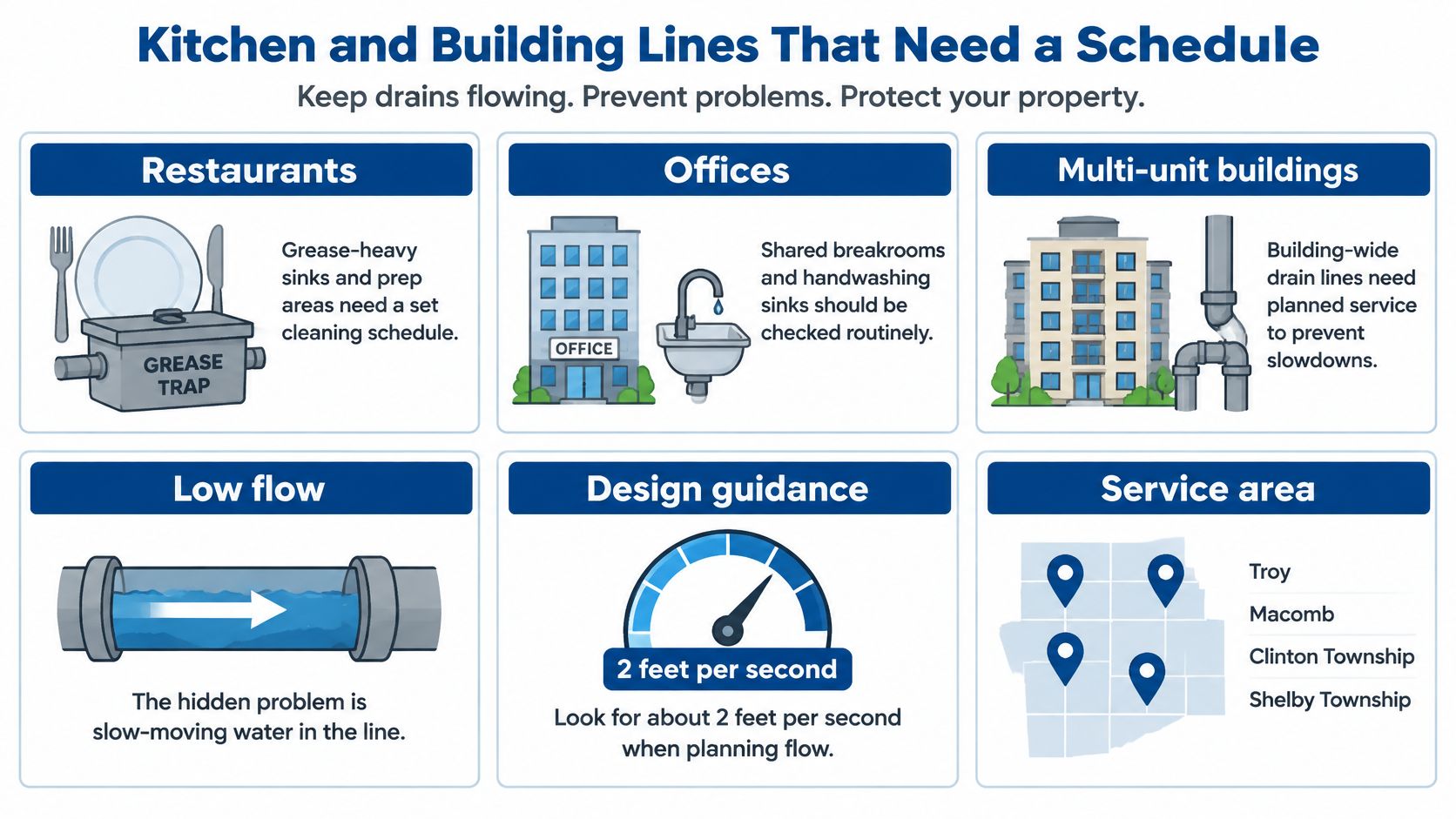
Restaurants, offices, and multi-unit buildings in Troy, Macomb, Clinton Township, and Shelby Township don't fail only because someone poured grease once. They fail because volume, quiet branches, and shared lines let deposits build between busy periods.
This checklist separates the properties that need written intervals from a typical single-family sink.
Low Flow Lets Solids Settle
Water has to move fast enough to carry solids. Precast drainage design guidance on self-cleansing velocity identifies approximately 0.75 m/s (2.46 ft/s) at one-third design flow as a minimum self-cleansing velocity for foul sewers. Below that kind of movement, grit, sand, and grease can drop out and wait. A later busy hour doesn't always wash the deposit away. It can pack more material against it.
Dead ends and underused branches are easy to forget. A mop sink used once a week, a breakroom sink in a quiet office, or a floor drain in a storage room can collect debris and odor while the main restrooms still work. The fixture that still drains can hide a branch that's loading up behind it. Put those fixtures on the inspection list instead of waiting for a complaint.
A Practical Sequence for Managed Properties
- Name the waste first. Decide whether the line mainly sees grease, food solids, sand, grit, hair, or root exposure from trees outside.
- Confirm grease interception. Commercial kitchens that need a grease interceptor should keep lids closed and clean the unit on a written schedule based on cooking volume. Hot water from a busy dish pit doesn't dissolve grease. It carries it farther down the line, where it cools and coats the pipe wall. The interceptor has to catch it before that happens.
- Inspect on an interval. Check accessible lines periodically and use a camera when the same spot returns. Our page on sewer line cleaning and what the service includes is a useful reference when you're planning that schedule.
- Match the tool to the pipe. Use a cable for a soft, localized clog and high-pressure jetting for grease or scale only after the pipe condition is known.
- Confirm and document. Verify restored flow, note defects the camera showed, and record repairs that were done or declined.
Commercial and rental line care intervals
| Component | Interval | Action |
|---|---|---|
| Grease interceptor | Written schedule based on cooking volume | Keep the lid closed and clean on schedule |
| Accessible lines | Periodic inspection | Camera when the same spot returns |
| Septic tank | Periodic professional inspection | Pump on the schedule set by tank size and household use |
| Floor drains and cleanouts | Each fall and after heavy rain | Check for odor or standing water |
Don't jet a fragile, cracked, or collapsed line just because jetting worked on a sound line last year. Don't trust one big flush to finish the job either. A high-flow event can move loose material and leave the hardened layer behind.
For a septic property, have the tank inspected and pumped on a schedule a professional sets for the tank size, wastewater volume, and solids loading. The pump-out date and the last receipt belong in the property file, not in someone's memory.
Property managers should log the symptom, date, line cleaned, camera finding, and next recommended step. Real estate agents and buyers can use the same logic before a sale. Several slow drains, recurring odors, or a wet cleanout justify a camera look before closing or starting a major renovation.
Record-keeping is the maintenance, not a stack of emergency invoices.
That record also helps separate drain cleaning from sewer repair. A dirty line needs cleaning. A cracked or offset line needs a repair decision. Guessing leads to repeat drain cleaning bills for a pipe problem that cleaning can't correct.
Frequently Asked Drain Questions
Why Does My Sink Keep Clogging After I Use a Drain Cleaner
A chemical opener can restore short-term flow while leaving much of the obstruction in place. Water finds a small path through grease, hair, or wipes, then that path closes again as more debris sticks. The chemical also leaves corrosive liquid in the line, which complicates later mechanical work. If the same sink needs repeated help, I would stop pouring and find out what's still in the pipe.
Are Flushable Wipes Safe for My Toilet
Not reliably. The package can say flushable while the sheet stays intact long enough to settle at a bend, a rough joint, or a low-flow section. Once it sits, grease and hair can bind it to other material. Treat every wipe as trash and keep a lined bin in each bathroom.
Can I Pour Cooking Grease Down the Disposal
No. A disposal chops food, but it doesn't make fat safe for the drain. Finely cut scraps can carry grease farther into the line before it cools and sticks. Scrape and wipe cookware first, collect cooled grease in a sealed container, and put it in the trash.
How Often Should a Home Get a Camera Inspection
About once a year makes sense for homes with mature trees, older sewer lines, or any line that has already backed up. Book it sooner when slow drains return, toilets gurgle, or more than one fixture is involved. A camera inspection is also smart before a home purchase when the seller reports past backups.
Does a Clear Sink Mean the Sewer Is Clear
No. A clear trap only shows the short branch near that sink is open. The main building drain can still have grease, roots, wipes, or a structural defect farther out. Several slow fixtures, sewage at a floor drain, or repeated backups call for an inspection of the main line.
Call Before a Slow Drain Becomes a Backup
Keep using the calendar while every fixture runs at normal speed and no sewer odor returns. Change your plan when the same drain slows again, more than one fixture is involved, a toilet needs more than a plunger, or a floor drain shows sewage.
Calling early usually gives you more options. A camera can locate the clog, show whether the pipe is dirty or damaged, and help you choose between cleaning, jetting, targeted pipe repair, or sewer repair before a Michigan thaw or hard rain pushes a weak line into a flooded basement. Waiting until wastewater is on the floor removes that choice.
What Happens on a Service Visit
Our technicians inspect the drainage system, locate the clog, and give you a range of options for fixing the problem. We review camera findings before recommending digging, which helps separate a cleaning job from a structural repair. The business has over 25 years of knowledge in unblocking drains, and that experience matters most when the symptom could have two or three causes.
Cost depends on how far down the clog is, the equipment needed, and whether a camera inspection is added. A drain cleaning for an average-sized home typically costs between $200 and $500. We'll explain the most economical option to clear the clog with straightforward pricing before work starts.
Jays Plumbing and Sewer serves homes and small businesses across Macomb County, Oakland County, and Wayne County, including Fraser, Sterling Heights, Clinton Township, Troy, Macomb, and Shelby Township. Along with drains, listed services include emergency service, excavation, water heater repair and water heater replacement, gas line work, kitchen and bath plumbing, and sump, sewage, and backup pump service.
If you're deciding whether a slow line can wait, call and describe the pattern. Which fixtures are slow, when it started, and whether a floor drain is involved tells us a lot. Contact Jay's Plumbing and Sewer at 586-634-3450, our 24/7 phone number, to schedule plumbing service or talk through the symptoms.
If a slow drain keeps returning, gurgling has spread to another fixture, or wastewater is showing at a basement floor drain, we can locate the clog, clean the line, or run a camera before recommending repair. Call Jay's Plumbing and Sewer at 586-634-3450 for drain cleaning, sewer inspection, or emergency plumbing across Macomb, Oakland, and Wayne counties, or visit Jays Plumbing and Sewer to schedule service and request a free quote.
