The shower's running, the bathroom's cold, and you're already late. On a winter morning in Fraser, Sterling Heights, or Clinton Township, a hot water heater not working can make replacing the whole tank sound like the quickest answer.
Don't order a heater or start pressing reset buttons yet. First rule out gas, carbon monoxide, scalding water, and an active leak. Then separate the complaint into power or ignition, controls, distribution, or demand above capacity. Those problems can feel identical at the shower, but they need different fixes.
Table of Contents
- Sort the Symptom Before You Replace Anything
- Leave the Area When Heat or Gas Turns Unsafe
- Safe Checks for Electric Gas and Tankless Heaters
- Why Electric Gas and Tankless Units Fail Differently
- Decide on Repair or a Planned Replacement
- Common Questions About Hot Water Heater Problems
- Call for Hot Water Before the Morning Rush
Sort the Symptom Before You Replace Anything
A cold shower doesn't tell you which part failed. It doesn't even prove the water heater failed. A shower cartridge can mix cold water into an otherwise working hot-water system, while a busy household can empty a sound storage tank faster than it reheats.
Write down what's happening before changing anything. That gives a plumber something more useful than “it stopped working,” and it helps keep a working heater from being replaced unnecessarily.
Record the complaint before touching the controls
Start with these observations:
- Heater type: Electric storage, gas storage, or tankless. A gas tankless heater also needs electricity for its controls.
- Affected fixtures: Every hot faucet, one bathroom, or only the shower.
- Temperature pattern: Completely cold, briefly hot, or lukewarm only when several fixtures run.
- Visible clues: A display code, rusty water, rumbling, soot, moisture, or an unusual odor.
If you notice gas odor or signs of unsafe combustion, stop gathering details and leave. The CDC's public health statement on carbon monoxide explains the health concern associated with this combustion gas. Investigating a fuel problem isn't worth staying in unsafe air.
What the hot-water complaint usually means
| Symptom | Likely problem | First safe move | Call now? |
|---|---|---|---|
| Ice-cold at every hot faucet | Power, gas supply, ignition, or both elements out | Note fuel type; don't relight if you smell gas | Yes if there's gas odor, soot, or no heat during a Michigan cold snap |
| Hot for a minute, then cold | Recovery, one element, sediment, or undersized tankless | List which fixtures ran at the same time | Yes if a restaurant, office, or multifamily peak has no usable hot water |
| Lukewarm and never truly hot | Thermostat, mixing valve, or scale | Leave the dial where it is; don't chase heat upward | Yes if temperature swings from cold to scalding |
| Rusty water, popping, or rumbling | Sediment or internal tank corrosion | Look for an active leak without touching wet equipment | Yes, the same day if the floor is wet |
| Water from the relief pipe or a puddle under the tank | Excess temperature or pressure, or a tank leak | Don't cap or plug the discharge pipe | Yes; treat an active leak as urgent |
| Tankless error code and no hot water | Flow, scale, venting, or ignition fault | Photograph the code; don't bypass sensors | Yes if hot water won't return after a manufacturer-approved power cycle |
Separate building demand from equipment failure
For property managers in Troy, Macomb, Shelby Township, and throughout Macomb, Oakland, and Wayne Counties, timing matters. Record which apartments or fixtures lost hot water, whether neighboring units are affected, and whether the problem followed an outage or unusually heavy use.
Say an office has hot water before opening but loses it during cleanup. That pattern calls for checking demand and recovery, not automatically replacing the heater.
We recommend having water heaters checked when they produce rust-colored water, unusual noises, or inconsistent heat. These warning signs of a failing water heater are reasons to arrange an inspection, not reasons to turn up the thermostat.
Leave the Area When Heat or Gas Turns Unsafe
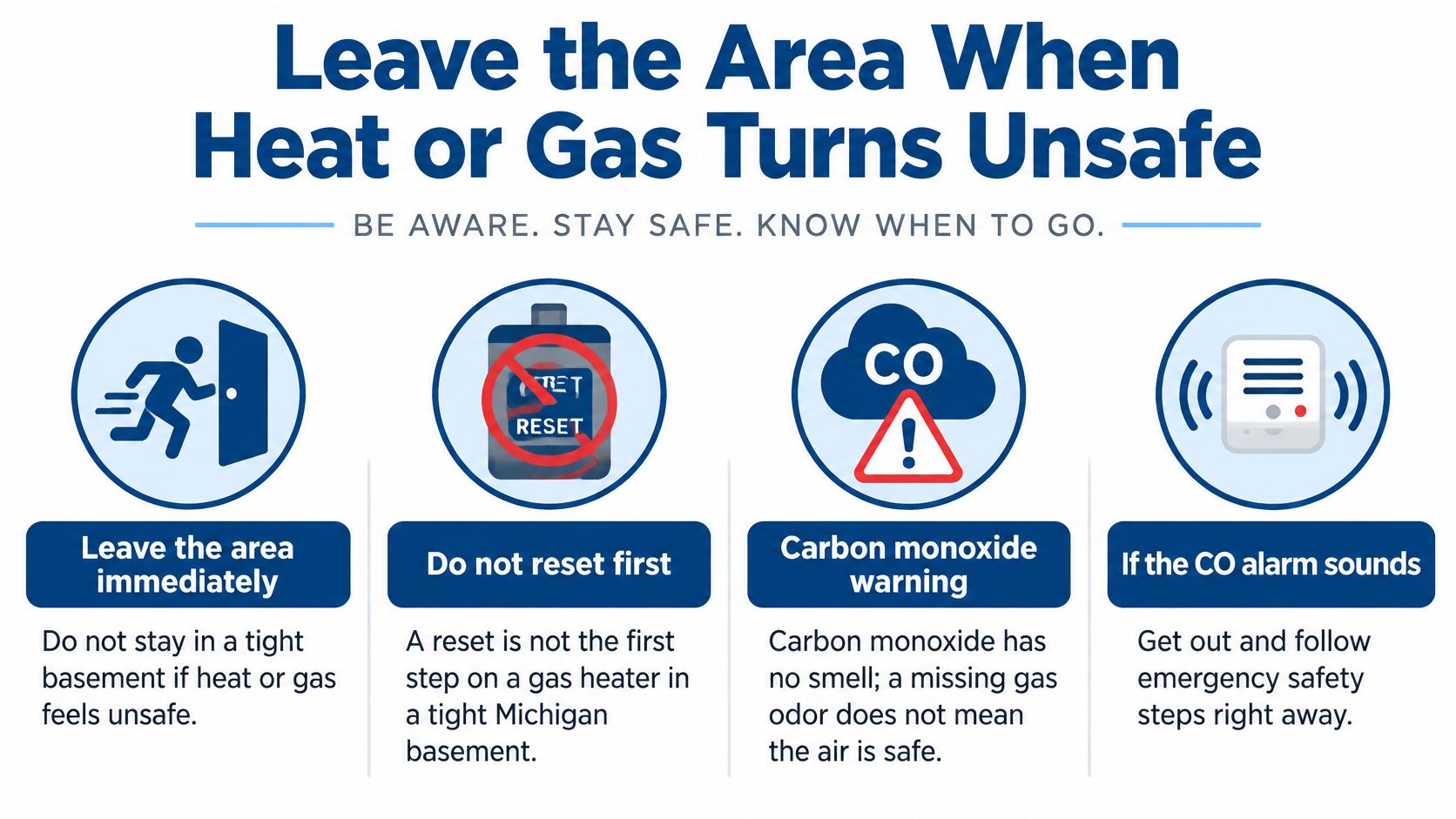
A reset isn't the first step on a gas heater in a tight Michigan basement. Carbon monoxide has no smell, so the absence of gas odor doesn't establish that the air is safe.
The CDC's carbon monoxide guidance recommends properly vented gas appliances, annual service by a qualified technician, and battery-operated or battery-backup CO detectors near sleeping areas. If an alarm sounds or occupants develop headache, dizziness, nausea, confusion, or unusual fatigue, get everyone outside and call emergency services.
Use these actions before investigating the heater:
Combustion trouble means leave, not relight
A disconnected, rusted-through, or visibly blocked flue needs professional attention. Soot around the burner opening, flame outside the burner area, or an abnormal lazy yellow flame also means you shouldn't try to restore operation.
If you smell gas, leave without operating switches, using flames, or making a call inside. Contact the gas utility or emergency services from outside. Don't stay behind to shut valves or collect a model number.
Restoring hot water comes after making the building safe, not before.
Only after the building has been declared safe should a technician diagnose ignition, gas pressure, combustion, or venting.
Sudden scalding water needs a different stop
Excessively hot water isn't evidence that the heater is finally working properly. It can indicate a failed control, an unsafe setting, or a mixing problem.
According to the Consumer Product Safety Commission's scald-prevention guidance, third-degree burns can occur after about 2 seconds at 150°F, 6 seconds at 140°F, or 30 seconds at 130°F, and even 120°F water can cause a third-degree burn after a five-minute exposure. Those exposure risks make sudden overheating especially concerning around children and older adults.
Don't test the water with your bare hand or raise the setting to see whether the heater responds. Keep people away from the affected fixtures and turn off the heater's energy source only if you can do so safely.
Water running from the temperature-and-pressure relief pipe, a missing valve, or damaged discharge piping also needs prompt attention. Never plug, cap, or redirect that outlet as a temporary fix.
In winter rentals in Clinton Township, Shelby Township, and Troy, there's understandable pressure to get showers working. When combustion, venting, scalding, or relief discharge is involved, leaving the equipment alone is the lower-risk choice.
Safe Checks for Electric Gas and Tankless Heaters
Homeowner troubleshooting should stay outside the heater's service compartments. You can confirm a power interruption, record an error, and identify a fixture problem without exposing wiring or disturbing gas components.
The EPA's home-maintenance guidance recommends professional annual water-heater service and visual checks for leaks, loose connections, corrosion, and deteriorating gaskets. A basic inspection is useful, but it doesn't replace electrical testing or combustion diagnosis.
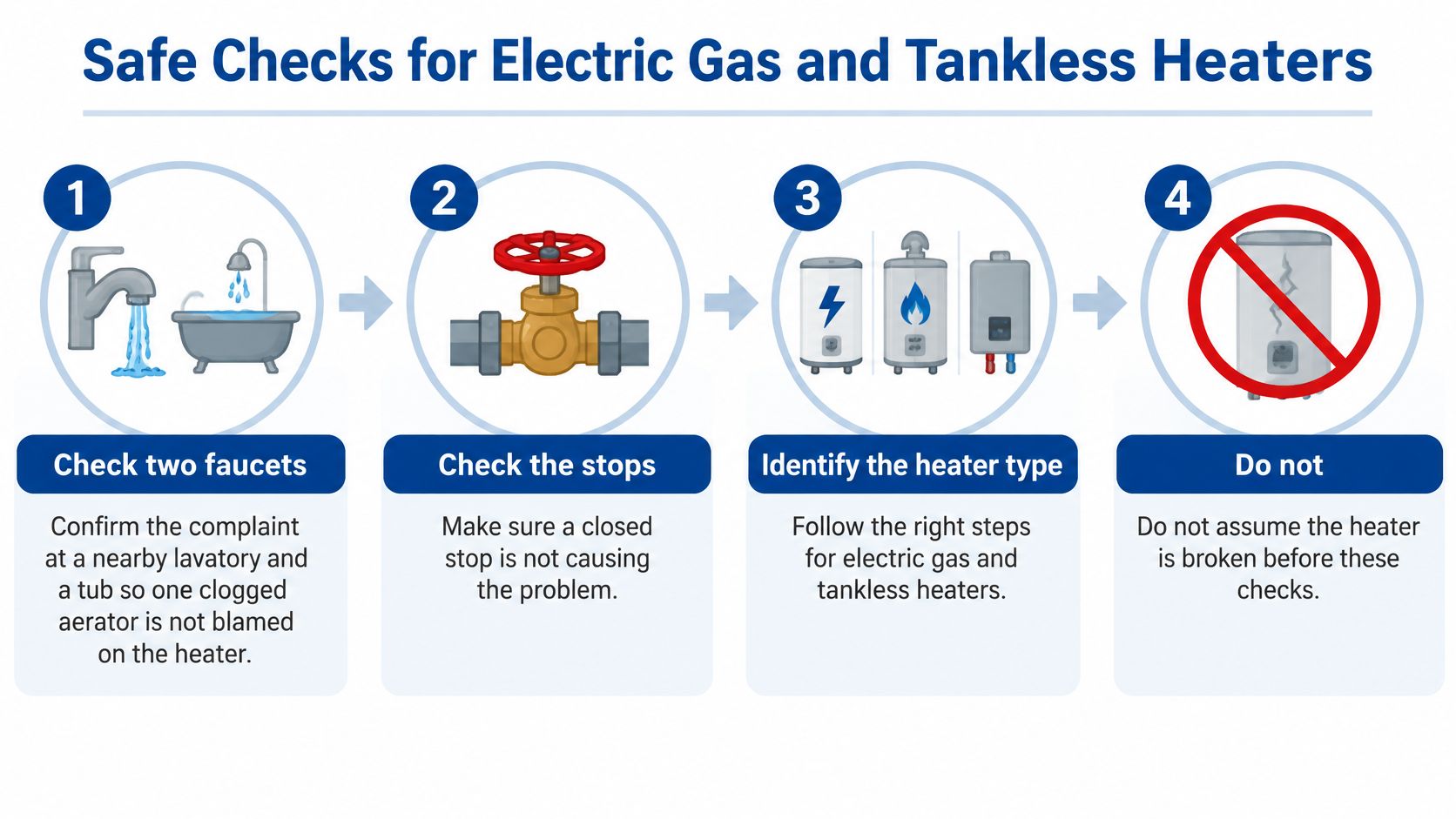
The safe sequence starts at the fixtures, not behind an access panel.
Check what you can see without taking anything apart
Compare separate fixtures. Try a nearby lavatory and a tub, provided there's no scald concern. Note both temperature and flow. A restricted aerator or closed fixture stop can create a local complaint that isn't a heater failure.
Identify the equipment. Read the accessible label for the manufacturer, model, fuel, and installation information. Photograph it rather than reaching behind piping or removing covers.
Look for water. Check the pan, tank bottom, visible connections, and relief-pipe outlet. If the tank itself appears to be leaking, stop. Don't stand in water to reach electrical equipment.
Inspect the electric heater's dedicated breaker. If the panel is dry and undamaged, there's no burning smell, and the manufacturer permits it, a single reset may be reasonable after an apparent power interruption. If it trips again, leave it off. Don't remove element covers, test live wires, or press an internal high-limit reset.
Read the gas heater's status. Note the pilot indicator, ignition status, or displayed fault without opening the burner compartment. Report whether other gas appliances were already operating normally. Don't light another appliance to test the supply, bypass a sensor, or attempt a relight when anything seems unsafe.
Check a tankless display and normal water flow. Note whether power is present and whether opening a hot fixture normally starts the unit. Photograph the code before following any manufacturer-approved power-cycle procedure. If the fault returns, stop resetting.
Read the temperature display without increasing it. A visible setting is useful information for the technician. Turning it higher can hide a recovery problem while making the next successful heating cycle unsafe.
Leave draining to the technician. Water inside can scald. Restoring electricity before a drained electric tank is completely full can damage exposed heating elements.
Know when the checks have done their job
A successful check either identifies a straightforward interruption or produces a clear service report. It doesn't have to produce a DIY repair to be worthwhile.
Tell the technician what changed after the check, including whether the display returned, the breaker held, or only one fixture remained cold. Don't clear fault histories or repeatedly cycle the equipment while waiting.
Before a Michigan winter, a maintenance appointment is a better place for testing safety controls, checking connections, and deciding whether sediment removal is appropriate. Those tasks require more than looking at the outside of the tank.
Why Electric Gas and Tankless Units Fail Differently
An electric storage heater, a gas storage heater, and a tankless unit can all deliver a cold shower for different reasons. Knowing the type narrows the investigation, but it doesn't identify a replacement part by itself.
For homes and small businesses around Macomb and Oakland County, the useful distinction is how the heater makes heat and how it delivers that heat during demand.
Storage heaters hold a reserve, but recovery matters
An electric storage heater can lose an element and still provide some hot water. The remaining heating arrangement may leave the household with much less usable capacity, so “it gets hot briefly” doesn't rule out an electrical fault.
A technician checks the supply, thermostats, high-limit control, and elements with appropriate electrical isolation. A breaker trip is evidence to investigate, not a repair diagnosis.
Gas storage equipment adds ignition and combustion checks. A burner that won't remain lit may involve flame proving, fuel delivery, a control, or a vent-related safety device. The right response isn't to adjust the thermostat until the burner cooperates.
Sediment can slow heat transfer at the tank bottom and produce rumbling. It sits between the burner's heat and the stored water, rather than burying the burner itself. This guide to a gas water heater not heating water explains the gas-specific troubleshooting concerns.
Tankless equipment needs both flow and heating capacity
A tankless heater must detect adequate flow before it starts heating. In a Shelby Township home, a newly installed low-flow showerhead might expose an activation problem even though the heater hasn't suffered a complete failure.
Capacity is a separate issue. A Sterling Heights restaurant may have usable hot water at one sink but lose temperature when dishwashing and cleanup overlap. A technician should compare actual simultaneous demand with the unit's ability to heat incoming water, especially during Michigan winters.
Scale can narrow a tankless heat exchanger's waterways or interfere with heat transfer. On storage equipment, mineral deposits can coat elements or collect at the bottom. The location changes, so the service procedure changes too.
Electric, gas, and tankless failure patterns
| Heater type | Typical pattern | Common cause |
|---|---|---|
| Electric storage | Some hot water, then it runs out quickly | One failed element or a tripped high-limit |
| Electric storage | No hot water at all | Breaker off, both elements out, or a control failure |
| Gas storage | Burner won't stay lit | Thermocouple, flame sensor, gas supply, or vent switch |
| Gas storage | Rumbling and slow recovery | Sediment on the tank bottom |
| Tankless | No heat until another faucet opens | Flow below the unit's activation rate |
| Tankless | Error code after heavy use | Scale, vent restriction, or ignition fault |
Use these patterns to describe the problem, not to order parts. If the kitchen runs hot while one bathroom stays cold, a cartridge or local valve deserves attention before anyone condemns the heater. That may be bathroom plumbing or kitchen plumbing work rather than equipment replacement.
Decide on Repair or a Planned Replacement
A storage tank leaking through its tank body needs replacement. A patch won't restore the integrity of a corroded pressure vessel.
Water at a fitting, valve, or pipe connection is a different situation. A plumber needs to trace the source before calling it a failed tank, particularly when water has run down from an upper connection.
Repair a sound heater, not just the latest symptom
An isolated element, thermostat, igniter, or flame-sensor fault can be worth repairing when the tank is dry and otherwise sound. For tankless equipment, a serviceable heat exchanger can make sensor replacement, fan repair, or professional descaling sensible.
Repeated relief-pipe discharge needs a broader diagnosis. Michigan's plumbing-code provisions state that a relief valve must not be used to control thermal expansion. Replacing the valve without checking pressure and expansion control can leave the cause unresolved.
Practical rule: Age helps frame the decision, but tank condition, repair history, and the confirmed fault should decide it.
Repair now or replace the heater
| What you see | Age context | Sensible next step |
|---|---|---|
| Active leak through tank body or corroded seam | Any age | Replace; don't patch the tank |
| Drip at a fitting, valve, or nipple only | Younger, otherwise sound equipment | Repair the connection and recheck |
| Relief pipe discharges repeatedly | Any age | Diagnose pressure and temperature; don't cap it |
| One electric element or gas igniter fault | Dry tank with limited repair history | Repair is often reasonable |
| Rumbling plus rusty hot water | Older equipment with visible deterioration | Plan replacement; assess whether flushing offers value |
| Tankless error with intact heat exchanger | Any age with a sound exchanger | Diagnose, repair, or descale before replacing |
| Runs constantly and never recovers | Demand may exceed capacity | Repair faults first, then assess sizing |
| Repeated high-limit or breaker trips | Any age | Stop resetting; inspect before choosing repair or replacement |
Age alone isn't a warranty of remaining life, and an older heater isn't automatically beyond repair. Ask the technician to explain what failed, what the proposed work restores, and what deterioration remains afterward.
Compare operating performance and disruption
The U.S. Department of Energy's water-heater information puts water heating at approximately 13% of annual U.S. residential energy use and consumer utility costs, with average annual consumption of about 19 million Btu for gas or oil equipment and 3,300 kilowatt-hours for electric equipment. A heater that keeps running without meeting normal demand deserves investigation, not a higher setting.
Replacement planning also gives you time to choose capacity and installation details. A guide to sizing a water heater for your home can help you prepare questions about household demand rather than buying the same size automatically.
In a 2025 report by Which?, a UK consumer group, 29% of homeowners who had replaced a heating system during the previous two years said an emergency replacement disrupted their routines, and another 29% said they lived without hot baths or showers, according to Which?’s report on planning ahead for breakdowns. That isn't a Michigan water-heater survey, but it illustrates the practical inconvenience of waiting for complete failure.
For a Wayne or Oakland County landlord, finding deterioration during fall maintenance leaves more room to schedule work than discovering a leaking tank during a freeze.
Common Questions About Hot Water Heater Problems
Can I reset the breaker and wait?
A single reset can be reasonable under the safe conditions described for an apparent power interruption. If it trips again, leave it off and call. Repeated trips require diagnosis, not repeated attempts.
Why is the water only lukewarm after a reset?
A storage heater needs time to recover after its supply has cooled or been used up. Check the manufacturer's recovery information, avoid drawing more hot water while it reheats, and arrange service if normal performance doesn't return.
Why does my water heater rumble?
Water heating beneath sediment can produce popping or rumbling. Professional sediment removal may help sound equipment, but rusty water or tank deterioration changes whether that work makes sense.
How much does repair or replacement cost?
Fuel, capacity, access, venting, electrical work, and connected piping affect the job. We quote the price upfront before work starts and charge by the job rather than by the hour. A forum price won't account for your installation.
Does annual service mean flushing every heater?
No. An annual professional assessment should consider the equipment's condition and manufacturer's maintenance requirements. Flushing or descaling is one possible task, alongside inspecting connections, controls, venting, and corrosion protection.
Can a frozen pipe cause no hot water?
Yes. A frozen supply line can interrupt flow even when the heater works. Frost, very weak flow, or missing cold water points toward a pipe problem; arrange prompt help and never use an open flame to thaw plumbing.
Call for Hot Water Before the Morning Rush
Call early when a complete loss of hot water affects children, older adults, tenants, or a business that needs hot water to operate. An active leak or safety-device discharge also deserves prompt attention.
A gas smell, CO alarm, or signs of unsafe combustion require leaving and contacting emergency services or the gas utility first. An emergency plumber diagnoses the equipment after the immediate hazard has been addressed.
Have a short report ready
You don't need a diagnosis before calling. Gather what's accessible without opening the equipment:
- Service address: Fraser, Sterling Heights, Clinton Township, Troy, Macomb, Shelby Township, or another community in Macomb, Oakland, or Wayne County.
- Equipment identification: Electric, gas, or tankless, plus a photograph of the accessible label.
- Complaint: All fixtures cold, a short hot supply, lukewarm water, a leak, or an error code.
- Recent changes: An outage, new fixture, unusual demand, or work near the heater.
- Checks completed: Whether you compared fixtures or attempted a permitted breaker reset.
- Business impact: Whether a restaurant, office, or rental property has no usable hot water.
If only one faucet is cold while the others work normally, a scheduled visit is usually appropriate unless there's a leak or scalding condition. Tell the dispatcher that distinction so the visit addresses the fixture as well as the heater.
Choose diagnosis over a rushed replacement
Searching for a “plumber near me” should lead to a clear explanation of the fault, not an automatic equipment sale. Our plumbers are trained and certified, and we explain the proposed work and upfront price before starting.
Jays Plumbing and Sewer offers 24-hour water heater repair and installation for electric and gas equipment, along with 24/7 emergency service for no hot water, burst pipes, and sewer backups. Call 586-634-3450 for emergency help or to request an estimate.
For a basement puddle, describe whether the water is clean, coming from the heater, or backing up through a drain. That distinction helps separate leak detection and pipe repair from drain cleaning, sewer repair, or sump pump repair. Residential plumbing and commercial plumbing calls need the right diagnosis before work begins.
After repairs, plan maintenance around leak checks, sediment condition, anode condition, and safe temperature control. We're happy to answer questions by phone if you're unsure whether the problem is urgent.
Jays Plumbing and Sewer provides water heater diagnosis, repair, maintenance, and replacement to help restore reliable hot water without guessing at the cause. Call 586-634-3450 to discuss your symptoms or schedule service, or visit Jays Plumbing and Sewer to request help.
