
You come home after a few weeks away, open the basement door, and notice a sewage smell. Or the guest bathroom smells unpleasant even though nobody has used it. Before you buy drain deodorizer or assume the sewer needs replacing, check the drains that haven't had water running through them.
Figuring out how to remove sewer smell from house plumbing starts with finding where the gas enters. A dry trap may be a simple homeowner fix. An odor that returns after refilling needs a closer look at the trap, vent, connections, or sewer line.
Table of Contents
- Match the Smell to Its Most Likely Source
- Signs Sewer Gas Is a Health Concern
- How to Refill Dry Traps and Check the Result
- Why the Smell Comes Back After Refilling
- Clearing Lingering Odor Once the Source Is Fixed
- Seasonal Habits That Keep Sewer Gas Out
- When to Stop Troubleshooting and Call a Plumber
Match the Smell to Its Most Likely Source
An unused guest bathroom or basement drain makes a dry trap a sensible first suspect. A trap is the curved section of drainpipe beneath a fixture. It holds water that separates indoor air from the drainage system.
You can usually see the P-trap beneath a sink. Shower and floor-drain traps are hidden below the floor, but they serve the same purpose. When the water evaporates, sewer gas can travel through the opening.
Use the location to narrow the search
Start where you first notice the odor during normal use. Don't put your face over drains, remove cleanout caps, or enter enclosed spaces to investigate.
Sewer smell symptoms, likely sources and first checks
| Where the Smell Is Strongest | Likely Source | First Check |
|---|---|---|
| Basement floor drain or laundry standpipe after a dry spell | Dried trap with no water seal | Pour water in and recheck over 24 to 48 hours |
| Guest sink or shower that has sat unused | Dried P-trap under the fixture | Run water for 30 seconds and smell again |
| Several fixtures gurgle when the toilet flushes | Venting problem or pressure swings in the drain system | Note which fixtures gurgle; don't open the vent pipe |
| Odor near an outdoor cleanout or after heavy rain | Blocked, root-intruded, or cracked sewer line | Look for wet spots in the yard and slow drains on the lowest fixture |
| Odor at the base of the toilet | Failed wax ring seal | Check for a rocking toilet, soft floor, or water near the base |
| Odor under the kitchen sink or by the dishwasher | Loose or leaking drain connection | Dry the area and look for drips, stains, or white crust on joints |
| Strong rotten-egg smell with headache or dizziness | Possible high gas concentration | Leave the area first, then follow the safety guidance below |
Under a kitchen sink, use a flashlight and dry paper towel to check accessible joints for moisture. Don't tighten plastic fittings aggressively. A cracked washer or misaligned pipe needs correction, not extra force.
For a toilet, observe movement without deliberately rocking it. Caulking around the base won't repair a failed drain seal and may hide leakage.
Practical rule: Use the table to choose the next safe check, not to diagnose a buried pipe from smell alone.
Signs Sewer Gas Is a Health Concern
Hydrogen sulfide gives sewer odor its familiar rotten-egg character. According to the Agency for Toxic Substances and Disease Registry, people can detect it at approximately 0.0005 to 0.3 parts per million, while concentrations above 500 ppm can cause sudden unconsciousness or death.
A noticeable smell doesn't establish a dangerous concentration. It also doesn't establish safety: at higher concentrations, people can lose their ability to smell the gas, so fading odor isn't proof that the problem has cleared.
An odor at a bathroom drain deserves investigation, but don't stay beside it if you feel unwell.
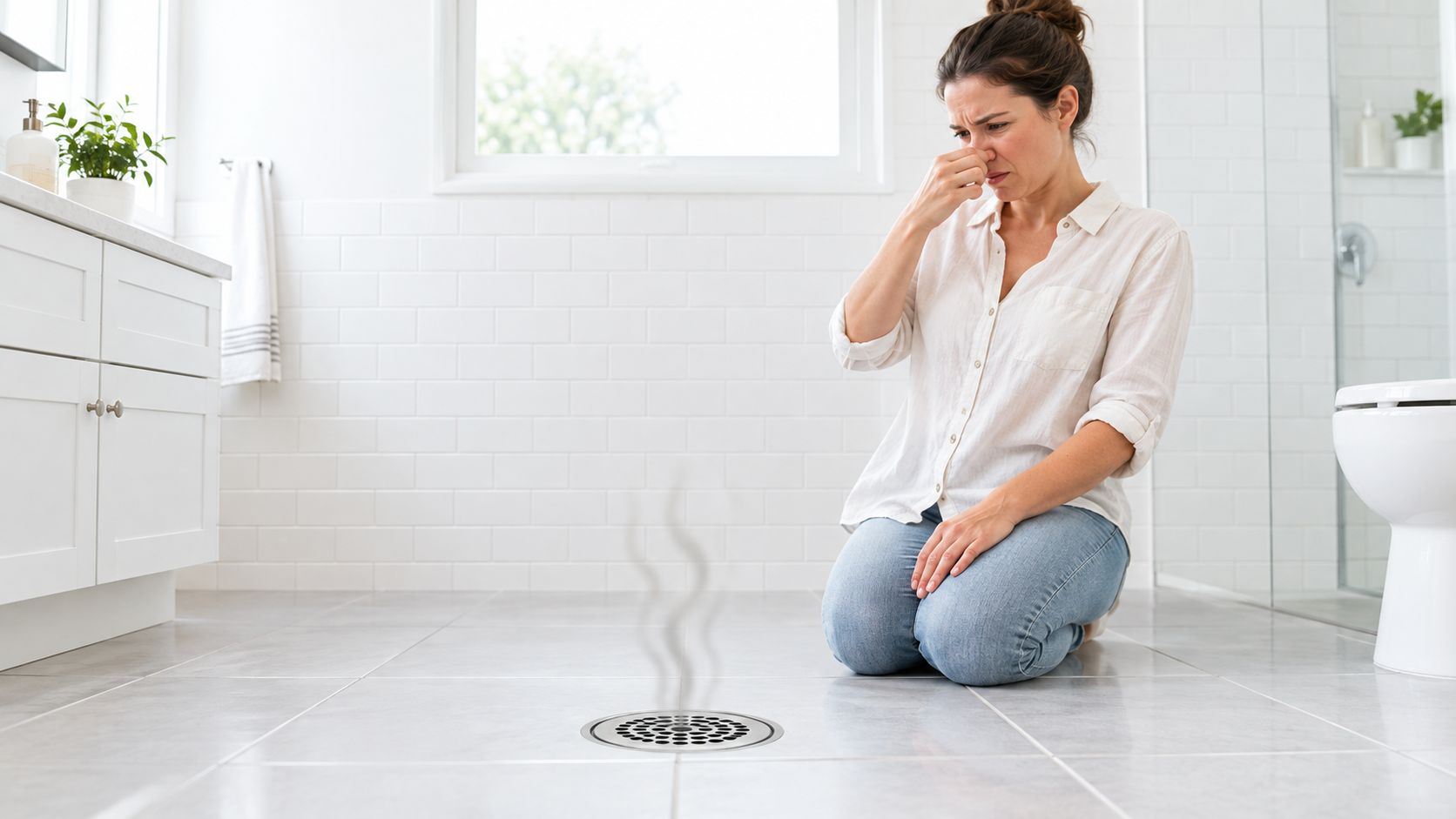
Leave first when symptoms appear
- Stop investigating: Leave if anyone develops headache, eye or throat irritation, dizziness, nausea, or breathing trouble.
- Avoid ignition sources: Sewer gas can contain methane. Don't use flames, create sparks, or operate electrical switches in a suspected concentrated atmosphere.
- Stay out of confined spaces: Never enter a manhole, sump, crawlspace, or similar enclosure to locate the source.
- Get appropriate help: Call emergency services from outside for severe symptoms or a strong, concentrated odor. Arrange professional assessment for persistent sewer smells.
- Consider natural gas: If the odor could be a fuel-gas leak, leave and contact your gas utility from a safe location.
A professional uses calibrated atmospheric testing and, when appropriate, controlled plumbing smoke testing. Flames, homemade smoke devices, and improvised pressure tests aren't safe diagnostic tools.
How to Refill Dry Traps and Check the Result
A trap must retain water to work. IAPMO explains that its water seal generally forms a barrier approximately 2 to 4 inches deep, keeping sewer gas out of occupied rooms.
You don't establish that depth by measuring water poured into the drain. The trap's shape determines the retained level; extra water should flow onward.
This visual summarizes the basic refill check.
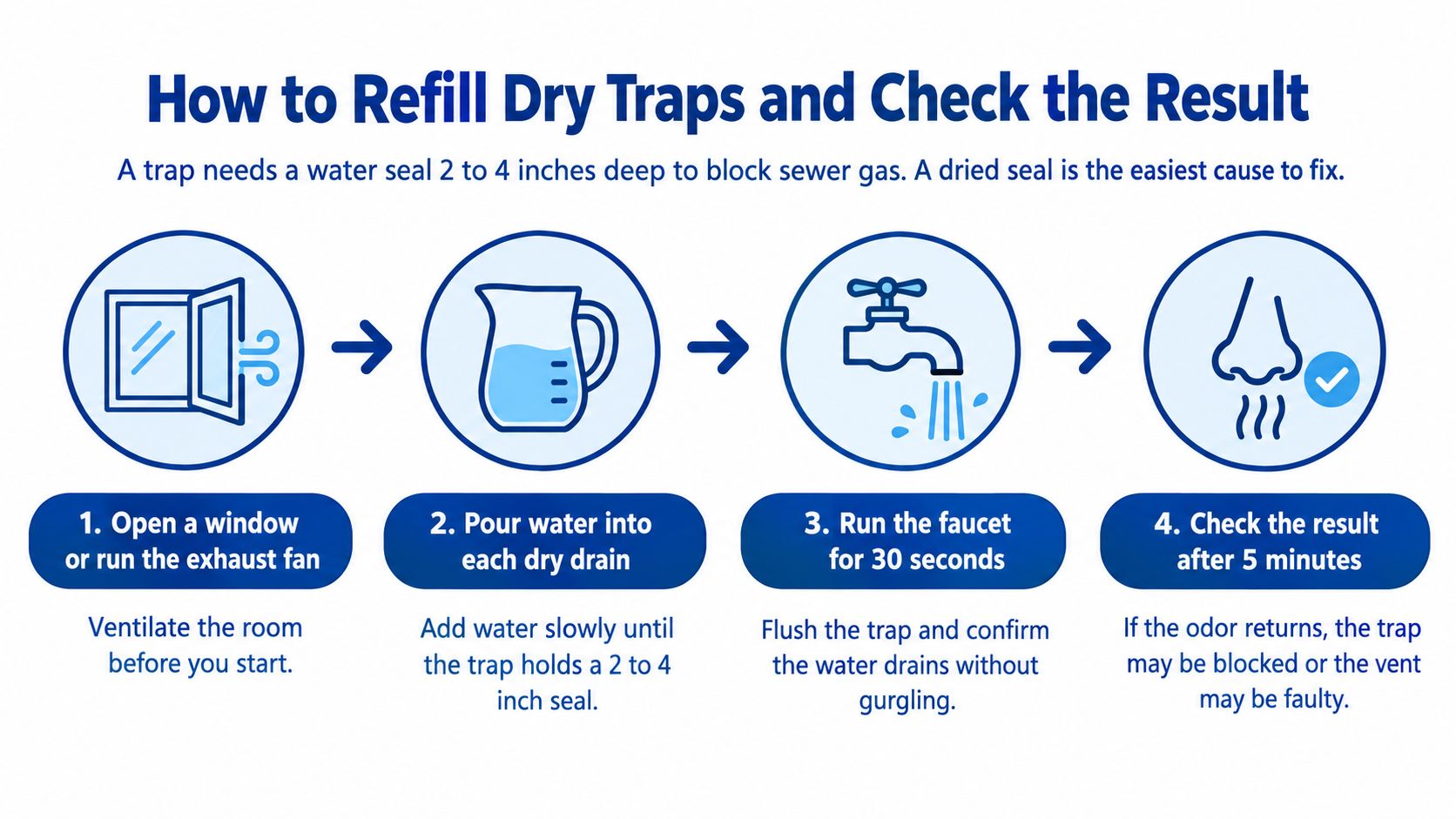
Follow a controlled refill test
Ventilate only if it's safe. For a mild odor without symptoms or suspected fuel gas, open a window. A bathroom fan can help once there's no concern about a concentrated gas atmosphere; keep children and pets away while checking.
Make a list of little-used drains. Include utility sinks, guest showers, laundry standpipes, and basement or garage floor drains. Check accessible openings without dismantling pipes.
Add water slowly. Pour about a gallon into each suspected basement or garage floor drain, stopping if it backs up. Run each unused sink or shower for about 30 seconds; these are practical refill amounts, not measurements of trap depth.
Let the room air clear, then check whether the fixture area still smells after a few minutes. The EPA-hosted sewer-gas response guidance recommends rechecking after 24–48 hours, which helps distinguish temporary improvement from a lasting result.
Address recurring evaporation carefully. A small amount of mineral oil floating on water can slow evaporation in an infrequently used floor drain. It won't repair a leaking trap, correct pressure problems, or make a blocked drain usable.
Skip drain cleaner, bleach, and fragrance for this test. They don't restore a failed seal, and mixing chemicals can create hazardous reactions.
Decide whether the test worked
A successful result means the fixture no longer smells after ventilation and the odor stays away during the recheck. Where the trap water is visible, it should remain present between uses.
Record which fixture improved and whether flushing a toilet or draining the washing machine brought the smell back. That information is more useful to a plumber than a list of deodorizing products you've tried.
Don't permanently cap a floor drain to stop an odor. It may still be needed to carry away water during a leak or equipment failure.
For a visual walkthrough, watch the refill demonstration.
Why the Smell Comes Back After Refilling
Refilling replaces missing water, but it doesn't explain why the water disappeared. Start with evaporation, then consider how the rest of the drainage system affects the seal.
How a working seal gets disrupted
- Evaporation: An unused drain gradually loses its standing water.
- Siphonage: Discharging wastewater can pull water from a nearby trap when the system can't admit enough air.
- Backpressure: A restricted drain can force air toward a fixture and disturb its seal.
- Defective venting: A blocked, damaged, or poorly configured vent can leave the system unable to balance pressure.
IAPMO explains that plumbing vents protect traps against siphonage and backpressure while maintaining air circulation. That's why an odor may appear when toilets flush, washing machines discharge, or several fixtures operate together.
Even a full trap can't stop gas escaping through a cracked drain connection, loose cleanout plug, failed toilet seal, or an opening around damaged underground plumbing. Foundation cracks near those defects may provide another route indoors.
Cleaning a drain's visible surface can improve cleanliness without correcting any of those problems.
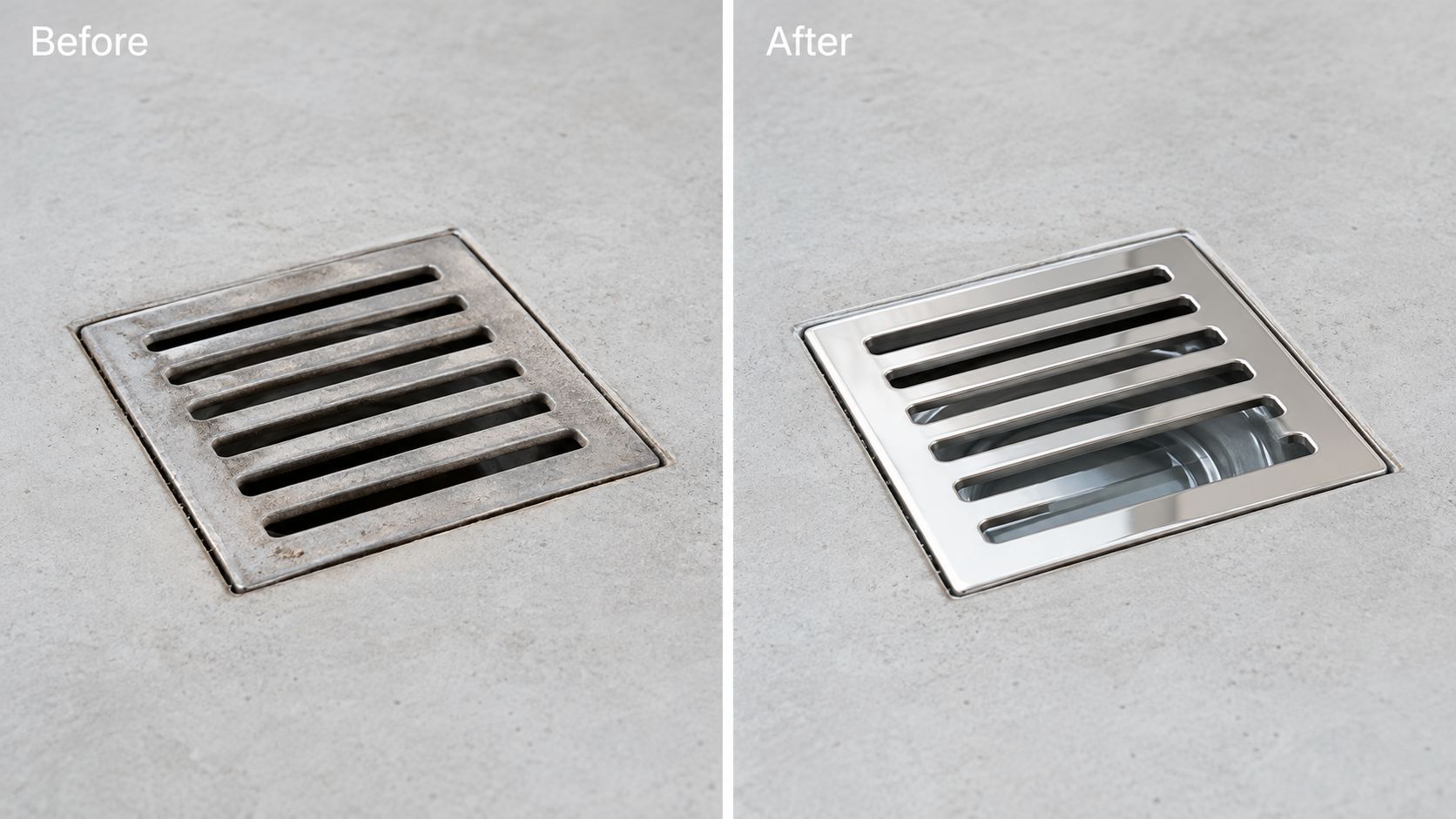
In a Michigan winter, snow or ice obstructing a roof vent can change drainage behavior during a cold snap. For example, a vent opening obstructed in January may contribute to gurgling that disappears during a thaw. Don't climb an icy roof to check.
A smell returning promptly after refilling warrants diagnosis. It suggests a seal or entry-path problem, but timing alone doesn't prove which component failed.
Clearing Lingering Odor Once the Source Is Fixed
After the plumbing defect is corrected, remaining odor may come from drain residue, stale room air, or damp nearby materials. Routine cleanup is reasonable only when there hasn't been sewage contamination.
Clean the room without adding chemicals
- Exchange the air. Open a window or use an outdoor-vented bathroom fan after the area is confirmed safe. Allow fresh air through until the room clears rather than relying on a fixed timer.
- Remove accessible stoppers, strainers, and floor-drain grates. Wash them with warm water and mild dish soap, then brush reachable drain rims without pushing debris farther down.
- Dry nearby materials. Wash uncontaminated bath mats and rags, and move cardboard away from floor drains. Damp storage can retain a musty smell that resembles a continuing plumbing problem.
- Check that bathroom and laundry exhausts discharge outside. If the furnace or air handler isn't circulating air normally, have the ventilation issue assessed rather than trying to mask it.
For accessible drain surfaces, this guide to cleaning floor drains explains the maintenance side of the job.
Cleanup limit: Mild soap and fresh air are for ordinary residue, not sewage-soaked carpet, padding, or subfloor.
Activated-carbon air filtration may reduce residual room odor, but it can't stop gas entering through defective plumbing. If the smell persists for about a week after repair, ask for a recheck for hidden moisture or a missed defect. If sewage entered the room, arrange appropriate contamination cleanup rather than waiting.
Seasonal Habits That Keep Sewer Gas Out
Prevention works best when you tie it to ordinary property checks. The same habits apply to residential plumbing, rental units, and commercial plumbing in offices or small businesses across Macomb County, Oakland County, and Wayne County, Michigan.
Before vacations and during Michigan winters
- Replenish unused traps: Make a monthly habit of running guest sinks and showers and adding water to seldom-used floor drains. Before leaving for an extended trip, include those fixtures on your shutdown checklist.
- Watch winter drainage changes: Frozen pipes and obstructed vents can cause different problems, but both deserve attention when cold weather brings slow flow or unusual sounds.
- Keep access clear: Remove snow around ground-level cleanouts without opening them. Have roof-vent snow or ice problems handled by someone equipped for safe roof access.
During heavy rain and warmer weather
- Check basement protection: A failed sump or backup pump can leave standing water and damp odors. Sump pump repair addresses groundwater handling; it doesn't clear a blocked sanitary sewer.
- Treat drain backups separately: Water rising from a basement floor drain calls for drain-system assessment. Don't assume every wet basement has the same cause.
- Protect drain flow: Keep grease out of kitchen drains and put wipes in the trash, including products labeled flushable.
Older properties in Fraser, Clinton Township, and Shelby Township may have clay or cast-iron sewer lines. If that's your property, root intrusion and deterioration are reasons to consider inspection, not reasons to assume replacement is necessary.
At an annual property review, discuss whether a camera inspection makes sense based on pipe material, previous backups, or recurring symptoms. Buyers, sellers, and real estate agents in Troy and Sterling Heights can also use a drain evaluation before closing to clarify unresolved concerns.
Common homeowner questions
Will garbage disposal repair solve a sewage smell?
Only if the disposal or its drain connection is the source. Food residue, leakage, and sewer gas need different remedies.
What if only hot water smells?
That points toward a water-supply or heater issue rather than automatically toward the sewer. Ask about water heater repair before assuming water heater replacement is needed.
Should I seal a leaking joint myself?
An accessible loose fitting may be straightforward, but cracked piping, concealed moisture, and recurring leakage need proper pipe repair. Leak detection helps when the source isn't visible.
When to Stop Troubleshooting and Call a Plumber
Call when the refill test doesn't hold, several fixtures gurgle, backups recur, or odor accompanies wet yard spots. Those observations give a licensed plumber a direction without requiring you to open pipes or buy more chemicals.
IAPMO's trap guidance identifies evaporation, siphonage, backpressure, and poor venting as causes of lost seals. A professional checks the system's behavior, not just the fixture that smells.
What the inspection should establish
Sewer smell situations and what a plumber checks
| Situation | What a Plumber Checks | Why It Matters |
|---|---|---|
| Smell returns within 48 hours of refilling traps | Trap condition, vent function, and pressure balance | Helps distinguish a defect from evaporation alone |
| Several fixtures gurgle or smell after flushing | Vent path and drain pressure during fixture use | Identifies pressure problems that fixture cleaning won't resolve |
| Odor near a cleanout or wet spots in the yard | Sewer-line camera inspection, with other testing as needed | Locates visible blockage, cracks, or root intrusion before digging |
| Recurring backups or slow drains on the lowest fixture | Drain and sewer condition, with jetting if suitable | Determines how to remove grease, sand, and root debris safely |
| Smell at the base of a toilet or a soft floor | Wax ring, flange, and floor condition | Finds leakage that may cause hidden water damage and subfloor rot |
| Odor in an older home with clay or cast-iron lines | Camera inspection for roots and deterioration | Guides targeted repair or replacement decisions |
A camera inspection should inform excavation decisions whenever access and pipe conditions allow. Hydro jetting can clear suitable lines, but fragile or collapsed piping needs a different approach, and substantial roots may require cutting. Cleaning won't repair a broken pipe.
A main sewer line repair evaluation helps separate maintenance from structural work. That distinction matters for homeowners, multi-unit property managers, restaurants with grease traps, and buyers evaluating older properties.
If you're searching for a “plumber near me,” describe the smell's location, refill result, and any drainage changes. An emergency plumber is appropriate for active backups or urgent failures; ordinary bathroom plumbing or kitchen plumbing odors can often start with a scheduled diagnostic visit.
Jays Plumbing and Sewer offers drain cleaning, camera inspections, sewer repair, and odor-source diagnosis for properties in Fraser, Sterling Heights, Clinton Township, Troy, Macomb, and Shelby Township, MI. Call Jay's Plumbing and sewer 586-634-3450 to discuss recurring odors, slow drains, estimates, or emergency service, or visit Jays Plumbing and Sewer to schedule an evaluation.
