
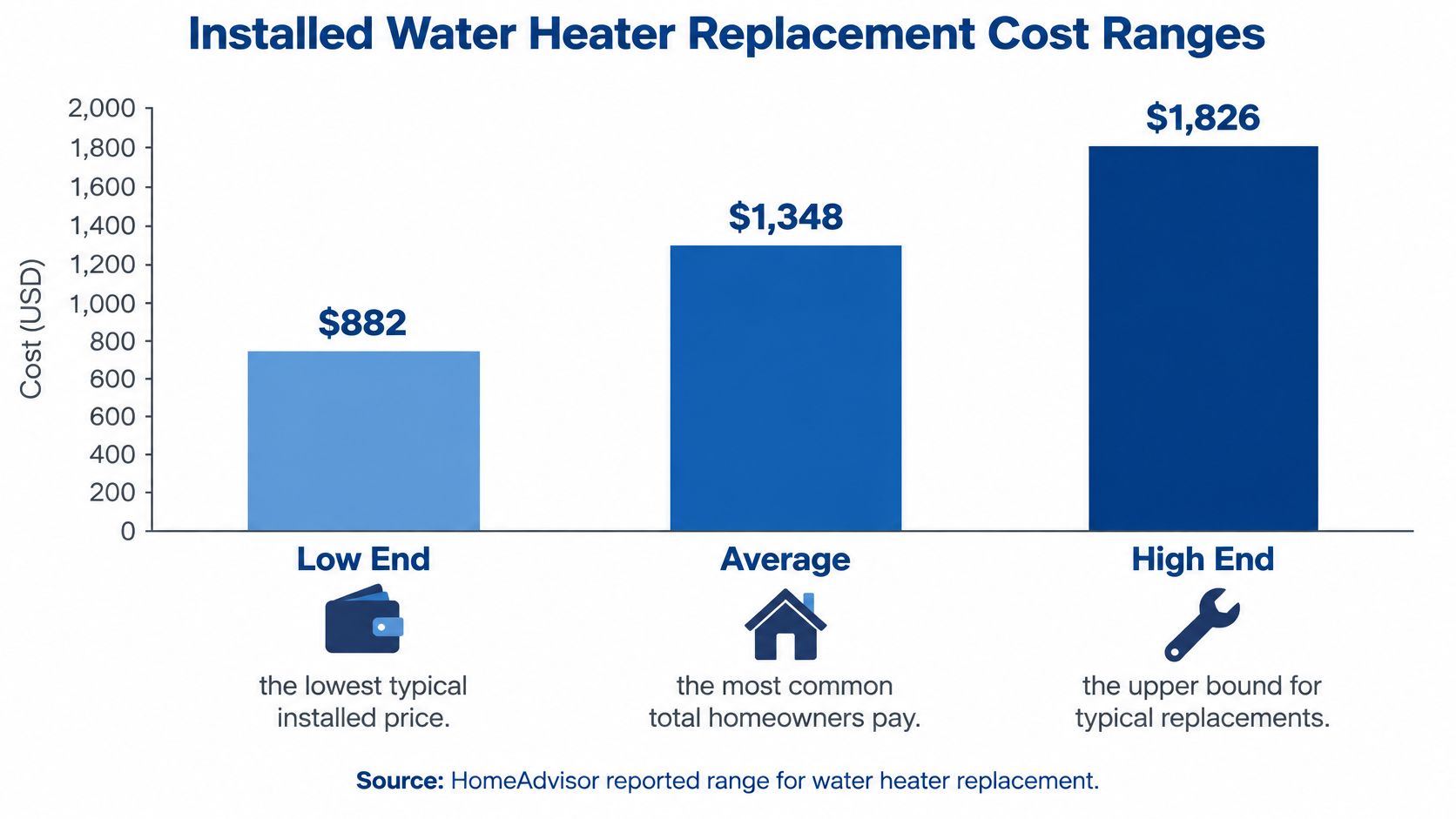
Most homeowners pay between $882 and $1,826 for a water heater replacement, and the average job lands near $1,348. A standard storage tank usually installs for $750 to $1,400, while tankless and heat pump systems cost more.
That spread is the useful part of asking how much does water heater installation cost, not a single national sticker. The tank is one line. Labor, hauling the old unit, valves, venting, and electrical or gas changes are the lines that move a real invoice. In Fraser, Sterling Heights, Clinton Township, Troy, Macomb, and Shelby Township, basements, older vents, and Michigan winters decide which of those lines show up. A written estimate you can read item by item beats any advertised average.
Table of Contents
- Installed Price Ranges for Each Water Heater Type
- Upfront Price, Running Cost and Rebates Compared
- Site Conditions That Push a Quote Above the Range
- Labor, Permits and Local Costs in Macomb and Oakland County
- Reading Two Sample Quotes Side by Side
- Frequently Asked Questions About Water Heater Costs
- Get a Written Estimate Before You Commit
Installed Price Ranges for Each Water Heater Type
A like-for-like replacement usually costs less than a job that changes fuel, venting, or location. HomeAdvisor reports that most homeowners pay $882 to $1,826, with an average of $1,348. Its plumbing cost guide puts standard storage heaters at about $750 to $1,400 installed and tankless systems at about $1,400 to $3,900. Use those ranges to check the equipment and scope lines in a quote, not as a fixed price for every home.
| Water Heater Type | Typical Installed Range | What the Range Usually Covers |
|---|---|---|
| Standard storage tank, electric | $750 to $1,400 | Like-for-like replacement with the same fuel and venting |
| Standard storage tank, gas | $700 to $2,700 | Gas connection, vent check and standard hookup |
| High-efficiency storage tank | $1,500 to $3,000 | Efficiency-rated model in the same location |
| Tankless, gas or electric | $1,400 to $3,900 | May include venting, gas or electrical upgrades |
| Heat pump water heater | $1,200 to $1,800 benchmark | Condensate drain, space and electrical checks |
The heat pump figure is an installed-cost benchmark from ENERGY STAR guidance, not a guaranteed quote. Site work can change the final amount. For a 50-gallon electric unit, the tank alone can cost as little as $500; Consumer Reports cites a Home Depot estimate of about $1,950 for average total installation. Those figures describe different scopes. A completed job may also include labor, removal and disposal, permits, shutoff valves, an expansion tank, venting, drain connections, code upgrades, and electrical or gas work.
Check what each estimate includes. A conversion from a standard tank to a heat pump or tankless system can require condensate drainage, added electrical capacity, gas-line changes, or a new vent. The same equipment range can therefore produce different totals depending on the work at the house. HomeAdvisor's published type ranges put gas systems at $700 to $2,700 and high-efficiency storage models at $1,500 to $3,000. Compare the listed scope with those national references, including whether the job keeps the same fuel and vent.
For a tankless conversion, review this tankless installation cost breakdown alongside the table. A range is most useful when the quote identifies the unit, connection changes, and included installation work.
Upfront Price, Running Cost and Rebates Compared
A higher-efficiency water heater costs more upfront than a standard unit, but lower energy use may offset part of that premium over time. For a heat pump model, the estimate depends on more than the appliance: compare its installed total with the expected energy savings, and check whether the quoted work includes any required site changes.
ENERGY STAR states that certified heat pump water heaters can be up to four times more efficient than conventional water heaters and can save a family of four about $550 a year, or more than $5,600 over the product's lifetime. Those figures describe potential operating savings, not the day-one invoice.
Efficiency ratings help explain the difference. Consumer Reports, cited in the ENERGY STAR factsheet, describes ENERGY STAR heat pump models with a uniform energy factor of roughly 3.3 to 4.1, compared with about 0.63 to 0.95 for many traditional storage heaters. The factsheet also estimates a 70% reduction in energy use versus a standard electric unit. A heat pump transfers heat from the surrounding air into the tank rather than producing all the heat with electric elements. ENERGY STAR's program guidance gives an installed-cost benchmark of about $1,200 to $1,800. Site work can push a current estimate higher, so check whether that benchmark matches the scope on your quote.
Compare the complete cost, not just the equipment subtotal. A low purchase price can be offset by higher energy use, while the savings from a more efficient model depend on the building's hot-water use and local energy rates.
For homes and commercial properties in Wayne, Macomb, and Oakland counties, compare these five items:
- Upfront price. Check the installed total and identify which site-work items are included.
- Expected annual energy cost. Compare local electric or gas rates and the building's hot-water use.
- Incentives. Record each credit or utility rebate and its conditions.
- Service requirements. Check filters, anode rods, descaling, and parts availability.
- Useful life. Consider how long you expect to own the property.
Incentives and the conditions attached
Federal and utility incentives change over time. Before counting a credit toward the project budget, confirm current eligibility with a tax professional and the local electric or gas utility. Ask whether a rebate applies to the exact model in the estimate, and have the conditions written down. If financing is offered, compare total cost, interest rate, fees, and payment length. A low monthly payment may cost more overall than paying the equipment premium upfront.
Sizing and where the unit sits
Capacity affects performance and the equipment choice. An undersized tank recovers slowly and relies more on backup heat. A heat pump tank that is too large can also add upfront cost without matching the household's needs. Heat pump models need enough surrounding air and a condensate drain. In a tight mechanical closet, they can slightly increase winter heating demand while helping with summer cooling or dehumidification. Use a water heater sizing guide to match capacity to household demand before choosing a model based on its efficiency rating alone.
Practical rule: Get every discount listed on the estimate, and keep optional upgrades separate from required code work.
Site Conditions That Push a Quote Above the Range
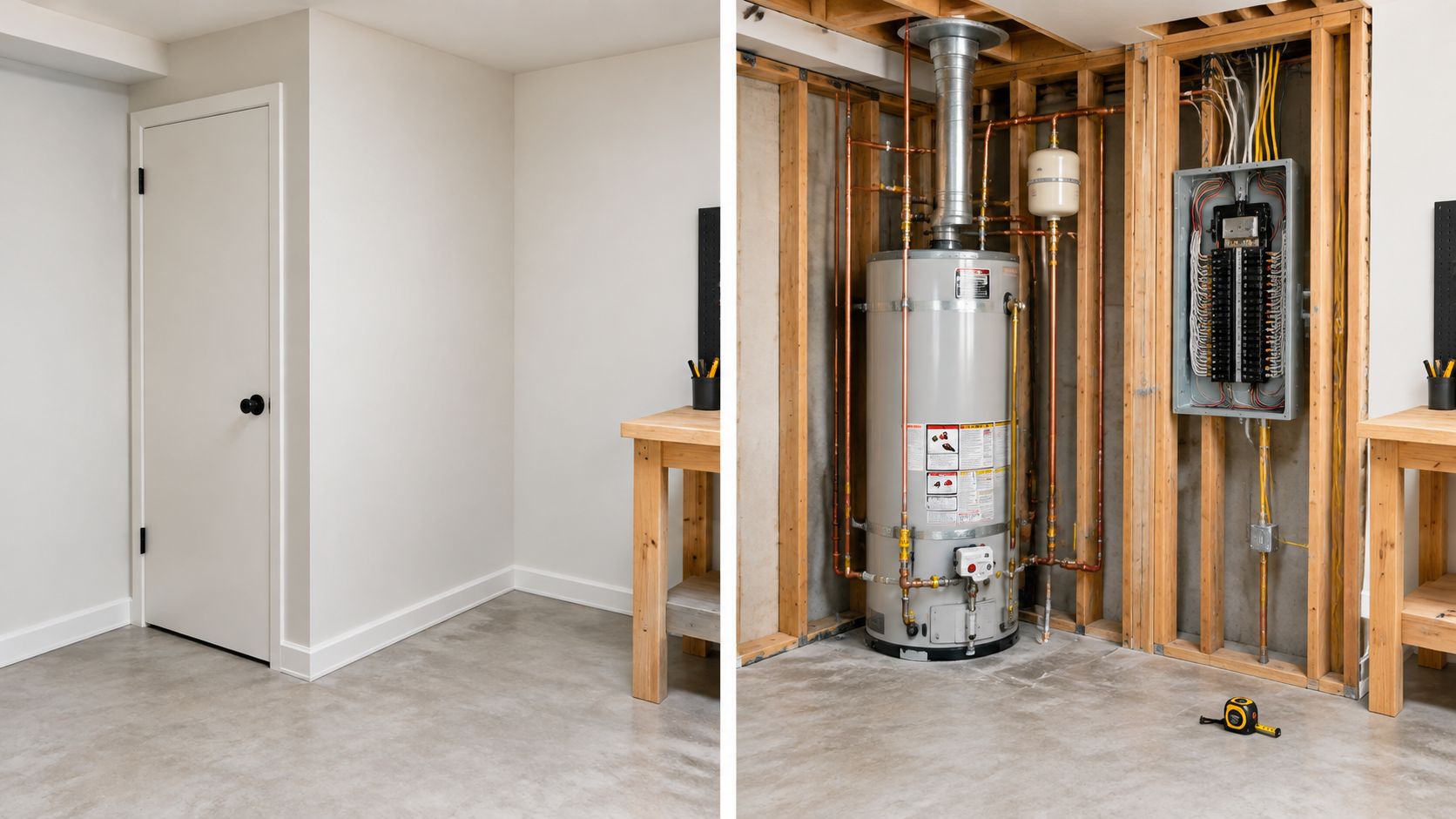
The tank is often the smaller part of the invoice once the closet or basement is opened. That is why two quotes for the same gallon size can sit far apart. Consumer-facing guides commonly report broad totals of roughly $1,600 to $5,800, with tank systems generally cheaper than tankless and heat pump models, according to ConsumerAffairs. Those guides rarely spell out which site conditions create the add-ons.
| Add-On | When It Shows Up | Why It Changes the Price |
|---|---|---|
| Venting changes | Tankless replaces a tank, or the old vent is undersized | New vent run and exhaust safety work |
| Gas line changes | Larger input or a relocated unit | Pipe sizing and gas code work |
| Electrical upgrade | Electric tankless or heat pump needs more capacity | New or dedicated circuit |
| Expansion tank | Closed water system with a check valve or pressure regulator | Protects fittings from pressure rise |
| Drain pan and discharge piping | Unit in a finished basement or upper floor | Protects the floor and routes hot water safely |
| Condensate drain | Heat pump water heater | Removes moisture produced during operation |
| Difficult access | Tight closet, narrow stairs or through-garage route | More labor hours and careful handling |
| Old unit removal and disposal | Every replacement | Hauling and recycling of the old tank |
A drain pan catches a slow leak before it ruins finished flooring. Discharge piping sends very hot water from the temperature-and-pressure valve to a safe spot, not across a hallway. An expansion tank gives heated water room to grow so fittings and the tank itself aren't taking that pressure every day.
A tankless unit replacing a tank usually cannot reuse the old atmospheric vent. A larger gas input may need a bigger line or a new route. An electric tankless heater or a heat pump may need a dedicated circuit. A heat pump also makes condensate, so it needs a drain that reaches a proper outlet. Tight closets, narrow stairs, and a path through the garage add hours because the old tank still has to come out in one piece and the new one has to go in without wrecking finishes. Removal and disposal is its own line on every replacement, not a favor folded into "install."
A same-for-same swap in an open utility room stays close to the published band. A conversion, or a move to a new wall, does not. Older homes in Macomb and Oakland County often have aging vents and basements that hold moisture, so more of these rows show up. Before anyone gives a final number, a licensed plumber should confirm fuel type, capacity, vent configuration, electrical capacity, location, pan and discharge needs, and whether the heater failed overnight.
The better question is not "What is the average price?" It is "What on my house will put this quote above the advertised range?"
Labor, Permits and Local Costs in Macomb and Oakland County
Labor follows the number of changes, not the gallon sticker. Trade estimates commonly put labor at $150 to $450 for a tank-style replacement and $600 to $1,900 for a tankless installation. A clear basement swap sits at the low end. New venting, a gas-line change, or a tight carry sits at the high end.
| Line Item | Typical Range or Rule | Who Usually Handles It |
|---|---|---|
| Labor, tank-style replacement | $150 to $450 | Licensed plumber |
| Labor, tankless installation | $600 to $1,900 | Licensed plumber |
| Plumbing permit | Set by the local enforcing agency | Contractor in Michigan |
| Inspection | Set by the enforcing agency and the scope | Scheduled after the work |
| Old unit removal and disposal | Usually its own line item | Contractor |
| After-hours or emergency call | Set by the company | Confirm in writing before booking |
Permits before the work starts
Michigan requires a plumbing permit before covered plumbing work begins. The Michigan Department of Licensing and Regulatory Affairs states that plumbing work shall not be started until a permit has been issued by the appropriate enforcing agency. The office is not the same in every city. Ask which authority covers Fraser, Sterling Heights, Clinton Township, Troy, Macomb Township, or Shelby Township, and whether the inspection fee is inside the quote. Permit and inspection needs grow when the job changes fuel type, venting, electrical service, gas piping, or the equipment location. Homeowners, landlords, real estate agents, and commercial property owners in Macomb, Oakland, and Wayne County should see permit fees and related code work named, not implied.
Winter, emergencies, and wet basements
A planned replacement on a mild day usually costs less than an emergency plumber call after a tank lets go and floods a basement. After-hours pricing should be stated before anyone turns a wrench. January work can mean frozen-pipe precautions and a heated work area so new piping isn't sitting in a cold chase. Heavy spring rain makes a drain pan and a proper discharge route more important, because a damp basement has less forgiveness if the new tank weeps. You can't control the weather. You can choose a scheduled water heater replacement before the tank picks the weekend for you.
Reading Two Sample Quotes Side by Side
These two quotes are illustrations, not invoices from a real kitchen table. They show how scope, not a sales pitch, sets the number.
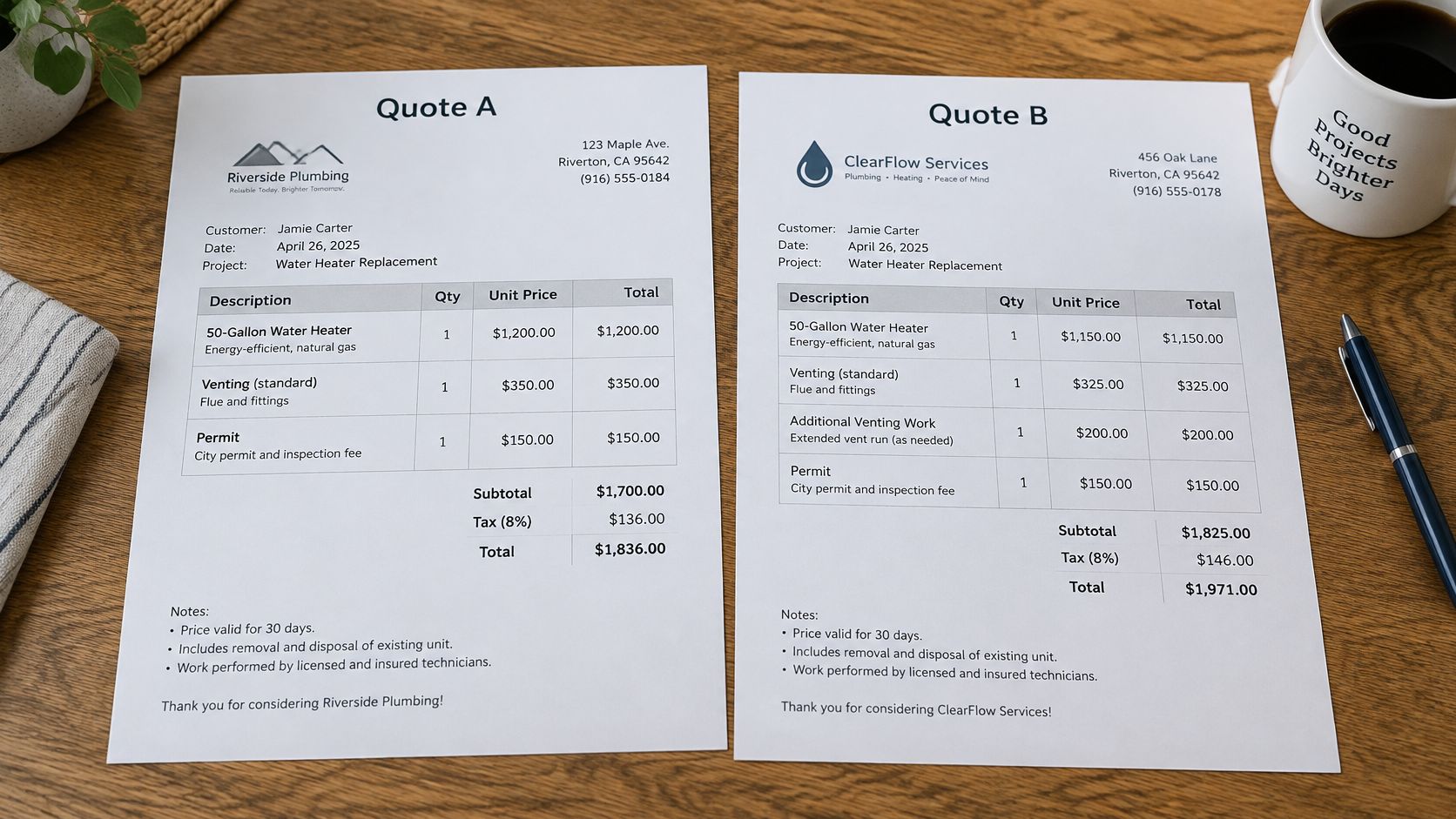
Clinton Township, same tank. A homeowner replaces a 50-gallon gas tank in an open basement. Fuel stays gas. The vent stays. The path to the unit is clear. The quote lists the equipment, labor, permit, inspection, old-unit removal, and a standard hookup. That package belongs in the typical standard-tank range because almost nothing about the house has to change. The lesson is simple. A clean same-for-same scope should look like a short list, and a short list should not carry conversion prices.
Sterling Heights, tank to tankless. Another homeowner wants endless hot water and is ready to leave the tank behind. The quote adds a new vent run, a larger gas line, an electrical connection for the controls, and a shift to a new spot on the wall. The total moves toward the top of the tankless range. That is not automatically a bad deal. Standby losses drop, and the household may stop running out of hot water on busy mornings. It is a bad deal only if those changes are buried in one lump sum.
A short video on what a replacement visit looks like helps when you're comparing those two kinds of scope.
What to check on any pair of quotes
- Same capacity and fuel. A 40-gallon electric quote is not a match for a 50-gallon gas quote.
- Same warranty terms. Years on the tank and years on parts should both be written.
- Same permit and inspection language. If one bid is silent, ask before you treat it as cheaper.
- Optional upgrades kept separate. A pan, expansion tank, or new shutoff that code requires is not the same as a nicer drip tray you could skip.
I would not sign either quote until a licensed plumber has stood in the room and confirmed the scope. A real estimate still depends on that house.
Frequently Asked Questions About Water Heater Costs
Should I repair or replace an aging water heater?
A repair can make sense when one minor part fails on a younger unit. When the tank is near the end of its service life, it leaks, or it needs a fix every few months, a planned replacement usually costs less over time than repeated emergency calls. The age is on the manufacturer's label. Our water heater repair page covers the warning signs worth checking first.
Why do two quotes for the same tank differ so much?
The model, the vent, the gas or electrical work, and the access are rarely identical even when the gallon size matches. Ask each plumber to list those items line by line. The gap is usually scope, not a mystery fee.
Can I install the water heater myself?
Gas, venting, electrical connections, and discharge piping are safety-critical. In Michigan the contractor performing the work is generally the party who pulls the permit. I would hire a licensed plumber rather than treat this as a weekend project.
Does a low quote mean a good deal?
Not by itself. A low number may leave out the permit, removal, required code work, or a different model than the one you were shown. Read every line before you compare totals.
Is a heat pump practical in a cold basement?
A heat pump pulls heat from the air around it, so a cool, unheated space can slow recovery. A plumber should check air volume and location before recommending one for a Michigan basement.
Get a Written Estimate Before You Commit
The equipment label and the installation scope are where a useful comparison starts. Water heaters must meet federal energy-conservation standards, as explained by the U.S. Department of Energy. Still, two compliant models can call for different installation work. Fuel, capacity, efficiency, venting, electrical needs, and location all affect the final price. High-efficiency installations generally cost more than standard tank replacements, so compare the installed total and expected running costs, not just the equipment price.
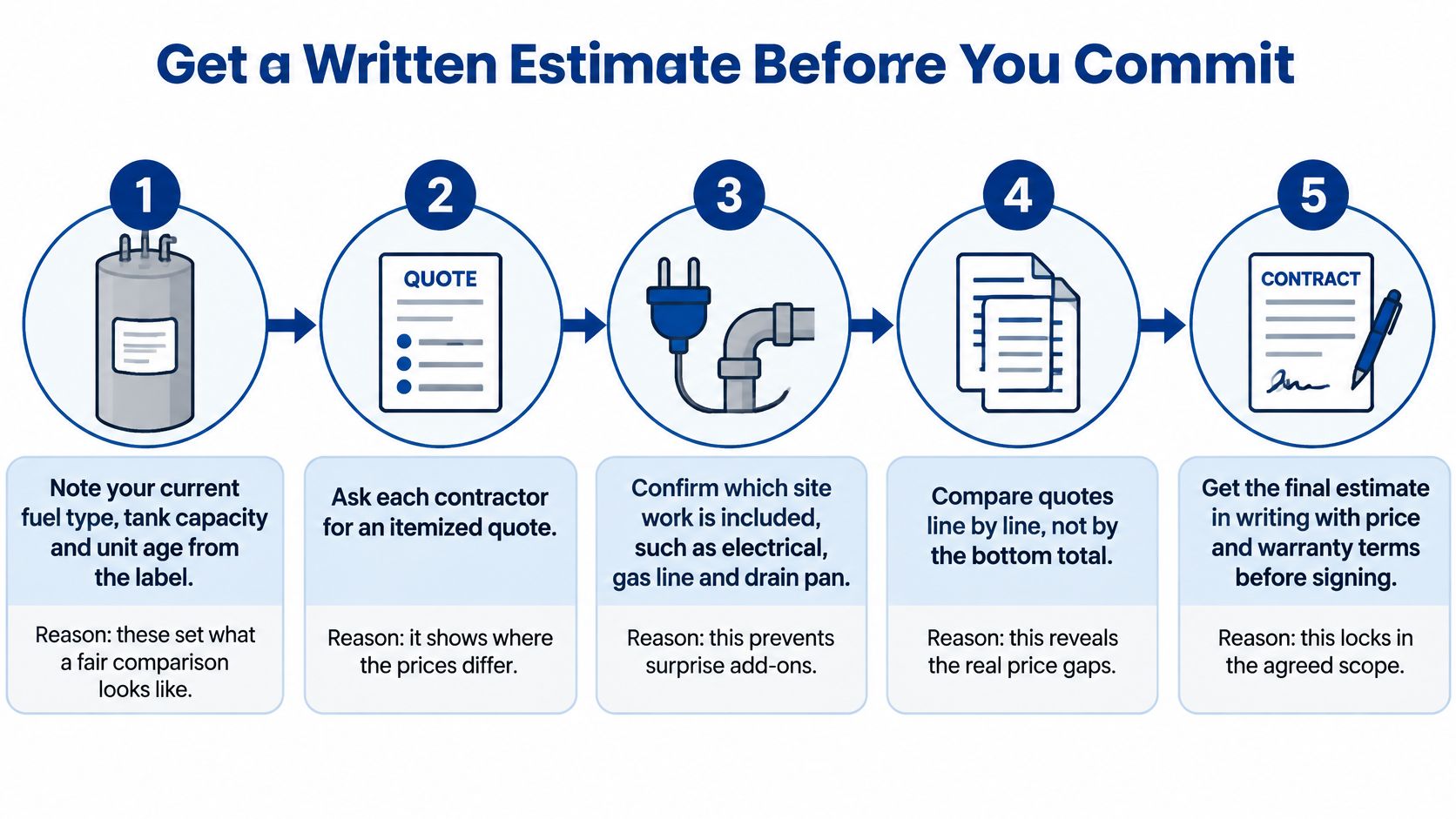
- Record the fuel, capacity, and age shown on the heater label. These details help a plumber quote a comparable replacement.
- Photograph the vent, gas connection, electrical panel, and installation area. Those site details can affect labor and required changes.
- Describe the problem clearly. No hot water, an active leak, or a planned upgrade can change the timing and scope of the visit.
- Request a line-item estimate. It should identify the model and capacity, labor, permit and inspection, removal and disposal, required code work, warranty, and any after-hours charge.
- Check that each bid names the same fuel, capacity, and model. A different heater can mean a different equipment cost and operating performance.
- Compare the expected lifetime cost, including energy use, available incentives, and service needs, alongside the installation total.
- Ask which proposed upgrades are optional and which are required for safe, code-compliant operation.
For service in Macomb or Oakland County, call Jay's Plumbing and Sewer at 586-634-3450 to request a written, job-based estimate. The team serves Fraser, Sterling Heights, Clinton Township, Troy, Macomb, and Shelby Township, with water heater repair, replacement, and installation for residential and commercial customers. If other work is needed, ask for drain cleaning, sewer or pipe repair, leak detection, garbage disposal repair, sump pump repair, or bathroom and kitchen plumbing to appear on separate estimate lines. That keeps the water heater scope and its cost clear.
Jays Plumbing and Sewer installs and replaces electric, gas, and tankless water heaters across Macomb, Oakland, and Wayne County, with job-based pricing before work starts. A line-item estimate can show which costs apply when a tank leaks, runs short of hot water, or is due for replacement. Visit Jays Plumbing and Sewer or call 586-634-3450 to schedule water heater service.
