
You're standing beside the basement water heater with a hose, listening to the same rumble you heard during the last shower. The drain valve looks stiff, the floor drain hasn't handled much water lately, and you're wondering whether flushing will help or leave you with a leak.
Learning how to flush sediment from a water heater starts before you open that valve. For an older Southeast Michigan tank, the first job is deciding whether it's safe to drain at all.
Table of Contents
- When to Stop Before You Cause a Leak
- How to Flush the Tank Step by Step
- How Often to Flush and What Sediment Looks Like
- If the Water Clears but Problems Stay
- Michigan Habits That Keep Sediment Down
- Call Jay's Before the Tank Fails
When to Stop Before You Cause a Leak
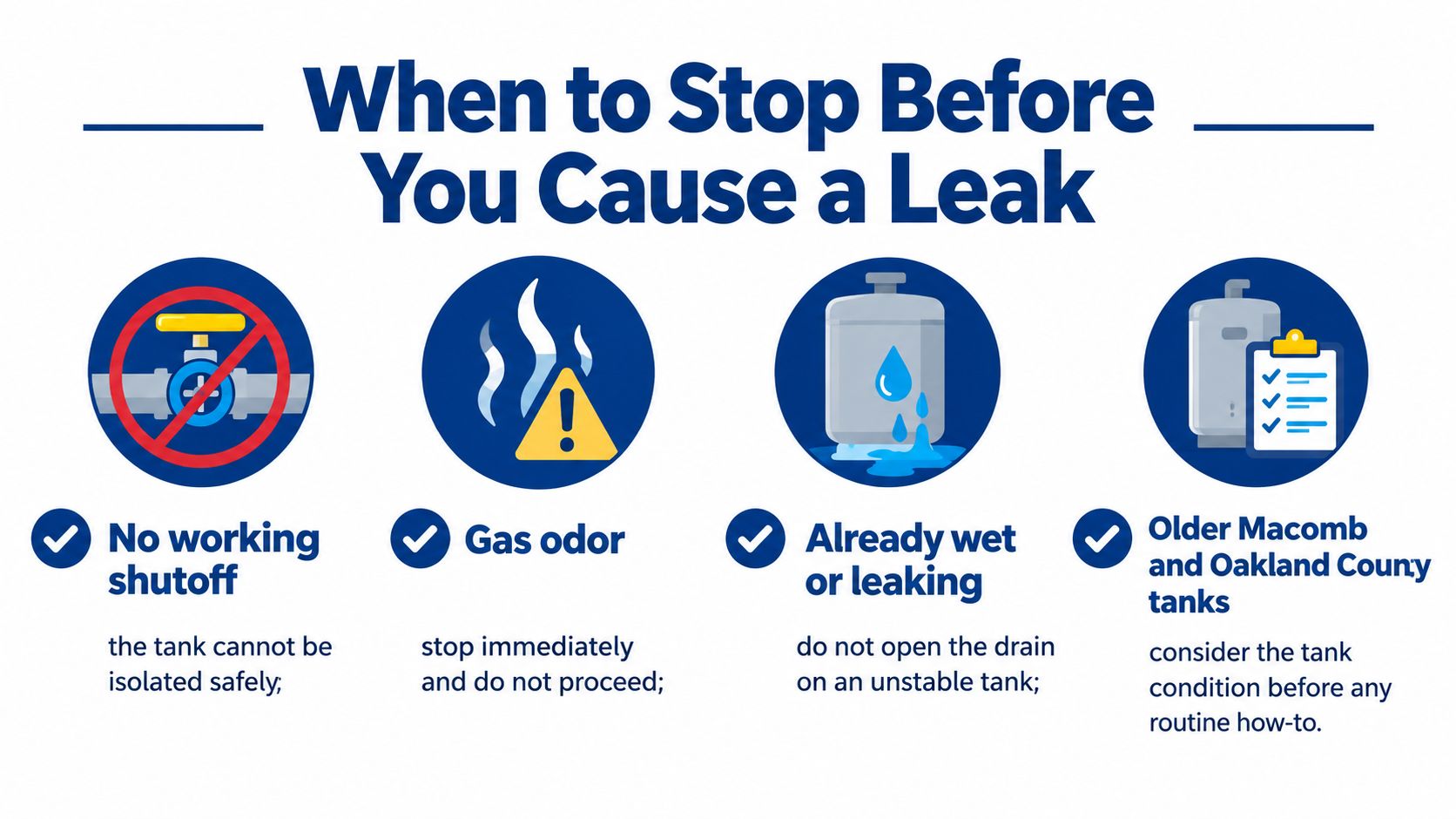
A seized or dripping drain valve is the risk homeowners often skip. Don't put extra pliers on a stuck handle. You can break the valve or disturb a connection that won't seal again.
Older Macomb and Oakland County basements need a condition check, not just a hose connection. Look around the base, drain connection, tank seams, and relief-valve discharge pipe before moving anything.
Make the stop-or-go decision first
The New Jersey Department of Health water-heater guidance warns about scalding discharge and drain valves that may not reseal after sediment gets into them. Wear safety goggles and heavy gloves, and keep children and pets outside the work area.
Stop or go before you open the drain
| What you find | Decision | What to do |
|---|---|---|
| No working shutoff | Stop | Do not open the drain |
| Gas odor | Stop | Leave power and gas off and call from outside; don't operate switches or controls |
| Tank already wet or actively leaking | Stop | Shut the cold inlet if you can safely, shut off energy, and call |
| Nowhere safe for hot water | Stop | Wait until a suitable floor drain or safe outdoor route is available |
| Seized drain handle | Stop | Do not add pliers or force the valve |
| Valve still drips after a few open-close cycles | Repair | Stop the flush and repair the valve |
| No flow, so the tank may not be empty | Stop | Do not restore electric power |
| Rust flakes plus a corroded shell | Stop | Draining may reveal a leak the sediment was hiding |
| Seam, drain, or relief valve weeps | Stop | Do not keep flushing |
If you smell gas, leave the building. Don't touch the breaker, gas control, lights, or phone indoors. Contact the gas utility or emergency services from a safe location outside.
Understand what draining can uncover
Loose grit can lodge in the drain-valve seat. Gentle opening and closing may clear it, but continued dripping means the valve needs attention, not harder tightening.
Rust flakes alongside a corroded shell deserve more caution. Sediment may be covering an already weakened area, and draining can expose a leak that maintenance didn't create.
A blocked drain doesn't prove the tank is empty. Treat it as a blockage, not permission to restart the heater.
If the heater is dry, the controls work, the drain handle moves normally, and you have a safe discharge route, a homeowner flush may be reasonable. If any stop condition applies, have a licensed plumber inspect it before proceeding.
How to Flush the Tank Step by Step
This procedure is for a conventional storage-tank water heater, not a tankless unit. Read the heater's operating label first, especially the shutdown and restart instructions.
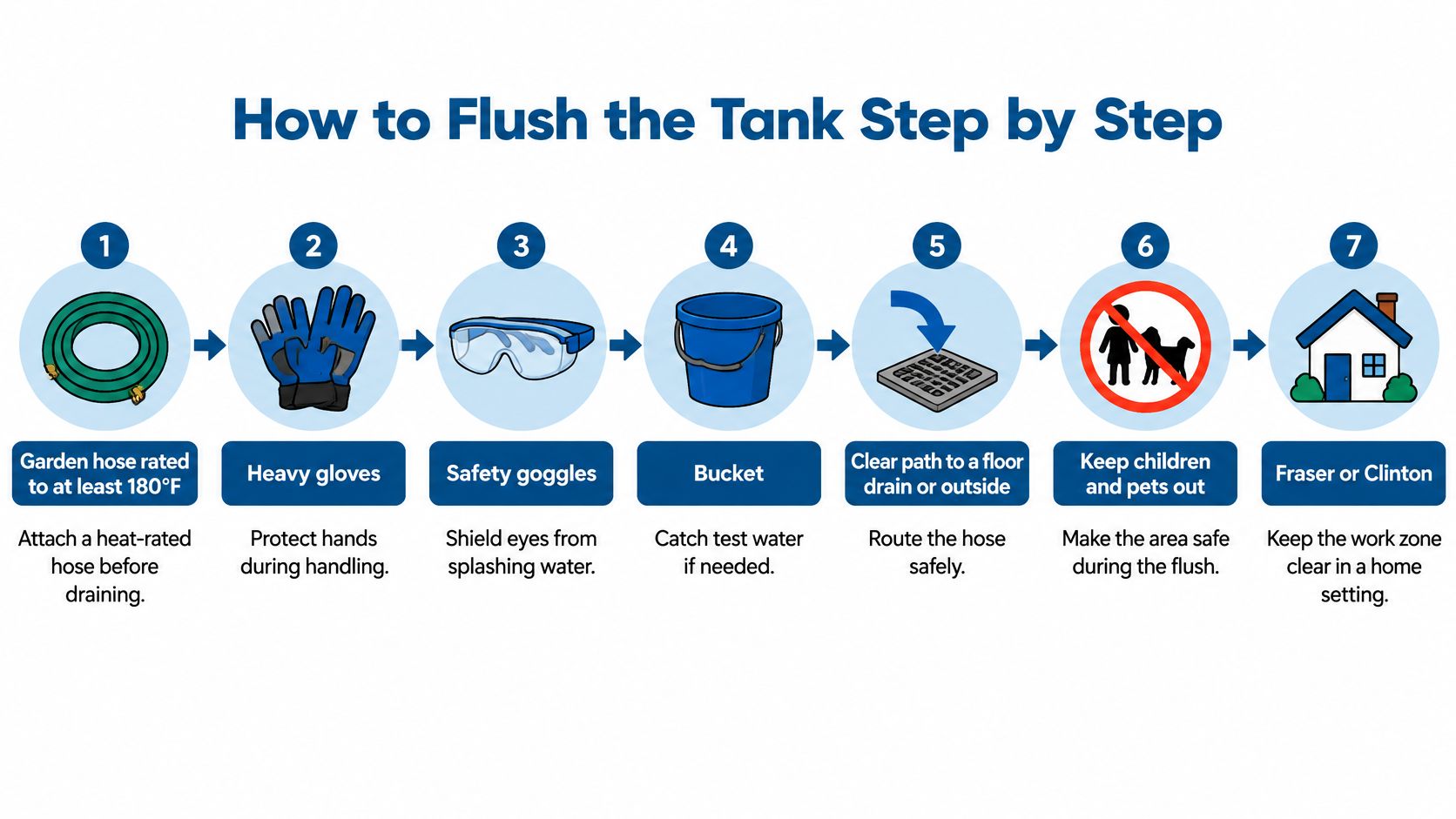
Gather your equipment before shutting anything down. The Department of Energy water-heater maintenance material describes a controlled drain-and-flush sequence using a hose rated for at least 180°F.
- Heat-rated garden hose: Check the printed temperature rating rather than assuming any outdoor hose will work.
- Heavy gloves and safety goggles: Protect against splashes and hot fittings.
- Bucket: Catch cooled test water and small connection drips.
- Clear discharge path: Use a suitable floor drain or outdoor location that won't expose people or property to hot water.
- Correct valve tool: Use the screwdriver or key the drain valve requires, without applying extra force.
Keep children and pets out of the work zone, whether you're in a Fraser utility room or a Clinton Township basement.
Drain, stir, and refill in order
Turn off the energy supply. Switch off the electric heater's breaker, or shut down the gas heater using its labeled procedure. Don't assume turning down the thermostat makes an electric tank safe to drain.
Open a nearby hot-water faucet with the cold inlet still open. Let replacement cold water cool the tank until the faucet discharge is no longer hot. Keep clear of the stream while checking it.
Close the cold-water inlet. If the shutoff won't isolate the tank, stop. You need control over incoming water before opening the bottom drain.
Thread the hose onto the drain valve. Route the discharge end downhill where practical, keep the hose free of kinks, and secure it so it can't move out of the drain. Don't discharge onto finished basement flooring.
Open the drain valve and leave a hot-water faucet open to admit air. Use the relief valve only if the manufacturer's procedure calls for it. Never plug its discharge pipe or use it as a convenient substitute for proper venting instructions.
Stir the settled sediment. When drainage slows, briefly reopen the cold inlet, then close it and let the loosened material drain. Repeat while watching for grit and discoloration. DOE operations and maintenance guidance describes staged flushing with cold-water bursts of 15–30 seconds.
Close the drain and reopen the cold inlet. Keep the hot faucet open while the tank fills and air escapes. Wait for sputtering to stop and a steady stream to flow, then check that the drain valve has sealed.
Restore energy only after the tank is completely full. Follow the heater's restart procedure. An exposed electric element can fail quickly in a partially empty tank, so uncertainty about filling is a reason to leave power off.
Don't force a blocked drain
If flow stops unexpectedly, check the hose for kinks without disconnecting it under pressure. Don't poke wire into the valve or remove it from a tank that may still contain water.
Hardened scale may require valve replacement or professional extraction. A slow, controlled job is preferable to turning a blocked valve into an uncontrolled discharge.
How Often to Flush and What Sediment Looks Like
Say your Sterling Heights tank pops when the burner fires and you're noticing chalky residue in the tub. Mineral buildup is worth checking, although neither symptom alone proves the tank needs replacement.
Sediment includes minerals, sand, and grit that settle on the tank floor and around heating surfaces. The buildup interferes with heat transfer, so recovery can slow and components can wear.
Use a schedule that matches the job
The EPA home-maintenance guidance identifies annual flushing as routine maintenance; a Michigan municipal handout describes approximately 30–75 gallons discharged during a typical tank flush. Plan the drainage route for that volume, not just a bucket.
The schedule below distinguishes preventive draining from a complete flush. DOE residential guidance recommends about a quart every three months, while its fuller-flush guidance uses approximately six-month intervals; EPA materials describe annual residential maintenance, and DOE storage-system guidance describes once- or twice-yearly service.
Sediment flush intervals by job
| Job | How often | What comes out | Do it sooner when |
|---|---|---|---|
| Light preventive drain | Every 3 months | About 1 quart | You need to limit loose silt before it accumulates |
| Full drain and flush | About every 6 months | Drain until discharge is clearer | Recovery is slowing or the tank rumbles |
| Standard home flush | Once a year | Often 30–75 gallons | Move-in, plumbing work, or discolored hot water |
| Busy storage tank | Once or twice a year | Repeated stir cycles | Rentals, small businesses, or high hot-water use |
| Hard-water check | More than yearly | Grit, flakes, or tint in the hose | Several samples stay dirty |
Follow the manufacturer's schedule rather than combining every interval into extra maintenance. Macomb, Oakland, and Wayne County properties don't all have the same water conditions or demand.
Rumbling, cloudy hot water, slow recovery, and grit in aerators call for an inspection rather than waiting for the calendar. Corrosion protection is a separate maintenance task, explained in this guide to water-heater anode replacement.
If the Water Clears but Problems Stay
Clear hose water tells you that the current discharge contains little visible debris. It doesn't prove the tank floor or heating surfaces are clean.
A National Institute of Standards and Technology study found that draining until water looks clear can be ineffective at removing large amounts of sand and sediment. Loose grit can wash out while compacted material remains around the dip tube, tank bottom, or heating surfaces.
Judge the heater, not just the bucket
Several consecutive clear samples are more useful than a single pale bucket. Even then, listen to the heater after normal operation resumes and check whether hot-water recovery improves.
Clear discharge is a useful stopping point for flushing. It isn't a certificate that hardened scale is gone.
After the flush what the symptom means
| What you see | Likely meaning | Next action |
|---|---|---|
| Several clear samples, noise gone | Loose sediment was the main issue | Return to the interval table |
| Popping returns within weeks | Scale may remain on heating surfaces | Inspect anode, burner, or elements |
| Cloudy hot water after refill | Grit may remain in tank or branch lines | Clean aerators and reassess the tank |
| Valve drips after closing | Debris or damage in the seat | Stop and repair the valve |
| No flow from the drain | Bridge of scale or a failed valve | Do not force it |
| Rust plus a wet shell | Possible tank corrosion | Shut down and schedule replacement review |
| Slow recovery on a clear flush | Failing parts or cemented scale | Repair or replacement, not more flushing |
These are diagnostic clues, not certain diagnoses. Cloudiness that clears quickly in a glass can be trapped air, while persistent particles deserve closer attention.
Separate maintenance from disinfection
Flushing does not disinfect a plumbing system or resolve a Legionella-control problem. Don't turn up the temperature dial as a substitute for a proper water-hygiene assessment.
A licensed plumber can evaluate temperature control and whether mixing or point-of-use protection is appropriate. The goal is to manage microbial concerns without creating a scalding hazard.
Persistent trouble warrants checking the heater's condition, controls, and heating components. These warning signs of a failing water heater can help you describe the problem when arranging service.
Michigan Habits That Keep Sediment Down
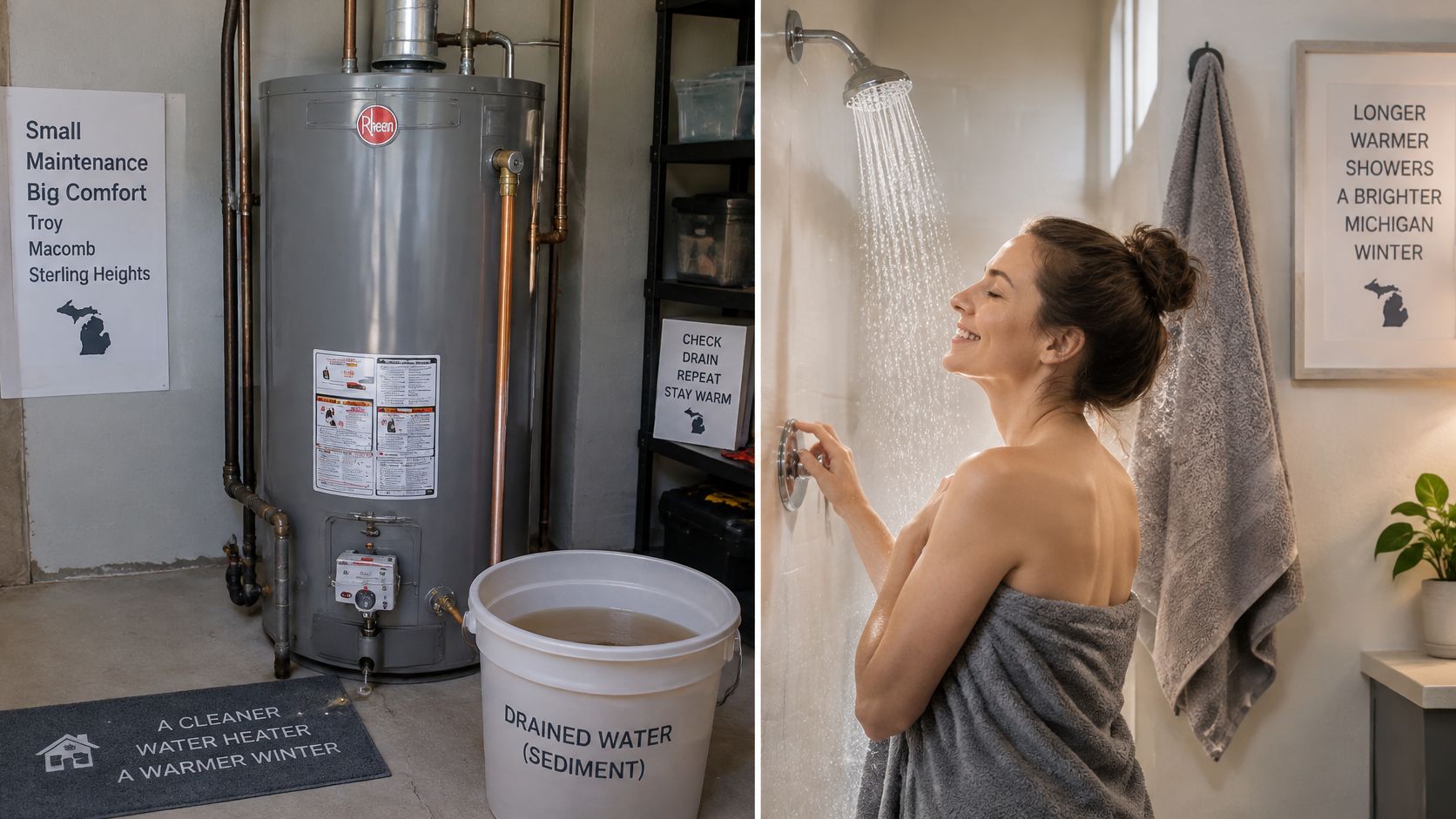
Between full flushes, pay attention to changes in performance rather than repeatedly opening the drain. During Michigan winters, colder incoming water makes the heater work harder to supply the same comfortable shower.
In Troy, Macomb, and Sterling Heights homes, that can make an existing recovery problem more noticeable. Don't assume every lukewarm shower means sediment, though. A heating element, control, or mixing problem can produce similar complaints.
Keep a useful maintenance record
- After pipe repair: Flush an appropriate cold faucet before using hot taps, then clean faucet aerators and shower screens. This helps keep loosened debris out of fixtures.
- For rentals and small businesses: Log service dates, discharge appearance, unusual noises, and whether the drain valve closed tightly.
- With hard water: Consider whether water treatment is appropriate. A softener can reduce new mineral scale, but it won't remove sand already settled in the tank.
- Before a large discharge: Check the basement floor drain. Arrange drain cleaning first if it's slow, and wait during heavy rain if the drain is backing up.
Basement rule: Don't test a questionable floor drain with a tankful of water.
Match maintenance to the equipment
Tankless heaters need the manufacturer's descaling procedure, not this bottom-drain method. Storage tanks need a schedule based on condition, water quality, and the manual.
For a fuller explanation of mineral deposits around fixtures and equipment, review hard-water buildup and plumbing maintenance. Frozen pipes, sump pump problems, and basement flooding also deserve attention before scheduling a discretionary flush.
Call Jay's Before the Tank Fails
A wet tank shell, a drain valve that will not close, or persistent particles in the hot water calls for diagnosis before another flush. If an older heater still rumbles after careful maintenance, repeated draining may not solve the problem.
A plumber can assess whether the issue is a repairable valve or heating component, or a deteriorating tank. That assessment can help homeowners, property managers, real estate agents, and buyers weigh repair against replacement.
Local help for the heater and the basement
Jay's Plumbing and Sewer, based at 17070 Masonic, STE 316, Fraser, MI 48026, provides water heater repair, maintenance, and replacement for gas, electric, and tankless equipment. The company serves residential and commercial customers across Macomb and Oakland County.
Emergency plumbing service and free estimates are available. Ask whether a slow floor drain can be checked during the visit before using it as a discharge route.
When you call, describe the symptom and the equipment. Jay's also handles leak detection, pipe and sewer repair, sump pump service, and kitchen and bathroom plumbing.
Frequently Asked Questions
Can I flush an older heater myself?
Only if the tank, shutoffs, drain valve, and discharge route appear safe to use. Age alone doesn't determine whether flushing is appropriate.
Should I agree to replacement immediately?
Ask what failed and whether repair is practical before deciding. You can ask questions before committing to replacement.
Call Jay's Plumbing and Sewer at 586-634-3450.
Jays Plumbing and Sewer offers water-heater maintenance, diagnosis, repair, and replacement when sediment flushing isn't enough. Visit Jays Plumbing and Sewer to discuss a noisy tank, a stuck drain valve, or a maintenance plan.
