
You're in bed when the toilet suddenly flushes. Nobody used the bathroom, the handle hasn't moved, and the sound disappears almost as quickly as it started. A toilet flush on its own is unsettling, but it usually points to a plumbing leak or, with sensor-equipped fixtures, a detection problem rather than anything mysterious.
For homeowners, landlords, and businesses in Macomb County and Oakland County, the important question is what's causing the cycle and how much water is being lost. A quick inspection can often identify the fault, while a plumber can address damaged valves, concealed leaks, sensor problems, or related bathroom plumbing issues before the problem grows.
Table of Contents
- What Ghost Flushing Really Means
- The Real Cost of a Phantom Flush
- How to Diagnose the Problem with a Dye Test
- Fixing the Most Common Mechanical Failures
- When It Is Not a Plumbing Problem at All
- When to Call a Professional Plumber
What Ghost Flushing Really Means
A toilet that flushes on its own usually isn't completing a normal flush. Instead, water is slowly leaving the tank and entering the bowl. As the tank level falls, the fill valve opens to restore the water level. That refill produces the familiar hiss, and the movement of water can sound like a short flush.
The most common source is the flapper, the rubber seal at the bottom of the tank. If it's warped, cracked, dirty, or sitting unevenly, it may allow a small amount of water through. A misaligned chain or mineral buildup around the flush valve seat can cause the same trouble. As explained in this overview of what ghost flushing means, the apparent flush is usually a repeated tank-to-bowl leak followed by an automatic refill.

Why a modern toilet shouldn't do this
Water-saving toilet design developed specifically to use water efficiently while still clearing waste. The history of dual-flush design includes Caroma's practical dual-flush toilet in 1981, with flush volumes of 11 litres for solids and 5.5 litres for liquids, followed by 6 litres and 3 litres in 1993, as documented by South Australian Memory. That evolution makes an unexplained refill or phantom cycle an abnormal failure, not a normal feature.
Lift the tank lid and watch the water level after the toilet has finished refilling. If the level slowly drops, suspect the flapper or flush valve seat. If the tank stays full but the fill valve continues running, look toward the fill valve, float assembly, or water-level adjustment.
The Real Cost of a Phantom Flush
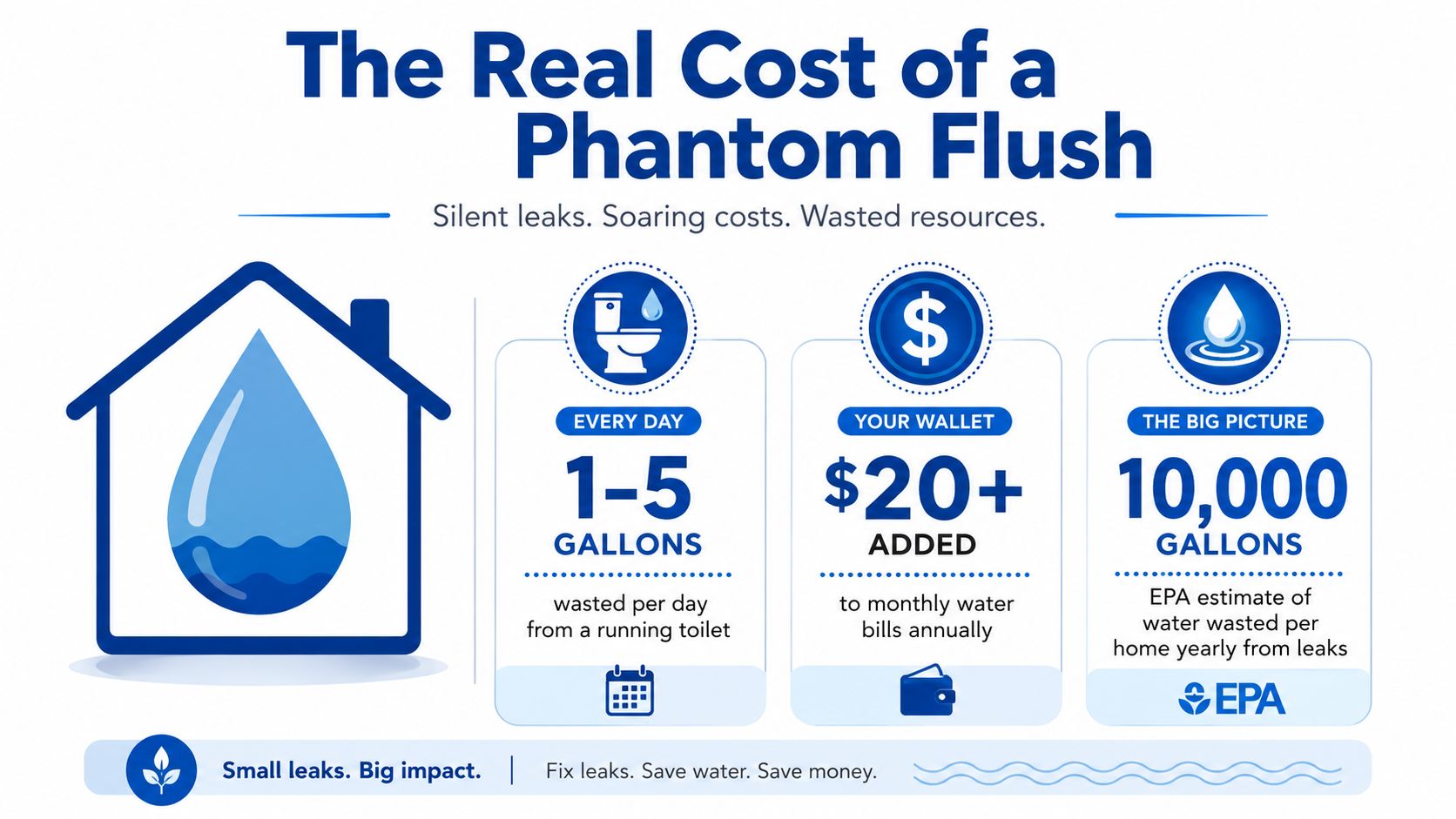
A phantom flush can seem too minor to matter, especially when it happens only at night. The problem is that a slow leak repeats without leaving a puddle, so homeowners may not notice it until the water bill changes or the toilet begins cycling more often.
The U.S. Environmental Protection Agency says household leaks waste more than 1 trillion gallons of water annually in the United States, and the average home loses over 10,000 gallons each year through leaks. The EPA also reports that 10% of homes have leaks wasting 90 gallons or more per day, with running toilets identified as a major category of water-wasting leaks. See the EPA leak facts and running-toilet guidance for the underlying figures.
How quickly the loss can grow
The sound you hear doesn't tell you the full volume of water moving through the fixture. If the fill valve remains open, water can flow at 3 to 5 gallons per minute and can reach as much as 4,000 gallons per day, according to the EPA material linked above. That's an extreme operating condition, but it shows why a toilet that keeps refilling deserves attention rather than a wait-and-see approach.
For a homeowner, the practical threshold is simple. If the toilet cycles repeatedly, the tank level drops while nobody is using it, or the water meter moves during a period of no water use, arrange a repair. Property managers should treat one report as a possible maintenance pattern, particularly if several units share aging fixtures or hard-water conditions.
Practical rule: A silent leak is still an active plumbing problem, even when the bathroom floor is completely dry.
A professional leak detection cost guide can also help homeowners understand why diagnosis matters before replacing parts at random.
How to Diagnose the Problem with a Dye Test
A food-coloring test is a useful first check because it separates a tank-to-bowl leak from a fill-valve problem. You won't need to remove the toilet or disconnect the supply line.
Follow these steps
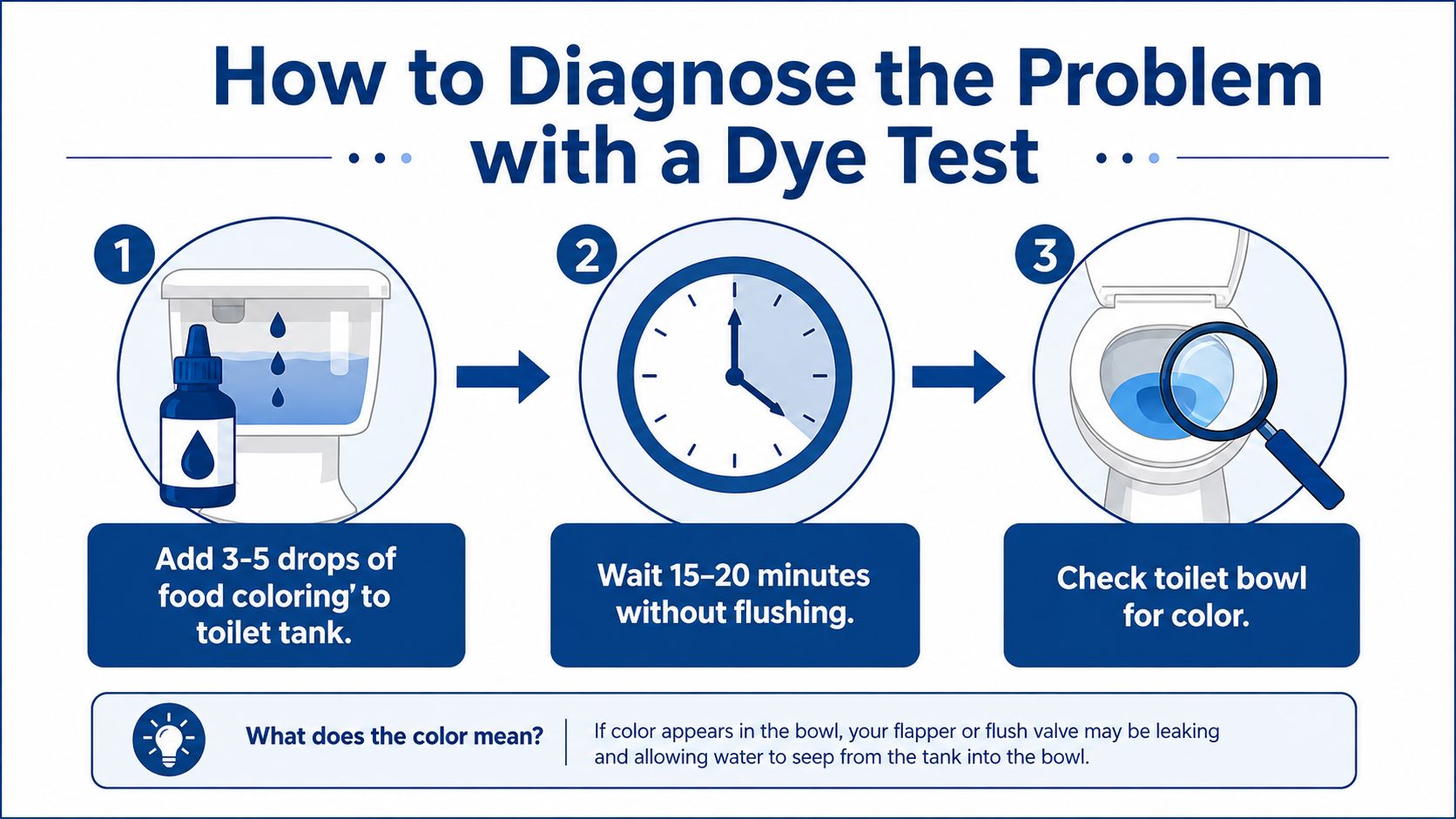
- Add the dye. Put 5 to 10 drops of food coloring into the toilet tank. Choose a strong color so a small amount of leakage is easier to see.
- Wait without flushing. Leave the toilet alone for about 15 to 30 minutes, as recommended in this toilet dye-test troubleshooting guide. Don't use the fixture during the test.
- Inspect the bowl. Look for colored water appearing in the bowl. Even a faint tint indicates that water is passing through the tank-to-bowl seal.
If the bowl turns the same color as the tank, the flapper or flush valve seat is the likely source. A dirty seat, mineral scaling, a damaged flapper, or chain tension can prevent a complete seal.
If the bowl stays clear but the tank refills or the fill valve continues making noise, the fault is more likely the fill valve or float assembly. The valve may be failing to shut off, or the float may be set incorrectly and allowing water to rise toward the overflow tube.
If the result isn't clear
Clean the tank and bowl, repeat the test, and make sure nobody flushes during the waiting period. A very slow leak may need more observation, while a toilet with a cracked tank, unstable shutoff valve, or water near the base should be handled by a professional rather than repeatedly tested.
For a closer look at the seal area, review this guide to toilet leaks between the tank and bowl.
Fixing the Most Common Mechanical Failures
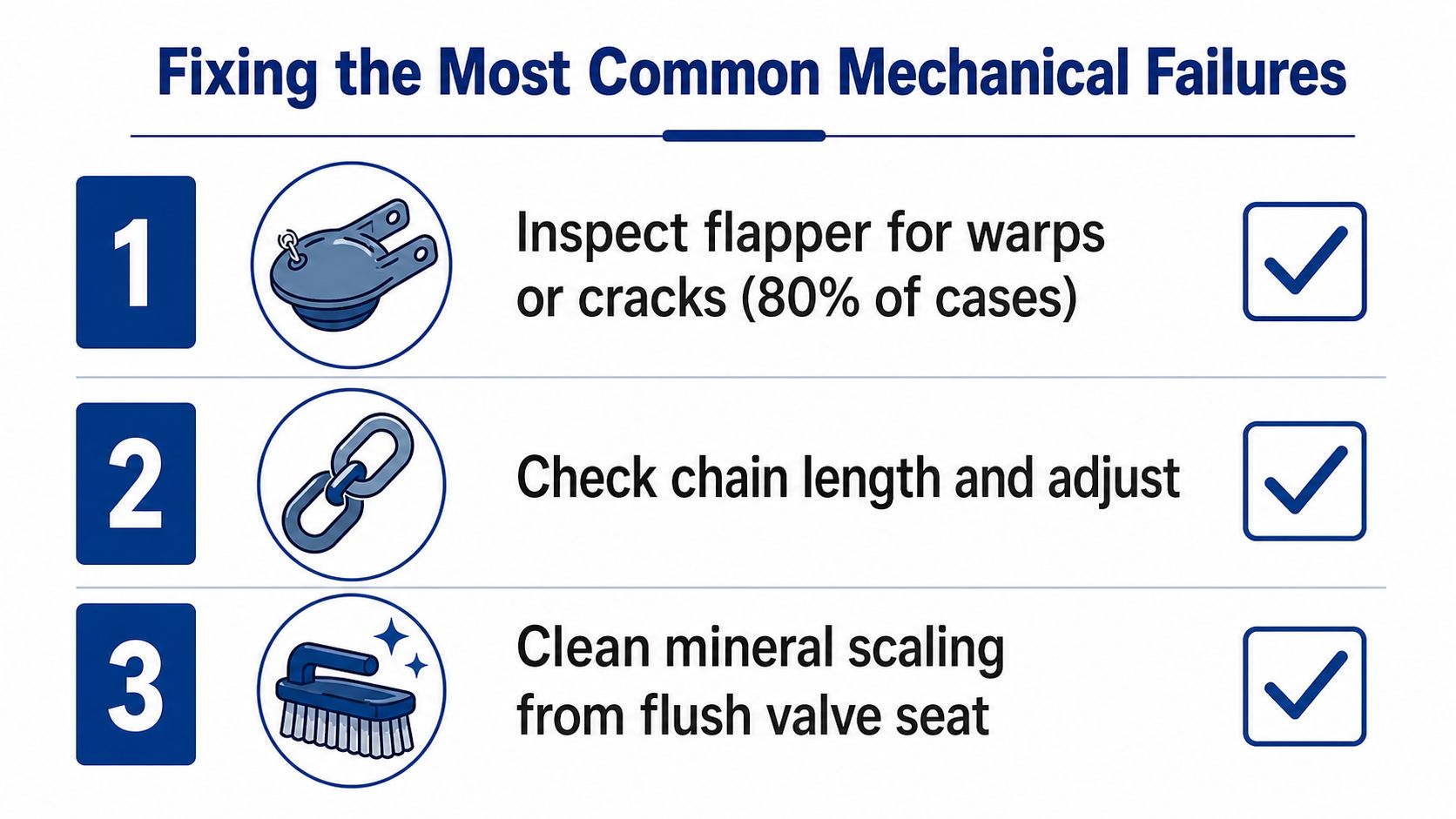
The flapper is the first component I inspect on a conventional toilet. One technical troubleshooting source estimates that the flapper accounts for about 80% of running-toilet cases, as described in this running-toilet repair explanation. That doesn't mean every toilet needs a new flapper, but it makes the seal the sensible starting point.
Start with the tank-to-bowl seal
Turn the water supply shutoff clockwise before removing parts. Flush the toilet to lower the tank level, place the lid somewhere safe, and take a quick photo of the existing setup so the chain and refill tube can be returned correctly.
Check three details:
- Chain position: Too much tension can hold the flapper slightly open. Too much slack can prevent the flapper from lifting and closing properly.
- Flapper condition: Look for warping, cracks, stiffness, or a surface that feels deteriorated.
- Flush valve seat: Mineral scaling or debris can create a path for water even when the flapper itself looks serviceable.
Clean the seat gently with a non-abrasive pad. If the flapper is damaged or no longer flexible, replace it with a part that matches the toilet's flush valve and mounting style. A universal part isn't automatically compatible with every one-piece or two-piece toilet.
Then check the fill valve
If the dye test shows a clear bowl but the tank still refills, inspect the float and fill valve. The float should move freely, and the valve should shut off once the tank reaches its intended level. Follow the manufacturer's adjustment instructions rather than forcing a plastic screw or arm.
Repeatedly replacing individual parts may not be the most sensible solution on an older fixture. When the flush valve, fill valve, flapper, handle, and connecting hardware have all deteriorated, a compatible rebuild kit can provide a more consistent repair than chasing one failure after another. This guide to fixing a running toilet covers the basic repair path, but porcelain cracks, seized connections, and leaking shutoffs call for professional help.
When It Is Not a Plumbing Problem at All
A sensor-equipped toilet can flush without a mechanical tank leak. In a commercial restroom, apartment common area, healthcare facility, or retail space, the sensor may react to conditions around the fixture rather than a problem inside the valve assembly.
Common triggers include:
- Sensor misalignment: A sensor aimed too far outward may detect movement near the toilet.
- Dirty lenses: Dust, cleaning residue, or other buildup can interfere with reliable detection.
- Reflections: Shiny tile, mirrors, and bright surfaces can confuse some sensor systems.
- Changing sunlight: Sunlight entering through a window can alter what the sensor sees during the day.
- Nearby movement: Passersby or activity near a stall can initiate a cycle on a poorly positioned fixture.
The key distinction is timing. A conventional toilet that refills after the tank level drops has an internal water-loss problem. A sensor toilet that flushes when someone walks past, when sunlight changes, or after the lens is cleaned may have an installation, calibration, or environmental problem instead.
Observe the fixture before buying replacement parts. Note whether the tank water level falls, whether the sensor light behaves unexpectedly, and whether the event corresponds with nearby movement or changing room conditions. Cleaning the lens, correcting the sensor position, or adjusting the fixture's settings may solve the issue, while replacing a flapper won't help a false electronic trigger.
Commercial property owners and managers in Macomb and Oakland County should also check whether several toilets began cycling after a remodel, lighting change, or cleaning-program change. For help separating a sensor issue from a genuine leak, Call Jay's Plumbing and sewer Now @ 586-634-3450.
When to Call a Professional Plumber
DIY troubleshooting is reasonable when the toilet has an accessible tank, the shutoff works, and the problem points clearly to a flapper, chain, or float adjustment. Stop and call a licensed plumber when the repair becomes uncertain or the same symptom keeps returning.
Professional service makes sense when:
- The repair doesn't last: Repeated flapper replacements can indicate a damaged flush valve seat or a broader rebuild need.
- Porcelain is cracked: A cracked tank or bowl isn't a safe seal to continue relying on.
- The bill stays high: Persistent usage after a repair suggests another fixture, supply line, or hidden leak may be involved.
- Several fixtures behave alike: Multiple toilets in one building may point to sensor, installation, water-pressure, or maintenance conditions.
- Drain symptoms appear: Repeated clogs, backups, or slow fixtures may require drain cleaning or a sewer camera inspection rather than tank-part replacement.
Jays Plumbing and Sewer provides residential and commercial plumbing service, toilet repair, leak detection, sewer repair, drain cleaning, pipe repair, water heater repair and replacement, sump pump repair, garbage disposal repair, kitchen plumbing, and bathroom plumbing across Macomb and Oakland County. The company also offers 24-hour emergency service, upfront job-based pricing, and follow-up calls to confirm satisfaction. Call Jay's Plumbing and sewer Now @ 586-634-3450 for a free estimate or to schedule service.
Fixing a toilet flush on its own early can reduce wasted water and help prevent a small fixture problem from becoming a larger property concern. If you're searching for a plumber near me in Fraser, Sterling Heights, Warren, Clinton Township, Shelby Township, Rochester Hills, or nearby Southeast Michigan communities, start with a clear diagnosis.
Call Jay's Plumbing and Sewer for toilet flushing problems, leak detection, sensor-fixture troubleshooting, and related residential or commercial plumbing service throughout Macomb and Oakland County. Visit Jays Plumbing and Sewer to schedule service or request an estimate before a hidden toilet leak keeps wasting water.
