Liquid grease should stay out of sink and floor drains. After it leaves the fixture, it cools and can stick to pipe walls. The U.S. Environmental Protection Agency identifies fats, oils, and grease (FOG) as the most common cause of reported sanitary-sewer blockages. A drain that empties normally doesn't show what is building farther down the line.
You finish cooking bacon, and the warm pan seems easy to rinse. The water disappears, so the cleanup feels done. At home, collect leftover fat for disposal rather than pour it down the drain. Commercial kitchens also need to manage FOG through proper collection and disposal, not rely on sinks to carry it away.
Table of Contents
- Why Pouring Grease Down the Drain Seems Harmless
- How Grease Hardens and Blocks Pipes
- Everyday Kitchen Items That Count as Grease
- Why Hot Water and Garbage Disposals Don't Fix It
- Signs Grease Has Reached Your Sewer Line
- Safe Grease Disposal Options for Homes and Businesses
- Calling a Local Plumber Before a Backup Starts
Why Pouring Grease Down the Drain Seems Harmless
The confusing part isn't what happens at the sink. It's what you can't see afterward.
A homeowner pours warm bacon fat into the drain, runs the faucet, and watches an empty basin. From the kitchen, the job looks finished. But watching water leave the sink only tells you that water can pass through the drain at that moment.
A working drain isn't necessarily a clean drain. Grease can pass beyond the fixture before it becomes a restriction, so the result of today's cleanup may not show up where you expect.
The mistake is understandable
After a family meal in Fraser, Sterling Heights, Clinton Township, Troy, Macomb, or Shelby Township, the focus is often on getting dishes done, not on what's happening underground. A greasy roasting pan can look like an ordinary washing job.
The useful distinction is between washing cookware and disposing of its contents. A sink handles the washing step. It shouldn't be the disposal route for leftover cooking fat.
Judge a grease-disposal habit by where the grease ends up, not by whether the sink empties afterward.
That distinction also keeps the response proportionate. Accidentally rinsing a greasy dish doesn't establish that your sewer line is blocked, and it doesn't automatically mean you need an emergency visit.
A practical response starts with a few questions:
- Is the drain behaving differently? Notice whether it's slowing or backing up rather than assuming damage.
- Is this a repeated habit? Changing the cleanup routine matters more than finding something else to pour after the grease.
- Does the problem keep returning? A recurring restriction deserves investigation, even if the sink eventually empties.
The answer to “can you dump grease down the drain” is straightforward. Knowing why the sink can appear unaffected makes that answer easier to follow.
How Grease Hardens and Blocks Pipes
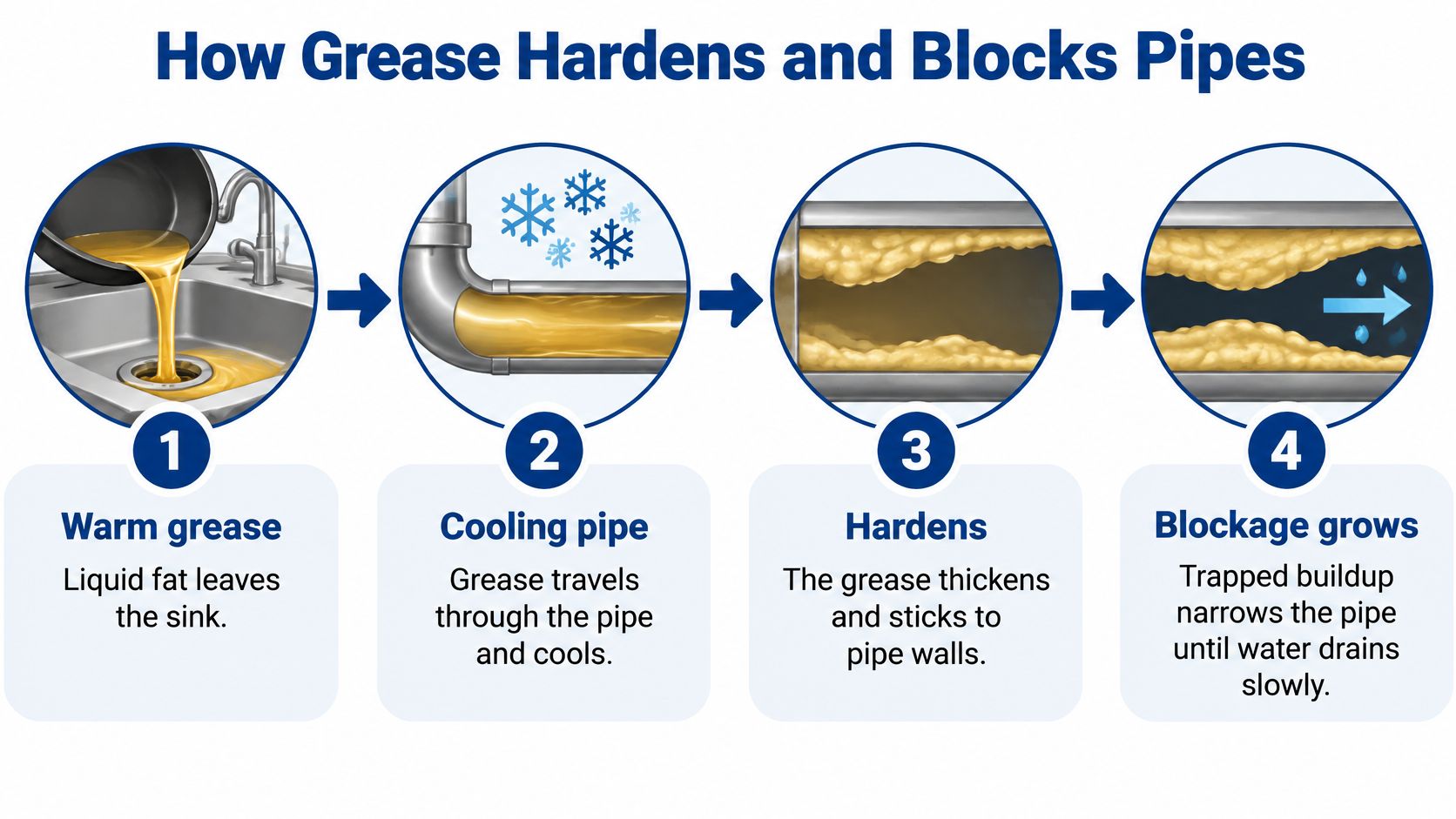
Warm cooking fat flows easily when it leaves a pan. As it moves through cooler piping, it can thicken, harden, and adhere to the pipe's interior.
Think of a candle-wax drip cooling on a surface. The comparison isn't exact, but it helps explain why something that pours freely can later leave a stubborn coating. With grease, that coating occupies space wastewater needs to pass through.
The process looks like this:
A restriction develops before a complete clog
City of San Diego grease-prevention guidance notes that household sewer lines commonly measure only about 2 to 4 inches in diameter. A hardened coating can reduce that available opening before the pipe becomes completely blocked.
The stages matter:
- Grease enters while it's fluid. It may leave the visible sink area without causing an immediate symptom.
- Some material adheres downstream. The location of the deposit isn't necessarily directly beneath the kitchen.
- Further deposits narrow the passage. Wastewater has less room to move, even while some flow continues.
- The restriction becomes noticeable. Slow drainage or a backup may be the first sign the homeowner sees.
This is why cleaning the visible sink opening doesn't tell you much about the condition of the rest of the line. The part you can reach and wipe isn't the whole drainage system.
Appearance doesn't identify the whole problem
Grease buildup may be hidden, and visible residue doesn't establish its depth or location. If you're also finding dark material near a drain opening, understanding black sludge in drain pipes can help you describe what you're seeing without assuming it identifies the entire blockage.
A complete stoppage is a symptom, not the beginning of the process. For a homeowner, the useful lesson is to pay attention to changing drainage performance rather than waiting until no water passes at all.
Everyday Kitchen Items That Count as Grease
Cooking oil and bacon drippings are obvious. The less obvious contributors are often already sitting on plates, utensils, and baking equipment.
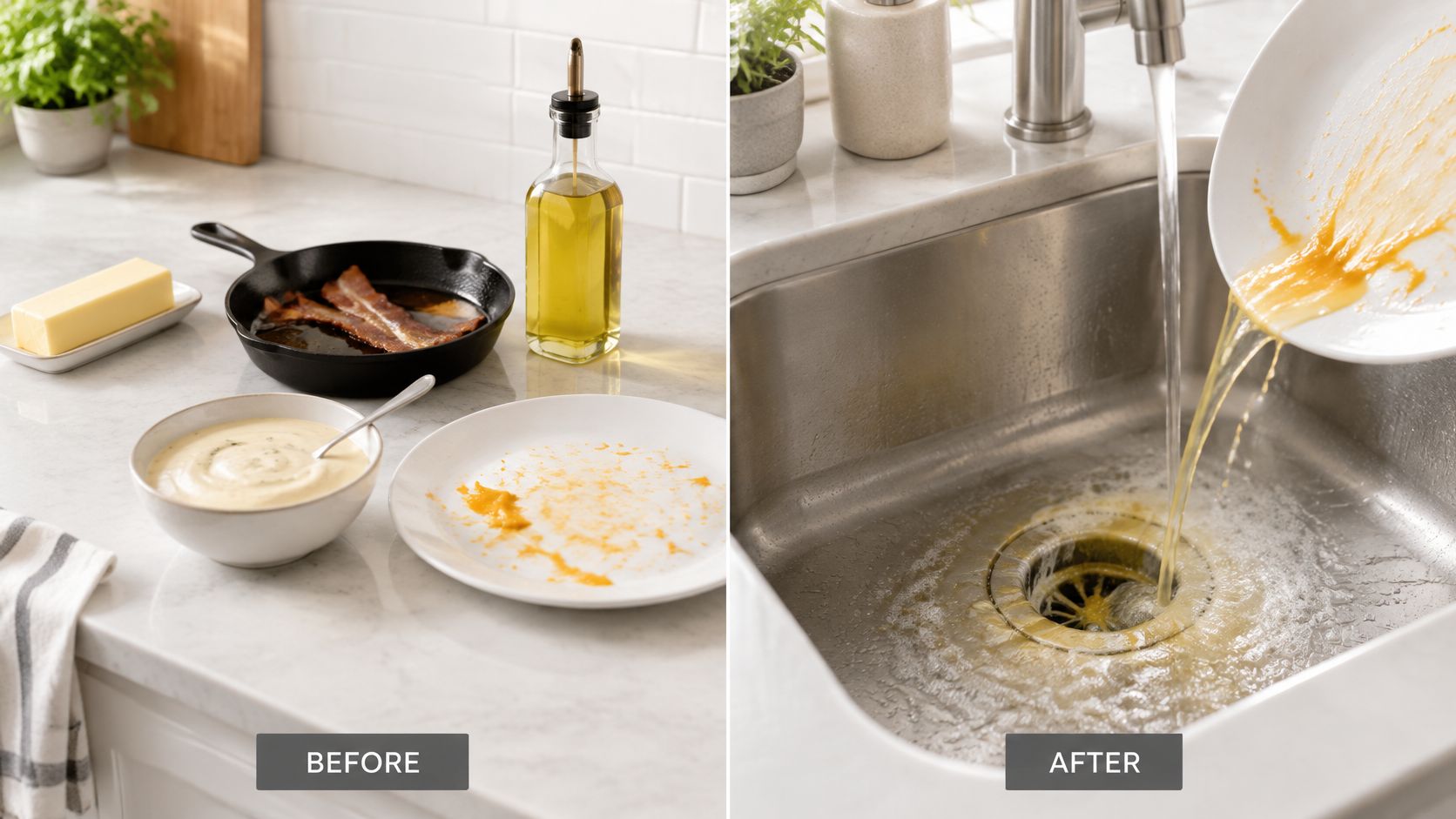
University of Georgia Extension's household FOG guidance identifies butter, mayonnaise, frosting, cheese, food scraps, syrups, batters, gravies, cooking oils, and grease as materials that contribute to fats, oils, and grease problems in plumbing. Its guidance also recommends keeping food scraps out of drains and wiping greasy cookware before washing.
A plate doesn't have to hold a puddle of oil to need scraping first.
Look beyond the frying pan
Different meals leave different cleanup jobs. The point isn't to treat every ingredient as chemically identical. It's to recognize the leftovers that shouldn't be deliberately washed into plumbing.
| Kitchen item | What to remove before washing |
|---|---|
| Bacon pan or roasting tray | Pooled fat and greasy drippings |
| Buttered plate or mayonnaise-covered utensil | Remaining food and oily coating |
| Frosting bowl or cheese-covered dish | Thick leftovers clinging to the surface |
| Gravy boat or mixing bowl | Remaining gravy, batter, or syrup |
| Dinner plate | Food scraps rather than a sinkful of rinsed leftovers |
A useful household test is simple: if you can scrape it off or wipe it away, remove it before washing. You don't need to identify the fat content of every sauce to make that decision.
Change the clearing step
Keep a scraper and a disposal container convenient to the cooking area. That makes proper cleanup a normal part of clearing the table instead of an extra task after the sink is already full.
- Scrape plates first. Don't use running water to push leftover food toward the drain.
- Wipe greasy surfaces. Remove the residue that remains after scraping.
- Wash afterward. Soap and water belong at the cleaning stage, not as a substitute for collecting leftovers.
This is especially useful for shared kitchens. A clear routine works better than expecting every family member or tenant to recognize which leftovers count as FOG.
Why Hot Water and Garbage Disposals Don't Fix It
Hot water can make a greasy pan look clean. That doesn't make it a grease-disposal method.
The same distinction applies to dish detergent. Moving grease out of sight isn't the same as removing it from the drainage system, even when the sink looks spotless afterward.
Hot water changes what you see
Historical EPA technical materials on oil and grease explain that hot water and detergent can move grease temporarily, but don't permanently remove it. After cooling, the material can reform and solidify farther into the sewer network.
That's the weakness in the familiar advice to chase grease with plenty of hot water. It relies on keeping material moving rather than keeping it out of the system.
Practical rule: Use hot water to wash properly scraped cookware, not to dispose of what you scraped out.
Normal dishwashing isn't the issue. Deliberately sending a panful of fat into the drain and expecting the faucet to make it harmless is.
A disposal changes food size, not the disposal route
A garbage disposal grinds food. It doesn't separate and collect the fat before the wastewater enters the pipe.
If fatty leftovers go through the disposal, they still enter the drainage system. Garbage disposal repair may address a malfunctioning appliance, but it isn't a solution for grease that has already traveled downstream.
The difference between these approaches is practical:
- Hot water and soap may make the immediate cleanup look successful.
- A garbage disposal reduces food into smaller material without capturing its grease.
- Separate collection keeps the material from entering the drain in the first place.
The consequences also extend beyond an individual kitchen. The EPA materials estimate more than 40,000 sanitary-sewer overflows annually, with about 48% attributed to sewer-main blockages. These are historical estimates, not a live count, but they show why grease prevention is a public-infrastructure issue as well as household maintenance.
That doesn't mean a single kitchen mistake causes a neighborhood overflow. It means the shared sewer system shouldn't be treated as a disposal route for cooking waste.
Signs Grease Has Reached Your Sewer Line
A slow kitchen sink doesn't prove you have grease in the sewer line. It does tell you there's a drainage problem worth understanding, especially when the same symptom returns after an apparent clearing.
The location of the symptom and whether other fixtures are involved help a plumber decide where to investigate. Don't assume the restriction sits directly below the fixture where you first notice trouble.
Follow the symptoms, not a guess
Use this checklist to describe the problem when you call:
- The kitchen drain repeatedly slows. Explain whether it has been cleaned before and how the problem returned.
- You hear unusual gurgling. Mention which fixture makes the sound and what else is running at the time. The sound alone doesn't establish a cause.
- Water backs up somewhere else. A tub or floor-drain backup deserves more attention than an isolated dirty sink opening.
- Wastewater rises from a floor drain. Stop using affected fixtures and arrange professional help rather than continuing to test the drainage system.
These observations are useful for diagnosis, not a homeowner's confirmation of grease. The guide to signs of a main sewer line clog can help you organize the symptoms before speaking with a plumber.
A camera separates possible causes
Wastewater technical guidance on FOG and sewer restrictions describes grease deposits that restrict flow and the use of camera inspection to distinguish buildup from roots, collapsed pipe, offset joints, or mineral deposits.
That distinction matters because the treatment should match the condition. Removing a deposit and repairing a damaged pipe aren't interchangeable jobs.
A recurring backup is a reason to identify the restriction, not simply repeat the last treatment.
For homeowners preparing to sell, buyers investigating a property, or real estate agents helping arrange an evaluation, a drain that happens to work during a visit isn't a substitute for investigating a known recurring problem. Ask what the inspection found and whether the proposed work addresses the documented cause.
If wastewater is actively coming back into the building, contacting an emergency plumber is more appropriate than waiting for another ordinary dishwashing cycle to see what happens.
Safe Grease Disposal Options for Homes and Businesses
The simplest household option is to collect the grease before washing the pan. The right destination afterward depends on local trash and recycling rules.
The EPA's National Pretreatment Program guidance on food-service grease identifies FOG as the most common cause of reported sanitary-sewer blockages. For household handling, the practical approach is to let grease cool, put it in a sealed container, and use household trash or an approved recycling program.
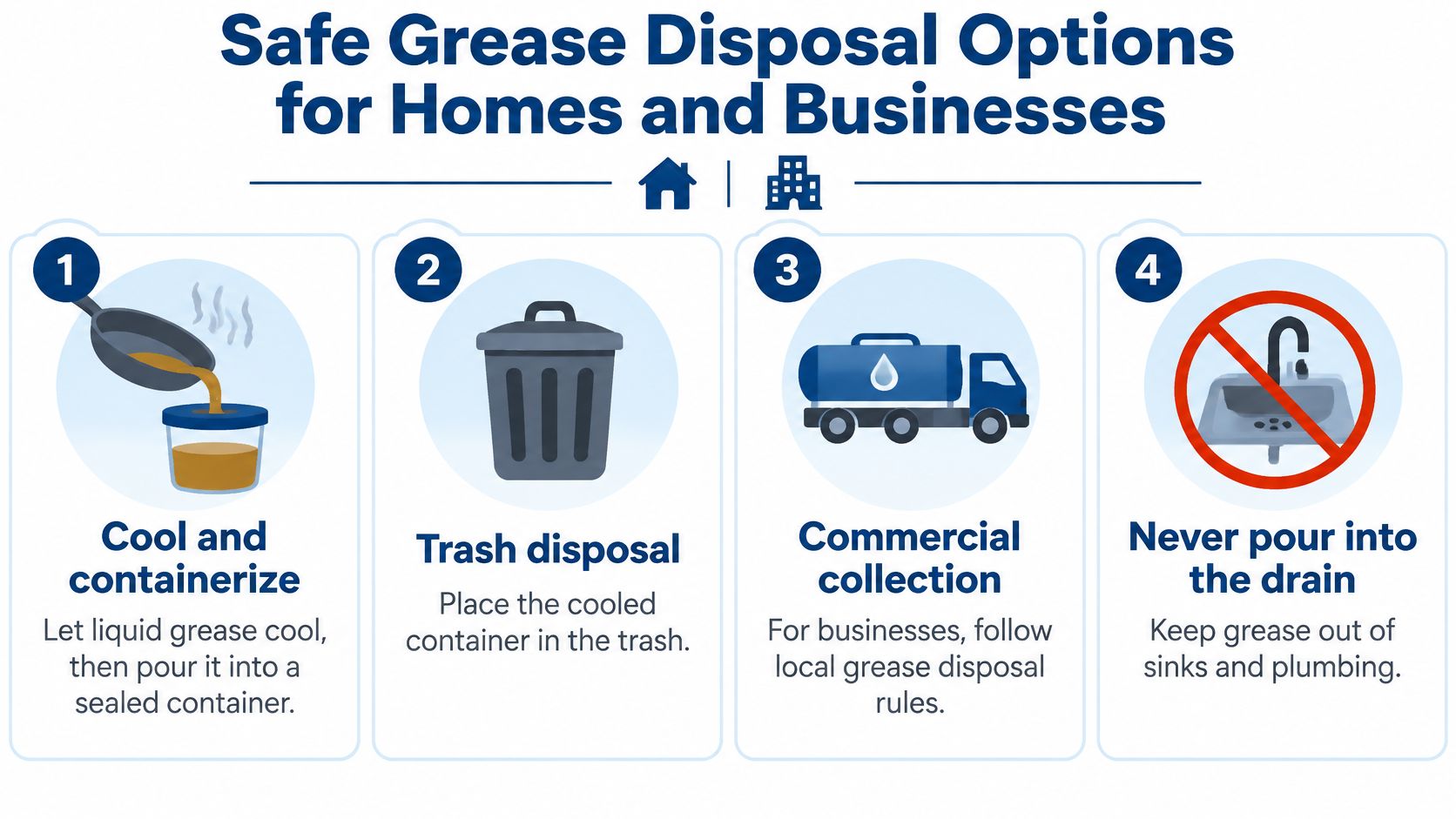
Choose an option that fits the property
| Option | Where it fits | Important limitation |
|---|---|---|
| Cooled grease in a sealed container | Household disposal where local trash rules allow it | Don't put hot grease into a container that can't safely hold it |
| Approved cooking-oil recycling | Households with access to a participating program | Confirm accepted materials and drop-off requirements |
| Commercial grease collection | Restaurants and food businesses | Collection must be part of an organized operating routine |
| Sink, floor drain, or outdoor dumping | Not an appropriate disposal choice | Moving waste elsewhere isn't proper collection |
A recycling program can provide a recovery route, but it has to be an actual approved program. Don't assume every recycling location accepts cooking oil or that every grease-containing waste belongs in the same collection stream.
Commercial responsibility goes beyond a container
A restaurant has a different operating problem from a household frying breakfast. Repeated food-service discharges call for staff instructions, grease-control equipment maintenance, and dependable collection.
Ohio EPA's assessment of fats, oils, and grease connects unmanaged disposal with blockages and overflows while noting that statewide quantitative estimates of residential and commercial sewer discharges aren't available. That's a useful reminder to avoid unsupported claims about exactly what a particular amount of grease will cost.
For property managers and commercial property owners, the practical checklist is operational:
- Write down disposal rules. Employees shouldn't have to guess where fryer oil or greasy leftovers belong.
- Maintain grease-control equipment. Collection practices don't replace equipment maintenance.
- Document recurring problems. Record where backups occur and what previous inspections found.
- Arrange appropriate cleaning. Compare the condition of the pipe and the proposed method when considering professional drain-cleaning options.
At home, prevention can stay simple: collect the bulk material, scrape, wipe, and then wash. At work, that same principle needs an accountable routine.
Calling a Local Plumber Before a Backup Starts
Call a licensed plumber when a kitchen drain repeatedly slows, a clearing doesn't last, or wastewater appears at another fixture. You don't need to wait for a complete stoppage to ask for an evaluation.
A camera inspection is one tool a professional may use to investigate the line:
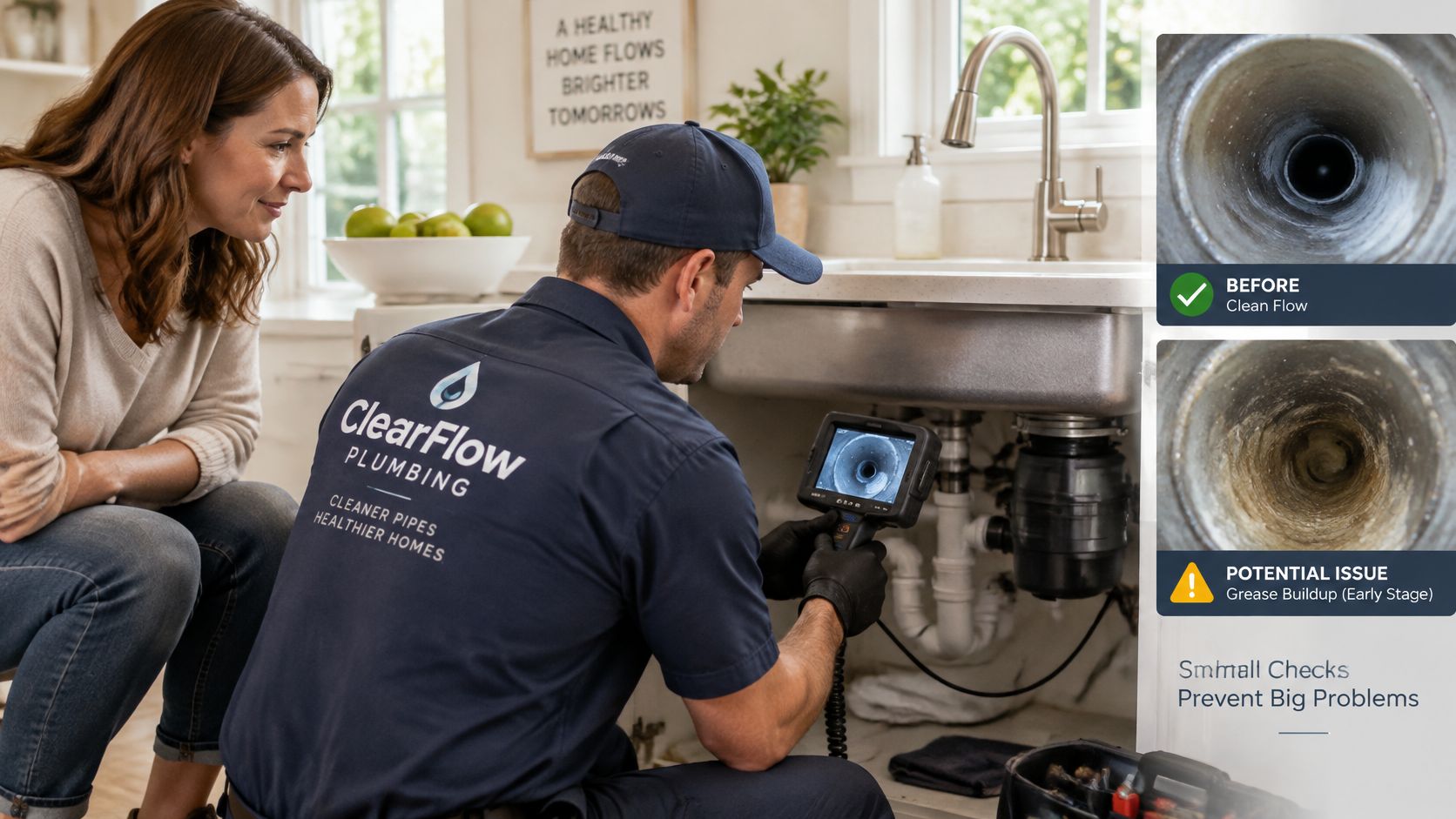
Ask for a diagnosis before a repair decision
A useful service conversation covers the location of the restriction, the pipe's condition, and the reason for the recommended work. Repeated chemical treatments may not remove established buildup, so another bottle isn't necessarily a meaningful next step.
Drain cleaning or high-pressure water jetting may be appropriate for deposits. Sewer repair or pipe repair may be needed when inspection identifies a structural problem. Cleaning can remove an obstruction, but it can't correct every pipe defect, and it won't prevent recurrence if disposal habits stay unchanged.
Before approving work, ask:
- What did you find? Request an explanation of the obstruction or damage.
- Why this method? The plumber should connect the proposed tool to the pipe's condition.
- What happens after cleaning? Ask how the result will be evaluated and what prevention makes sense.
- What does the estimate include? Clarify the proposed scope before authorizing additional work.
This video provides another resource alongside that conversation:
Local service should match the actual problem
For homeowners searching “plumber near me” in Fraser, MI; Sterling Heights, MI; Clinton Township, MI; Troy, MI; Macomb, MI; or Shelby Township, MI, explain whether you need scheduled maintenance or help with an active backup. Across Macomb County and Oakland County, and when arranging service for a Wayne County property, confirm location coverage and availability when you call.
Keep other concerns separate during scheduling. Kitchen plumbing, bathroom plumbing, and commercial plumbing may involve different work from water heater repair, water heater replacement, leak detection, or sump pump repair. Michigan winters, frozen pipes, heavy rain, and basement flooding are also useful context to mention, but they shouldn't be assumed to explain a grease-related drain complaint.
Frequently asked questions
Can I handle this myself if I poured grease down once?
Change the disposal habit and pay attention to drainage. A single incident doesn't establish that you need sewer work.
Should a recurring slow drain be inspected?
Yes. Professional evaluation is more useful than repeatedly treating an unidentified restriction.
Jays Plumbing and Sewer offers residential plumbing and commercial drain service, sewer camera inspections, drain cleaning, high-pressure jetting, and 24-hour emergency response. If grease may be behind a recurring slow drain or backup, call 586-634-3450 to ask questions, confirm service availability, or request a free estimate.
