The washer is draining, someone's taking a shower, and suddenly the basement floor drain starts gurgling. Then water appears around the drain, even though nobody's using anything downstairs. In a Macomb County home, that's a reason to pause the laundry, not flush another toilet to see what happens.
If your main drain is clogged, the useful question isn't just how to get water moving. It's whether the obstruction is inside your property's sewer line, whether the public sewer is backing up, and whether the pipe needs cleaning or repair. Start with safe observations, then choose the next step based on what you find.
Table of Contents
- What a Main Drain Clog Actually Means in Your Home
- How to Tell the Main Line Is the Culprit
- Is It Your Pipe or the City Sewer
- Safe DIY Steps Before You Call a Plumber
- What a Professional Brings That a Plunger Cannot
- When Excavation and Replacement Become the Answer
- Preventing the Next Backup in Your Home or Building
What a Main Drain Clog Actually Means in Your Home
Think about that basement laundry situation. The floor drain might be where you notice the water, but it isn't necessarily where the problem started. Wastewater from elsewhere in the house may be reaching a shared pipe that can't carry it away.
Your main drain collects wastewater from the smaller drains serving your sinks, toilets, showers, and appliances. Inside the building, plumbers distinguish the building drain from the sewer lateral that continues outside toward the municipal sewer or septic system. Homeowners commonly call that entire shared route the main line.
Why a shared blockage affects different rooms
A sink trap serves a particular fixture. A restriction farther downstream can affect fixtures that otherwise have little to do with each other, such as a kitchen sink and a basement toilet.
The Milwaukee Metropolitan Sewerage District's guidance on private laterals supports looking beyond an individual trap when multiple fixtures back up, particularly at the lowest level. That pattern calls for main-line diagnosis rather than repeated work on the drain where water happens to appear.
Quick Clog Triage at a Glance
| What You Notice | Likely Location | First Response |
|---|---|---|
| A sink drains slowly while other fixtures behave normally | Fixture trap or nearby branch | Evaluate that fixture |
| Separate rooms develop drainage trouble together | Shared building drain or lateral | Pause water use and arrange diagnosis |
| Wastewater rises through a basement drain | Downstream restriction or sewer backup | Keep clear and call for help |
| Nearby properties back up during heavy rain | Possible public-sewer surcharge | Contact the sewer utility |
Practical rule: The place wastewater comes out isn't automatically the place that needs repair.
A plunger may help a local fixture obstruction. It shouldn't be your main-line diagnostic tool.
How to Tell the Main Line Is the Culprit
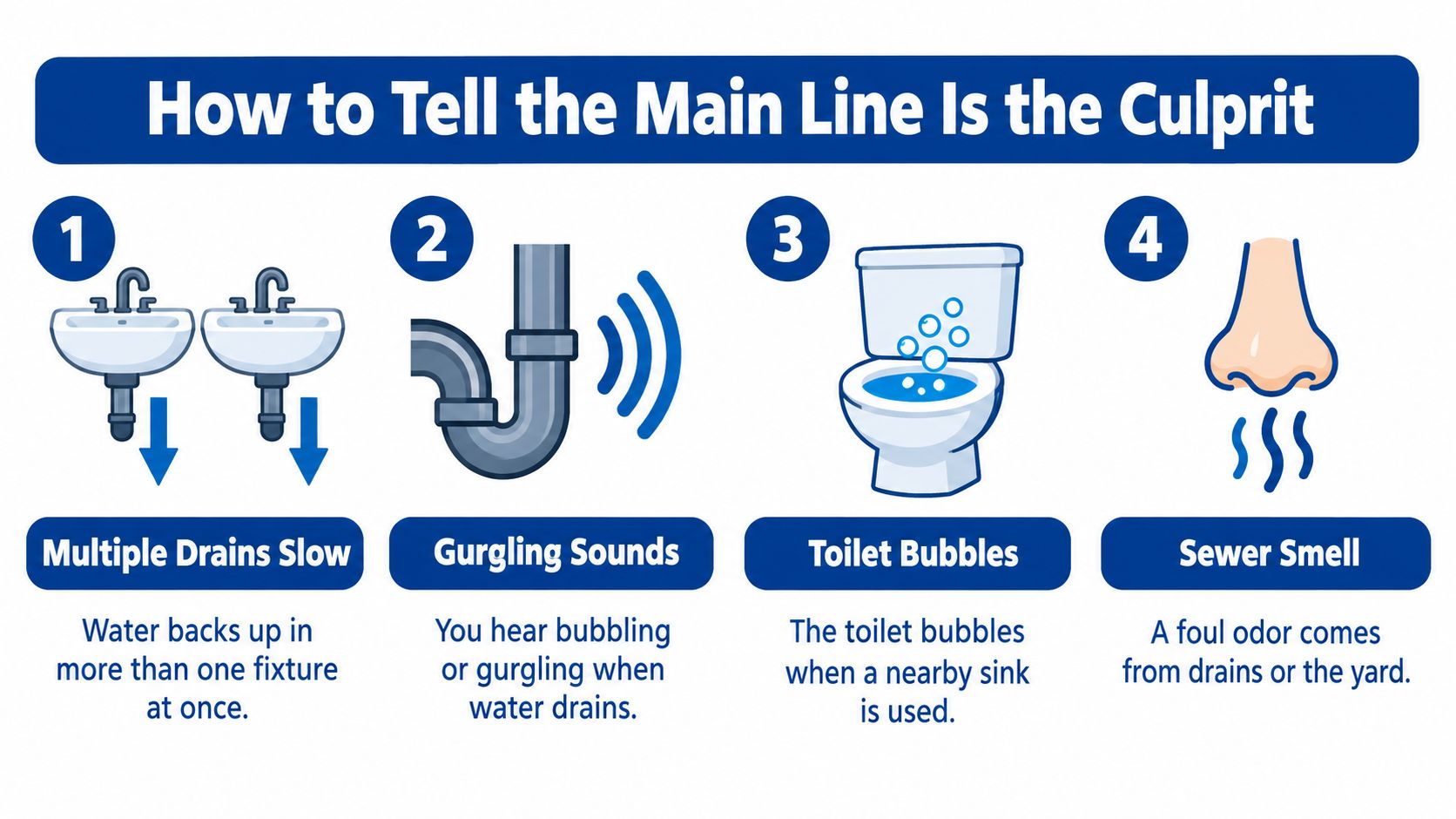
Watch how fixtures interact, not just how slowly an individual sink empties. A toilet that bubbles when another fixture drains gives a plumber different information than a bathroom sink that's been sluggish by itself.
Use this checklist to organize what you've already noticed.
Observe without creating another backup
- Identify the lowest affected fixture. Check the basement floor drain, downstairs toilet, laundry sink, or lowest shower from a dry, safe location.
- Compare separate areas. Trouble limited to a bathroom can involve its shared branch. Trouble involving the kitchen and basement deserves a broader inspection.
- Record cross-fixture reactions. Note whether the washer discharge coincided with floor-drain water or whether a toilet bubbled while a sink drained.
- Find the cleanout visually. Look for an accessible capped fitting and tell the plumber where it is. Leave it closed.
Don't run the washer or repeatedly flush toilets just to reproduce a symptom. If wastewater is already rising, the evidence is clear enough to stop testing.
What doesn't prove a main-line clog
Gurgling or an unpleasant smell alone doesn't establish the location or cause. Treat those observations as useful information, not permission to order excavation.
For a homeowner in Sterling Heights or Clinton Township, a clear description helps more than guessing the pipe material. Tell the technician which fixture reacted first, what was running, and whether the problem stopped when water use stopped.
A localized clog may justify a careful plunger attempt if there's no contamination or chemical cleaner present. Multiple affected fixtures, rising wastewater, or an overflowing floor drain are reasons to call an emergency plumber instead.
Is It Your Pipe or the City Sewer
A backup during heavy rain deserves a different conversation from a kitchen drain that gradually became slow. The private lateral may be restricted, but the public sewer may also be carrying more water than it can handle.
FEMA's guidance on sewer-backup protection explains that overloaded sewer systems can force wastewater into basements and other low-lying areas. Cleaning your property's pipe won't resolve an overloaded public main.
Compare the pattern before authorizing work
| Observation | What It Suggests | Useful Next Step |
|---|---|---|
| Neighbors report backups at the same time | Possible shared public-system problem | Report the event to the sewer utility |
| Trouble occurs only during storms | Possible surcharge or rain-related inflow | Record weather and timing |
| Trouble follows ordinary water use in dry weather | Private-line restriction deserves investigation | Arrange a lateral inspection |
| A recently cleaned line backs up again | Unresolved deposits, defects, or outside conditions | Review footage and cleaning records |
These clues guide the investigation; they don't establish responsibility by themselves. Ask the municipality where its maintenance responsibility ends rather than assuming the property line answers that question.
Property managers in Fraser and Shelby Township should save photos, tenant reports, timestamps, and the municipal report number. A recorded camera inspection can document the property-side pipe and support a more informed discussion before anyone digs.
Don't authorize another identical cleaning simply because the previous cleaning briefly restored drainage.
For the first call, say: “Wastewater is backing up at the lowest fixture. It started during heavy rain, and nearby properties are affected. Can you check the public main and give me a report number?”
If neighbors aren't affected, explain that too. Accurate details help the utility and plumber coordinate instead of treating separate possibilities as the same problem.
Safe DIY Steps Before You Call a Plumber
The most useful DIY work is often controlling water use and gathering information, not forcing a tool into the sewer. Your goal is to avoid adding wastewater while giving the technician a clear starting point.
Keep the distinction between fixture maintenance and main-line service in mind when considering household methods.
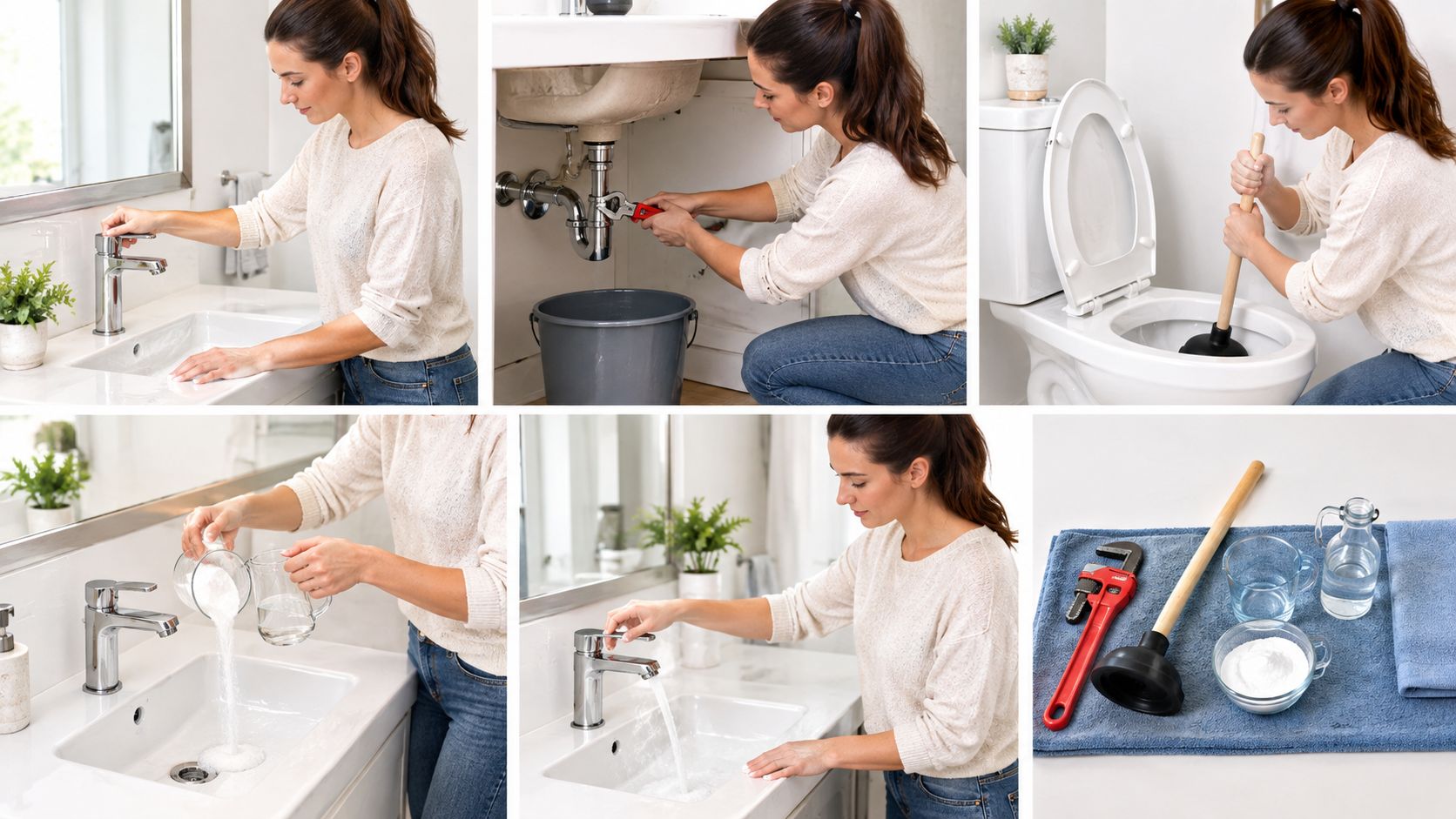
A safer sequence
- Pause household discharge. Stop laundry, showers, dishwashing, and unnecessary flushing. Tell everyone in the building.
- Keep the area clear. Don't step into wastewater to reach tools or inspect a drain.
- Locate access without opening it. Our explanation of what a sewer cleanout is can help you recognize the fitting. Don't remove a cap from a backed-up line; wastewater may escape.
- Limit plunging to a local problem. If only a fixture is affected and conditions are safe, a plunger may be reasonable. Stop if another fixture reacts.
- Leave powered main-line equipment to a professional. A hand auger intended for a nearby fixture isn't a substitute for selecting sewer equipment around pipe condition and access.
What to avoid pouring into the drain
Don't add chemical drain cleaner to an undiagnosed main-line backup. It won't identify roots, a displaced joint, or a collapsed section, and it complicates subsequent handling of the wastewater.
Likewise, don't treat baking soda, hot water, or an enzyme product as proof that the main line is repaired. Before using any maintenance product, ask whether it fits the diagnosed problem and follow its label.
For visual context, this video accompanies the household troubleshooting discussion.
If you've already used a drain product, tell the technician exactly what it was. Keep the container available rather than relying on memory.
What a Professional Brings That a Plunger Cannot
Restoring flow and diagnosing the pipe are separate jobs. The right equipment depends on the obstruction, the pipe's condition, and the available access, not which machine is strongest.
The drainage maintenance discussion from Build Construct distinguishes opening a passage with a cable from removing wall deposits with water jetting, while emphasizing structural suitability and post-cleaning inspection.
Here's how those tools fit together.
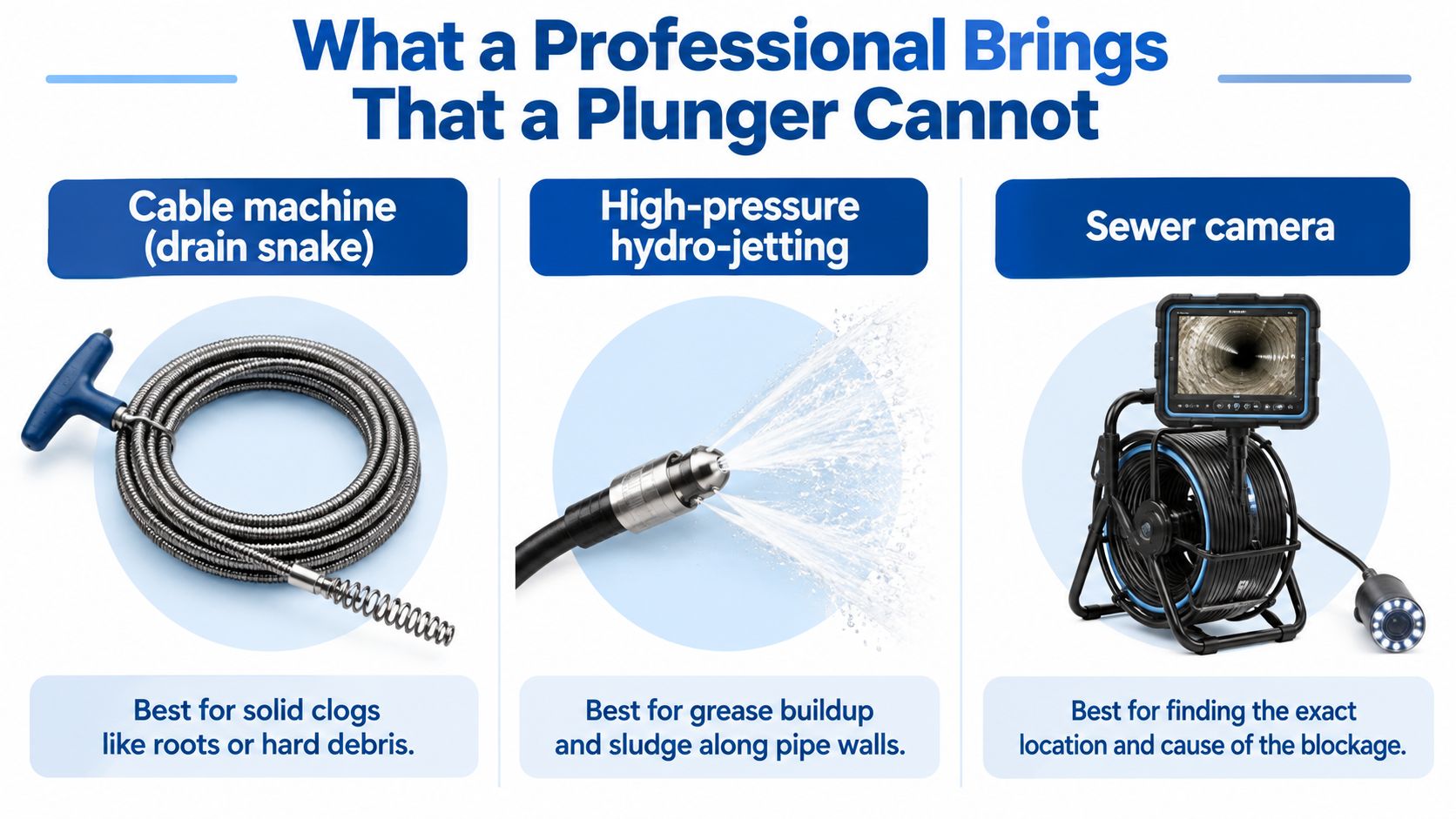
Match the tool to the problem
| Tool | Useful Role | Important Limitation |
|---|---|---|
| Cable machine | Establishes passage through an obstruction using suitable tooling | Drainage alone doesn't confirm clean pipe walls |
| High-pressure hydro-jetting | Removes grease, sludge, scale, and dispersed deposits | Requires a pipe that can tolerate the work |
| Sewer camera | Documents deposits, defects, and their location | Sludge or standing wastewater can obscure the view |
A cable machine can use different heads, so “snaking” isn't a single standardized treatment. Ask what the technician plans to remove and how they'll verify the result.
Camera-first thinking isn't always camera-first sequencing
Inspection should guide the decisions, but a completely obstructed line may need limited clearing before a camera can see anything useful. Once passage is restored, the technician can assess the pipe before choosing more aggressive cleaning.
A useful video camera sewer inspection records the route with a running footage counter and documents the downstream connection where accessible. Ask for an explanation of what remains after cleaning, not just footage of water moving.
Before approving service: Ask whether the quoted work includes opening the line, cleaning deposits, recording an inspection, and checking the result.
Those are different tasks. Upfront clarity helps you compare estimates for drain cleaning without assuming every contractor has priced the same scope.
When Excavation and Replacement Become the Answer
A camera showing a collapsed section changes the conversation. So does a displaced joint that keeps catching material or a damaged connection admitting roots. Cleaning can remove an obstruction, but it can't rebuild missing pipe or realign a failed section.
The U.S. Forest Service review of roots and sewer systems explains why root-related stoppages deserve attention to joints and pipe defects. Removing roots without addressing their entry point can leave the underlying problem in service.
Require evidence before choosing the repair
- Cleanout repair: Access may be damaged or unusable without the entire lateral needing replacement.
- Targeted pipe repair: A documented isolated defect may support repairing that section.
- Broader replacement: Extensive deterioration or multiple failed areas may justify a larger project.
- Trenchless assessment: Ask whether trenchless sewer repair fits the actual condition, rather than assuming every pipe qualifies.
Michigan winters and frozen ground belong in the site discussion, but they aren't a diagnosis. Ground movement can affect pipe alignment; the repair recommendation should still rest on documented findings.
Why Michigan cleanout access matters
Michigan's plumbing rules specify cleanouts no more than 100 feet apart on horizontal building drains and building sewers, along with requirements at direction changes greater than 45 degrees, stack bases, and the building-drain junction. The junction access must reach finished ground or basement-floor level, subject to the rule's exceptions.
That helps explain why a technician checks basement caps and foundation-wall access before discussing excavation. A licensed plumber should evaluate how the rules apply to your piping.
For an older home in Oakland County or Macomb County, request the recorded defect, its location, and alternatives. A second opinion is sensible before committing to major sewer repair.
Preventing the Next Backup in Your Home or Building
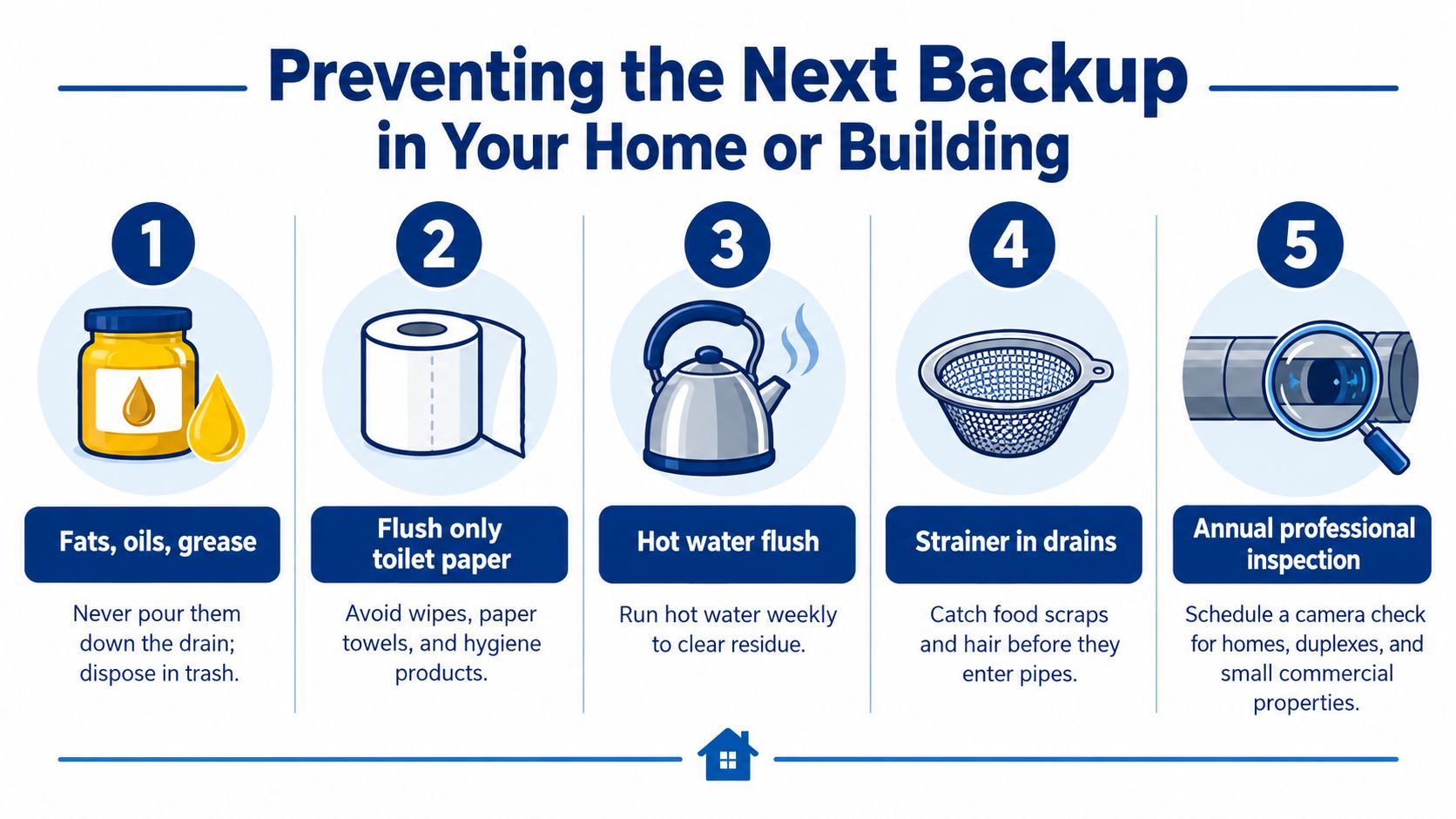
Prevention works best when it matches the cause. A restaurant with grease deposits, a rental with recurring wipes, and a home with damaged root-prone joints don't need identical maintenance plans.
The EPA's report on sanitary sewer overflows identifies grease, debris, and roots as major blockage causes and explains that grease can solidify inside sewer lines. Keeping those materials out is useful; assuming every backup has the same cause isn't.
A usable maintenance checklist
- At every meal cleanup: Keep fats, oils, and grease out of sinks. Collect them for appropriate disposal instead.
- With every flush: Keep wipes, paper towels, and hygiene products out of toilets, regardless of flushability claims.
- During routine housekeeping: Keep floor drains free of stored items and don't use them to dispose of debris.
- When arranging landscaping: Identify the lateral's route and discuss planting locations before adding trees or shrubs nearby.
- At a scheduled property review: Confirm that cleanouts remain visible and accessible. Save inspection footage and service records together.
- After documented buildup or recurrence: Have the plumber recommend a cleaning interval based on findings and building use, not a universal calendar.
This visual summarizes common habits, but hot water isn't a repair for grease accumulation or a defective pipe.
Restaurants and multi-unit properties may benefit from planned jetting when inspection shows recurring deposits. Home buyers, sellers, and real estate agents can use recorded inspections to clarify condition before a transaction rather than relying on a sink draining during a showing.
Protect people and preserve documentation
If sewage reaches the floor, prioritize exposure control over unclogging. The EPA's sanitary sewer overflow health guidance identifies bacteria, viruses, and other pathogens as potential hazards.
Keep children and pets away, avoid electrical equipment near wet areas, and arrange appropriate professional cleanup. From a safe position, photograph waterlines, affected rooms, and damaged contents before cleanup; save service records and ask whether failed parts should be retained.
Contact your insurer promptly about sewer-backup coverage and documentation requirements. Coverage can be separate, and flood-related coverage has specific conditions, so don't assume a standard policy covers every backup.
Frequently asked questions
Will a backwater valve solve the problem?
It may reduce reverse flow during public-system overload. It won't remove a private-line obstruction or repair a collapse, so installation should follow diagnosis.
Should every home receive an annual camera inspection?
Not automatically. Set the interval around known defects, previous backups, property use, and the plumber's findings rather than ordering inspections without a reason.
Is basement water always a sewer problem?
No. Describe whether water rose through a drain or entered elsewhere. Heavy rain may call for a separate discussion about sump pump repair, leak detection, or pipe repair.
What should I ask when searching for a “plumber near me”?
Ask about main-line access, recorded inspections, cleaning methods, and written repair options. Residential plumbing and commercial plumbing needs differ; a kitchen plumbing or bathroom plumbing visit isn't automatically a sewer diagnosis.
For properties in Fraser, MI; Sterling Heights, MI; Clinton Township, MI; Troy, MI; Macomb, MI; and Shelby Township, MI, the practical objective is the same: establish the cause before choosing the fix. Water heater repair, water heater replacement, and garbage disposal repair are separate service needs, not substitutes for investigating a shared drainage problem.
Jays Plumbing and Sewer offers drain cleaning, sewer camera inspections, high-pressure jetting, repair assessments, and free estimates for properties across Macomb, Oakland, and Wayne counties. Call Jay's Plumbing and Sewer at 586-634-3450 to discuss a recurring clog or request a second opinion before excavation; for active sewage backups or basement flooding, ask for 24/7 emergency service.
