You're halfway through a shower in Shelby Township, and the water suddenly turns cold. The unit may not have “failed” without warning. Mineral scale, a clogged inlet filter, restricted venting, or a neglected condensate line can gradually reduce performance until the heater finally shuts down.
Tankless water heaters don't need no maintenance. They need the right maintenance, scheduled around water hardness, hot-water demand, and Southeast Michigan weather. That applies whether you own a home in Fraser, manage apartments in Clinton Township, operate a business in Troy, or oversee a property elsewhere in Macomb, Oakland, or Wayne County.
Table of Contents
- The Tankless Water Heater Maintenance Mindset
- Why Tankless Units Need a Different Kind of Care
- Flushing and Descaling a Tankless Water Heater Step by Step
- Beyond the Flush Filters Vents and Other Often Missed Tasks
- How Often to Service Your Unit Based on Hardness and Use
- DIY Maintenance Compared to a Professional Visit
- Your Yearly Tankless Care Checklist and When to Call a Pro
The Tankless Water Heater Maintenance Mindset
A tankless heater rewards small, regular checks. Instead of storing a large volume of heated water, it sends incoming water through a heat exchanger and heats it as you use it. That design saves space and can provide continuous hot water, but it also puts mineral buildup directly on the surfaces responsible for transferring heat.
A steady routine helps prevent the familiar complaints, including temperature swings, reduced flow, error codes, and a unit that works harder than it should. Manufacturer guidance commonly treats descaling as routine preventive care, with the exact interval determined by the model, water quality, and handbook. A. O. Smith, Rheem, and Navien maintenance guidance summarized here all point homeowners toward scheduled scale control rather than occasional repair.
The basic tasks
A practical tankless maintenance routine includes:
- Descaling: Circulate an approved solution through the heat exchanger to remove calcium and magnesium deposits.
- Inlet-filter cleaning: Rinse the small screen that catches sediment before it reaches the unit.
- Vent inspection: Look for leaves, nests, ice, or other obstructions around the exhaust and combustion-air openings.
- Condensate care: Keep the drain, trap, and neutralizer components clear on condensing models.
- Freeze protection: Protect exterior units and piping during Michigan winters, especially during a cold snap.
- Professional inspection: Have a licensed plumber evaluate gas, electrical, combustion, venting, and internal safety components when the unit shows warning signs.
Practical rule: Annual service is a reasonable starting point, but hard water and heavy use can make that interval too long.
Homes in Macomb and Oakland counties may have either municipal water or private well water, and those supplies can behave differently. A water softener may reduce the mineral load, but it doesn't eliminate the need to follow the heater manufacturer's maintenance instructions.
Why Tankless Units Need a Different Kind of Care
Scale matters more in a tankless heater because the heat exchanger contains relatively narrow water passages. Calcium and magnesium can collect on heated surfaces, restricting flow and reducing heat transfer rather than just settling at the bottom of a storage tank. This overview of tankless heat-exchanger testing also highlights why maintenance needs vary by unit design, water conditions, and use.
A storage tank often brings attention to sediment, corrosion, and the anode rod. A tankless model shifts the focus toward the heat exchanger, inlet screen, burner or heating elements, venting, and condensate system. That's why a tank-style flushing habit doesn't automatically translate to tankless care.
Tank versus tankless
| Care Item | Tank Water Heater | Tankless Water Heater |
|---|---|---|
| Main scale concern | Sediment can collect inside the tank | Mineral scale can build on the heat exchanger |
| Corrosion protection | Anode-rod condition matters | Heat-exchanger and component condition matter |
| Routine water service | Traditional flushing may be part of maintenance | Descaling is commonly the central task |
| Flow concerns | Usually less immediate from internal scale | Restricted passages can affect hot-water flow |
| Other inspection points | Relief valve, tank connections, burner or elements | Inlet filter, venting, condensate, ignition, and freeze protection |
Household use changes the schedule too. A family with back-to-back showers, frequent laundry, and a recirculation loop sends more water through the heat exchanger than a lightly occupied home. A property manager should also account for occupancy changes instead of applying one calendar to every building.
For related tank maintenance, this guide to anode-rod replacement explains why tank and tankless systems require different service decisions. The larger lesson is simple. Identify the type of heater first, then follow the care routine designed for that type.
Flushing and Descaling a Tankless Water Heater Step by Step
A Southeast Michigan unit may need descaling sooner than the calendar suggests. Hard municipal water in Macomb and Oakland counties, along with mineral-heavy well water, can coat the heat exchanger and restrict flow. Before starting, read the manufacturer's handbook. It may require a specific solution, hose layout, valve sequence, or service method. If you smell gas, stop and leave the work to a licensed plumber. Do not open combustion compartments or bypass safety controls.
Use this sequence:
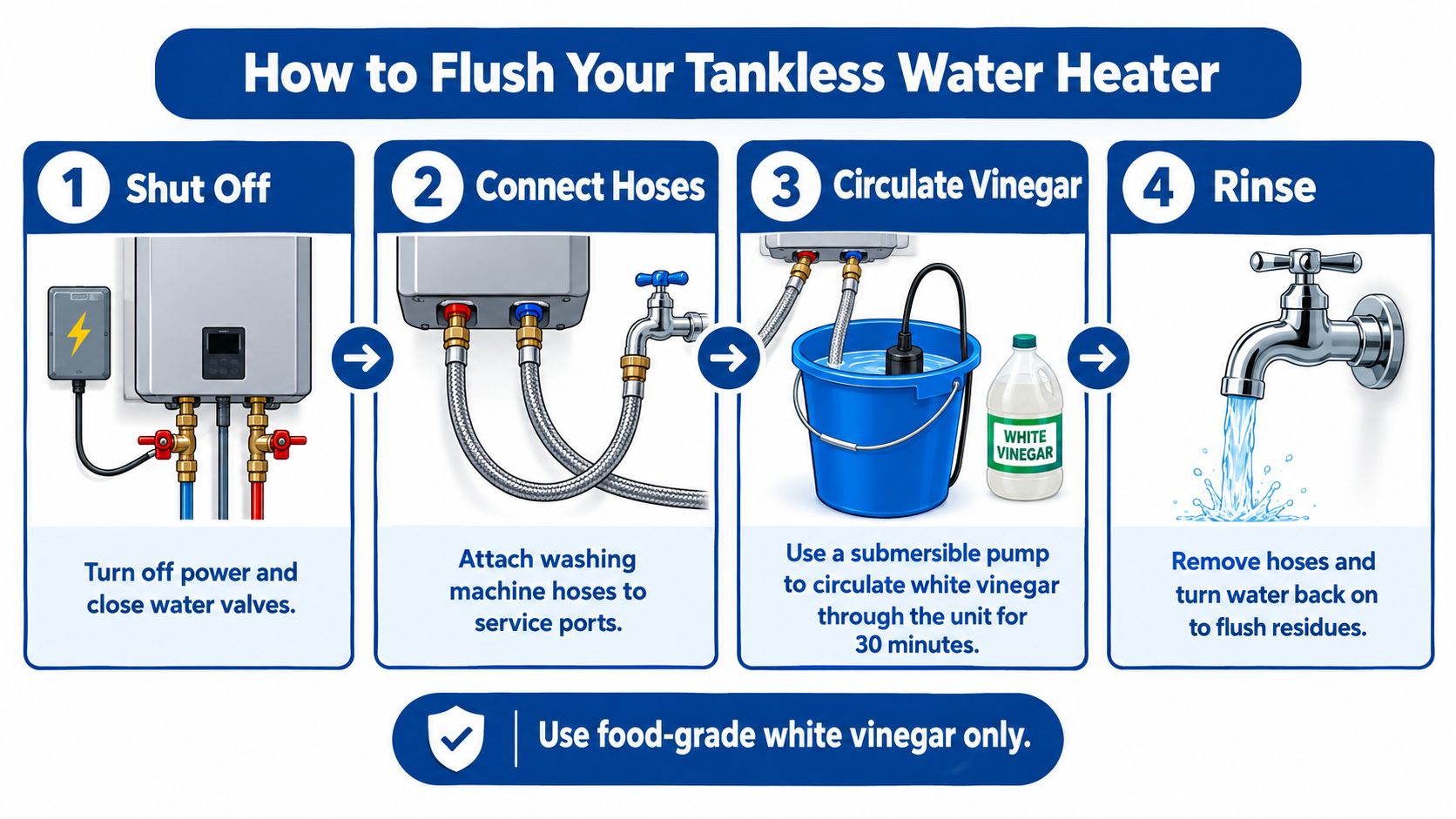
- Shut down the unit safely. Turn off the gas supply on a gas-fired model or the electrical supply on an electric model. Close the cold-water and hot-water isolation valves. Open a nearby hot-water faucet briefly to release residual pressure.
- Connect the service equipment. Attach washing-machine hoses to the service ports. Put the pump in a bucket containing food-grade white vinegar or the manufacturer-approved descaler. Secure every connection before starting the pump.
- Circulate the solution. Run the pump through the heat exchanger for about 45 to 60 minutes, following the unit's instructions. Bob Vila's tankless flushing guidance outlines the isolation, circulation, and rinse sequence. Rinnai's procedure specifies 4 gallons of undiluted white vinegar for its process and notes that circulation may take up to 45 minutes. On a hard-water home's schedule, this is the maintenance step that addresses mineral buildup directly.
- Rinse thoroughly. Stop the pump, remove the solution, and flush the heater with fresh water. Navien calls for a clean-water rinse lasting at least 10 minutes after descaling. Navien's descaling instructions explain that rinsing removes loosened scale and remaining solution.
- Restore operation. Close the service ports, reopen the water valves slowly, and check for leaks. Restore power or gas, then run a hot-water fixture. Listen for normal ignition or heating and watch for error codes.
A two-bucket setup simplifies the job. Keep the pump and solution in one bucket, and use the second for rinse discharge. Hard well-water homes may also find the inlet filter easier to inspect while the water is isolated. Never force a stuck filter or damaged cap.
Stop and call a licensed plumber if you find cracked fittings, a gas odor, water on the floor, persistent error codes, damaged valves, or warranty service conditions you cannot verify.
The pump-and-hose method suits accessible installations and homeowners who can follow the manufacturer's sequence precisely. It will not repair a failed sensor, unsafe venting, combustion problem, electrical fault, or heat exchanger already damaged by scale. Michigan's hard water makes the flush worthwhile, but it does not replace diagnosis when the unit is malfunctioning.
Beyond the Flush Filters Vents and Other Often Missed Tasks
Descaling gets most of the attention, but a tankless heater can also lose performance because air, water, or condensate can't move correctly. Keep the exterior cabinet clean with a soft cloth or vacuum attachment. Don't spray water into the cabinet or remove covers that protect gas and electrical components.
Check the water path
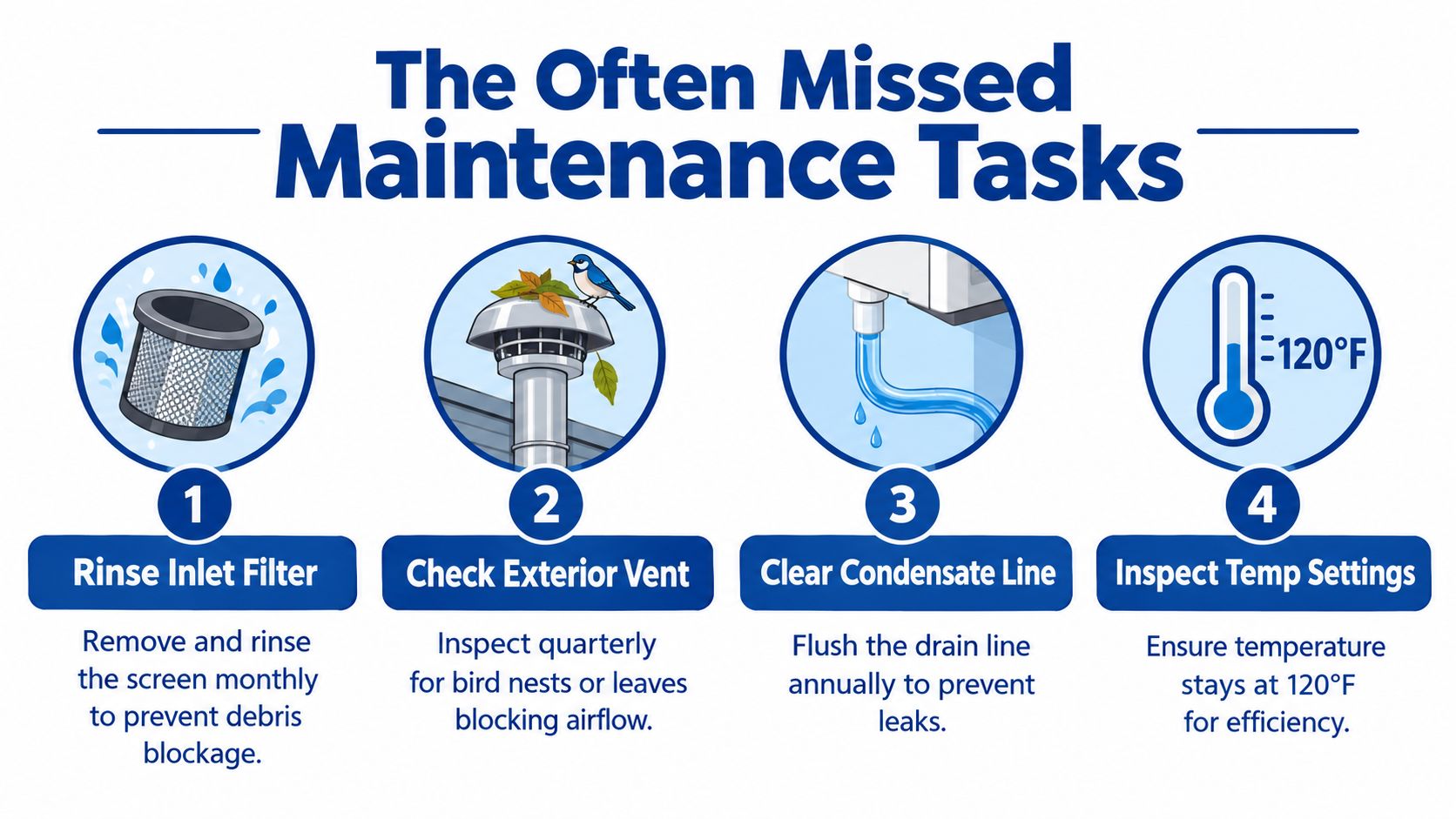
Turn off the water supply before removing the inlet filter. Rinse the screen with clean water and reinstall it carefully, making sure the seal sits correctly. Sediment from older piping, well systems, or nearby plumbing work can clog the screen and create a flow problem even when the heat exchanger is clean.
Condensing units need attention at the condensate drain, trap, neutralizer, and pump if one is installed. Look for standing water, drips, algae-like residue, or a pump that runs repeatedly without clearing the line. A licensed plumber should handle internal cleaning when the trap is damaged or the drain arrangement appears improper.
Check air and cold-weather exposure
Inspect exterior intake and exhaust openings for leaves, insects, bird nests, snow, and ice. The vent must remain open, and the piping must stay in the condition required by the manufacturer. Gas-fired units also need adequate combustion air, while electric models still require clear airflow and sound electrical connections.
Michigan winters create a separate concern. Exterior units and water lines exposed to freezing temperatures need the manufacturer's freeze-protection setup, dependable power where required, and insulation appropriate for the installation. If a unit is mounted near an exterior wall in Fraser, Sterling Heights, or Macomb, check the surrounding piping before the first hard freeze. Frozen pipes can split even when the heater cabinet appears intact.
Gas-line service information from Jays Plumbing and Sewer is relevant when a gas connection, shutoff, or supply line shows damage or suspected leakage. Don't troubleshoot a gas smell yourself.
How Often to Service Your Unit Based on Hardness and Use
Water hardness should drive the schedule more than the calendar alone. Manufacturer guidance doesn't provide one universal interval because water conditions differ. Noritz explains that hard water may require annual service while softer water can sometimes go four to five years between maintenance visits, although homeowners should still follow the specific model handbook and inspect the system regularly.
For a typical Southeast Michigan home, annual descaling is a sensible baseline. Hard-water homes may need service about every 6 to 12 months, and some high-mineral conditions justify service every 3 to 6 months. This hardness-focused tankless maintenance guidance specifically connects shorter intervals with higher hardness and heavier demand.
A practical planning grid
| Water Hardness (GPG) | Small Household (1-2 people) | Average Household (3-4 people) | Large or Recirc Use (5+ people) |
|---|---|---|---|
| Soft or softened water | Inspect and follow the handbook, with service potentially at 12 months or longer | Annual review is a practical starting point | Annual service may be appropriate, with earlier attention if flow changes |
| Average hardness | Plan routine annual descaling | Annual descaling and regular filter checks | Consider a shorter interval when demand is continuous |
| Hard water | Service about every 6 to 12 months | Service about every 6 months when scale appears quickly | Consider service every 3 to 6 months and professional evaluation |
The table is a planning tool, not a replacement for testing or manufacturer requirements. A private well can carry more sediment than a municipal supply, and a softener that isn't working can change the correct interval.
Bosch's maintenance information recommends annual heat-exchanger descaling and also identifies qualified service checks at 400 operating hours or 25,000 cycles for applicable equipment. Bosch's maintenance schedule shows why actual operation can matter alongside household size.
DIY Maintenance Compared to a Professional Visit
For a Southeast Michigan homeowner, a DIY flush can be sensible when the heater is accessible, the isolation valves operate, and the manual gives clear instructions. Hard water in Macomb and Oakland counties can make descaling more frequent, especially on a well or an unsoftened municipal supply. Gather a submersible pump, washing-machine hoses, a bucket, food-grade white vinegar or an approved descaler, and enough time to isolate, circulate, rinse, and restart the system.
The circulation stage takes about 45 to 60 minutes. Setup, rinsing, and checking for leaks extend the visit. The unit manual controls model-specific steps. A homeowner outline can help, but it does not replace those instructions.
What a professional adds
A licensed technician can inspect parts that a routine flush does not address:
- Combustion and gas operation: On gas-fired equipment, the technician can evaluate burner performance and combustion conditions.
- Electrical components: Connections, controls, sensors, and heating elements require appropriate testing.
- Venting: The intake and exhaust arrangement can be checked for blockage, damage, moisture, snow, and installation concerns. Southeast Michigan winters make exterior vent inspection especially important.
- Error history: Repeated faults may indicate flow, ignition, temperature, sensor, or control problems that scale removal will not correct.
- Leak sources: A slow fitting or condensate leak is easier to locate during a complete service visit than after water reaches the floor.
- Warranty documentation: Written records can show that maintenance followed the manufacturer's handbook when service documentation matters.
DIY costs less when you already own the pump and hoses, but its scope is narrower. A professional visit costs more than descaling solution because it includes diagnosis, safety checks, and work that should not be performed by an unlicensed homeowner.
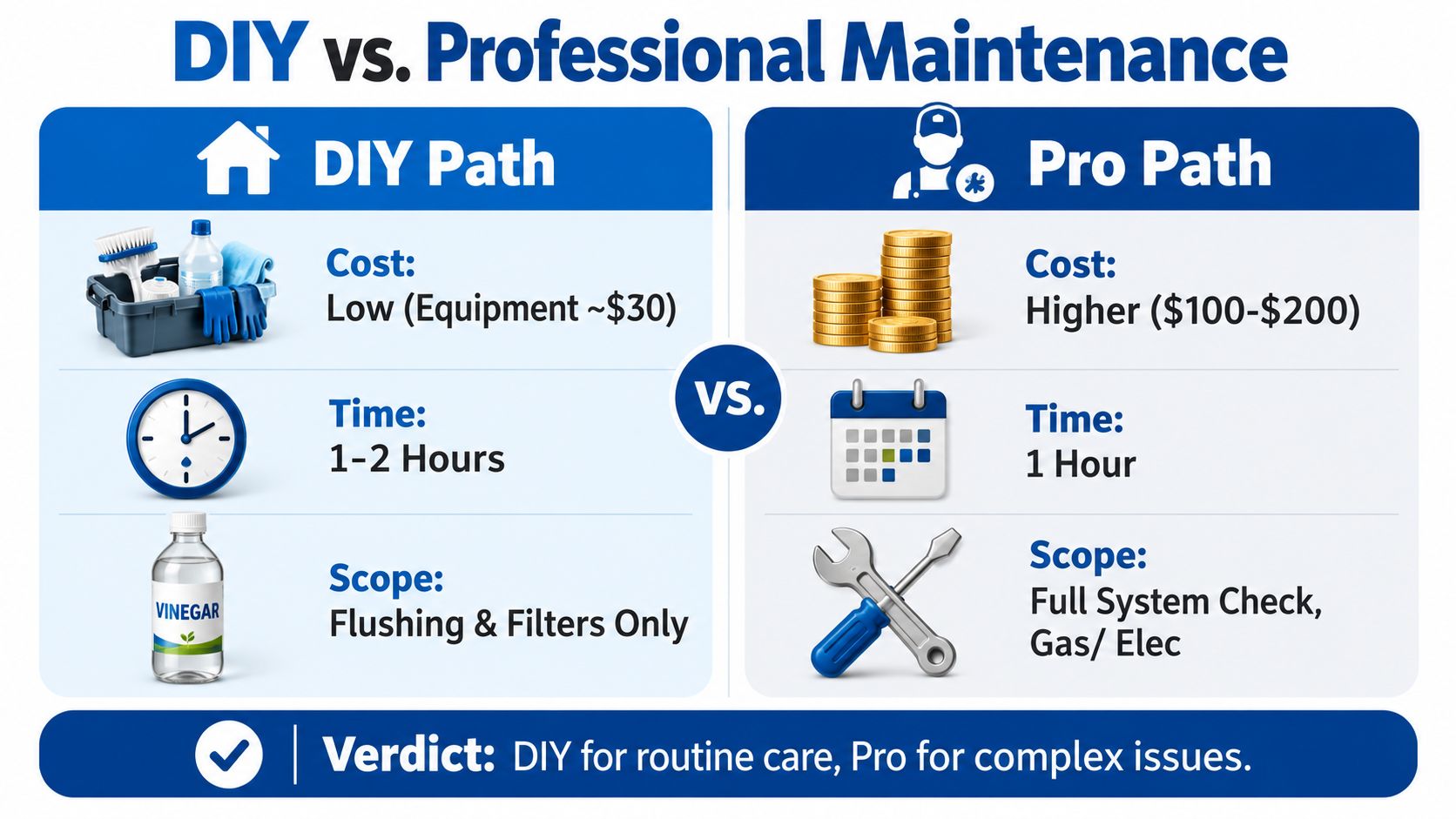
Stop DIY work and call for service if you smell gas, find water pooling beneath the unit, hear ignition clicking without a flame, see a persistent error code, or still have no hot water after a proper reset. Professional service is also the practical choice for commercial properties, heavy demand, complicated recirculation systems, or units affected by severe scale and sediment.
Your Yearly Tankless Care Checklist and When to Call a Pro
A calendar taped inside the utility closet can prevent maintenance from becoming an emergency. Keep the unit model and serial information with the records, note each service date, and record any changes in flow, temperature, or error messages.
Monthly and quarterly checks
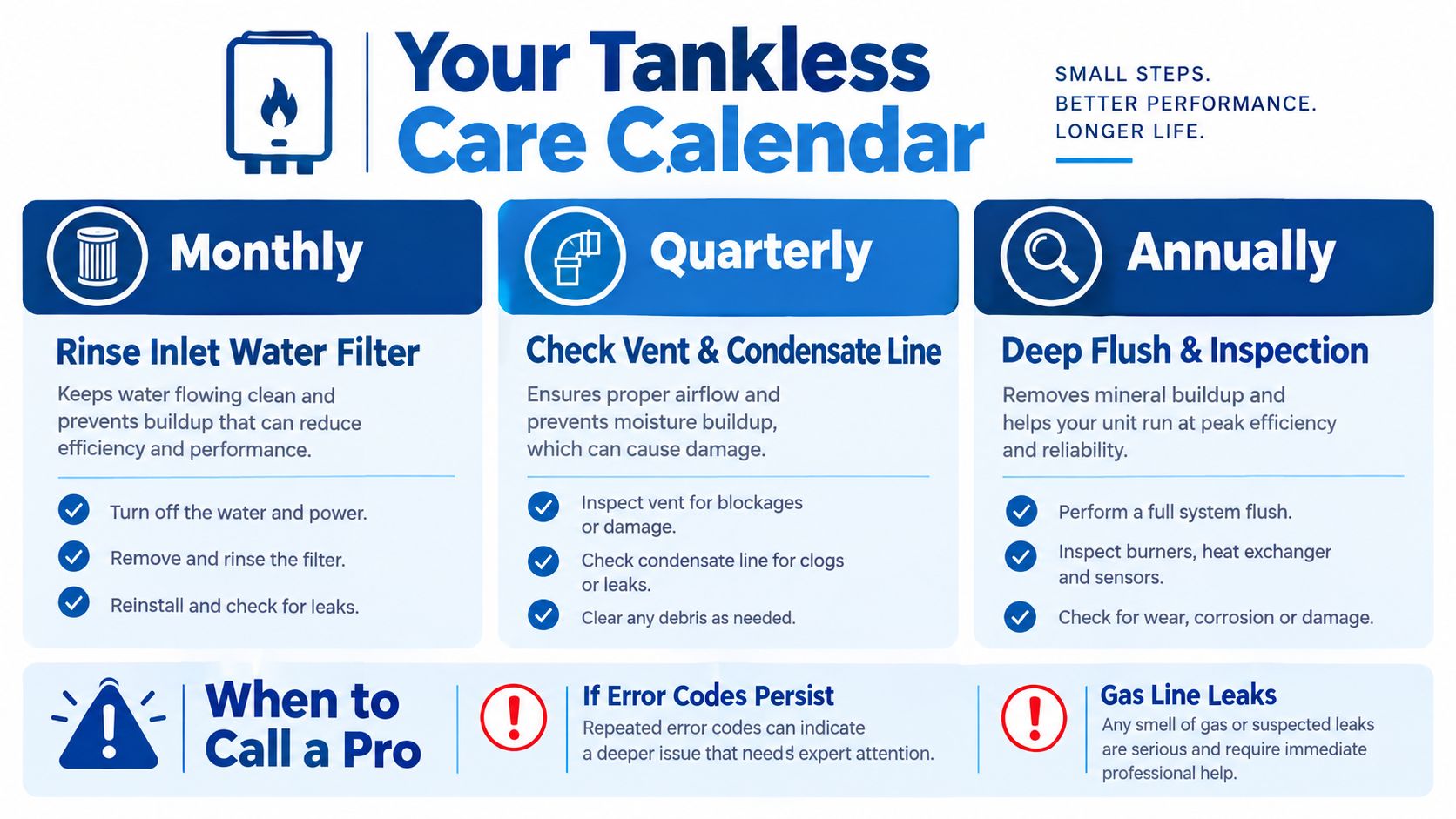
Monthly: Rinse the inlet water filter if the manufacturer permits homeowner cleaning and the filter is accessible. Look for cabinet moisture, unusual sounds, temperature changes, and visible pipe damage.
Quarterly: Check the exterior vent and combustion-air openings for leaves, nests, snow, and ice. Inspect the condensate line for drips or standing water, and confirm that the drain path is open.
Before Michigan winter: Verify that exterior piping has appropriate freeze protection and that the unit's required power and protection systems are available. Heavy rain and basement flooding can also affect nearby drains, sump systems, and utility areas, so keep the heater and surrounding equipment dry.
Annual service decisions
Schedule descaling according to water hardness, use, and the manufacturer's handbook. Annual service is a common baseline, but hard-water homes, large households, recirculation systems, and commercial properties may need a shorter cycle.
A professional should handle combustion, gas, electrical, venting, internal safety, and complicated condensate work. A yearly professional tune-up can also create useful maintenance documentation, but no plumber should promise a specific lifespan or guarantee that a component won't fail.
Use this tankless troubleshooting guide when you're sorting out a performance change, then call for same-day help when:
- Error codes persist: The unit won't return to normal after the manufacturer-approved reset.
- Hot water stays off: A reset doesn't restore operation.
- Water pools below the heater: Shut off the water supply if safe and arrange service.
- Ignition clicks without flame: Don't keep attempting ignition on a gas unit.
- A sulfur or gas-like odor appears: Leave the area if needed and contact an appropriate emergency service before having a plumber inspect the installation.
These concerns can affect residential plumbing, commercial plumbing, and properties between routine service visits. They may also overlap with water heater repair, water heater replacement, leak detection, pipe repair, or gas-line work.
Call Jays Plumbing and Sewer at 586-634-3450 for tankless water heater maintenance, repair, installation, and replacement throughout Macomb, Oakland, and Wayne counties. The team also handles emergency plumbing, drain cleaning, sewer repair, leak detection, pipe repair, sump pump repair, garbage disposal repair, bathroom plumbing, kitchen plumbing, and commercial plumbing. Visit Jays Plumbing and Sewer to schedule service or request an estimate.
