A gas line issue rarely starts with drama. It usually starts with a homeowner in Fraser catching a faint sulfur smell near the furnace, hearing a soft hiss behind the dryer, or noticing that something just feels off around the meter. That's the kind of call a plumber takes seriously right away, because gas line repair isn't one single task, it's a safety-driven process that starts with finding out where the problem really is before anyone touches pipe.
For homes across Macomb County and nearby Oakland County communities, the first question isn't “Can it be patched?” It's “Where does the utility stop, where does the homeowner's responsibility begin, and what condition is the line in once it's exposed?” That's the work behind a proper gas line call, and it's why a licensed technician looks at the whole system, not just the visible leak.
Table of Contents
- What Gas Line Repair Really Means
- Warning Signs That Suggest You Need Gas Line Repair
- What to Do the Moment You Suspect a Gas Leak
- How a Licensed Plumber Diagnoses and Repairs the Line
- Repair or Replace How the Right Call Gets Made
- Gas Line Repair Costs and Responsibility Allocation
- Permits Licensing and Why DIY Gas Work Is Never Worth the Risk
- Preventing Gas Line Problems and Knowing When to Call
What Gas Line Repair Really Means
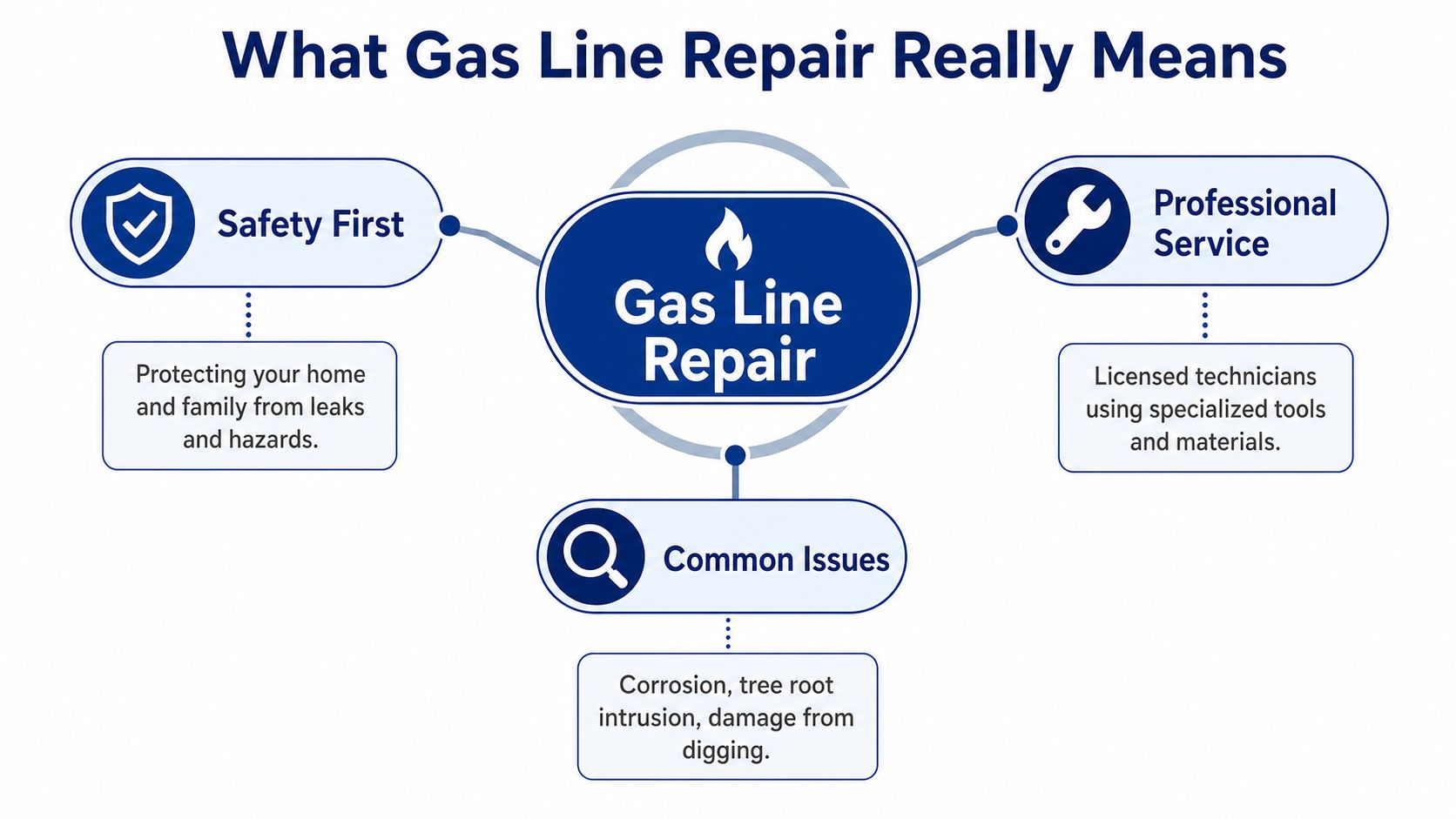
A homeowner usually hears the phrase gas line repair and thinks of one cracked pipe. In practice, the job is broader. It can include inspection, isolating the affected section, replacing damaged fittings or pipe, and pressure testing the line that carries natural gas or propane from the meter to appliances.
A typical Fraser call starts inside the house. A customer might smell gas near a water heater, and the technician has to decide whether the issue is at the appliance connection, in the shutoff, or farther back in the piping. The answer changes the repair completely, which is why a real service call begins with a systematic check instead of jumping straight to a wrench.
Practical rule: If the line hasn't been identified, it hasn't been repaired yet.
On older Southeast Michigan homes, gas piping can vary a lot by remodel history. Some properties have newer appliance connectors at the furnace or range, while buried service runs and older black iron sections may still be in place. That mix matters because a visible leak at one appliance can point to broader wear in the rest of the line.
Common Gas Line Materials in Older Macomb County Homes
| Pipe Material | Typical Home Age | Most Common Issue |
|---|---|---|
| Black iron | Many older homes and long-running retrofit systems | Corrosion, thread wear, and aging joints |
| Flexible appliance connector | Often found at ranges, dryers, and water heaters | Rub-through, kinking, or loose fittings |
| Buried service piping | Varies by install history | Excavation damage, shifting soil, or corrosion at vulnerable points |
The repair category also includes work that happens after the pipe is already opened up. That can mean securing the area, checking the affected run, and confirming the system holds pressure again before the gas is put back in service. For a homeowner, that's the difference between paying for a temporary patch and paying for work that restores the line safely.
Warning Signs That Suggest You Need Gas Line Repair
A gas problem usually leaves clues before it turns into a full emergency. The trick is knowing which clues are serious, which ones are early warnings, and which ones mean you should stop what you're doing and leave.
The signs that matter most
- Rotten-egg smell: Natural gas is odorized, so that sulfur-like smell is a warning, not something to ignore.
- Hissing near a pipe or fitting: That sound often points to escaping gas at a joint, connector, or damaged section.
- Dead vegetation in a straight line over a buried run: If grass dies in a narrow strip, the line below it deserves attention.
- Appliance issues that repeat: A pilot that keeps going out, or a burner that won't stay lit, can be tied to gas supply trouble.
- Scorching or discoloration around connectors: Heat marks can signal a problem at the appliance hookup.
- Unexplained changes in usage: If the gas bill rises without a clear reason, the system should be checked.
A homeowner doesn't need to diagnose the cause before calling. The point is to recognize the pattern and treat it as a gas issue until a technician proves otherwise. In a lot of cases, what looks like an appliance failure turns out to be a fitting, connector, or buried section that isn't holding correctly.
A faint odor is enough to pay attention. A hissing sound is enough to stop normal use and leave the area.
The safest response depends on how strong the sign is. A mild odor near an appliance still warrants a same-day call. A stronger smell, a hissing line, or dizziness without another clear cause means the situation should move immediately into evacuation and emergency response. You don't need to wait for proof. You need to get the system checked by a professional who knows how to isolate the line without making the situation worse.
What to Do the Moment You Suspect a Gas Leak
Leave the building right away. Do not flip lights on or off, use switches, or open and close anything that could spark. Fans, phones used indoors, and other small electronics can create a spark, so safety guidance says calls should be made from a safe distance, with one recommendation placing that distance at 350 feet from the home (gas leak safety guidance).
Once you are outside and away from the house, call 911 and the gas utility first. A plumber comes after that, because the utility and emergency responders need to secure the site before any repair work starts. For local response coordination, many homeowners keep emergency service contact options ready before they ever need them.
A simple order of operations
- Get everyone out. No one should stay behind to check one more thing.
- Avoid switches, phones indoors, and open flames. Do not create a spark while you are trying to figure out the source.
- Move away from the building. Stay at a safe distance before making any calls.
- Call 911 and the gas utility. Let them decide how the site gets secured.
- Call a licensed plumber for the repair. The plumber handles diagnosis and restoration after the area is safe.
If the only clue is a faint odor and you are not sure whether it is gas or something else nearby, do not gamble on it. Leave first, then let professionals sort it out. The common mistake is staying inside to confirm the smell, and that is the wrong time to test your own judgment.
A lot of people ask whether they should shut off the home valve before leaving. That is not the moment to experiment. If you are not already trained and standing in a safe situation, your job is to get out and make the calls, not start working the system.

How a Licensed Plumber Diagnoses and Repairs the Line
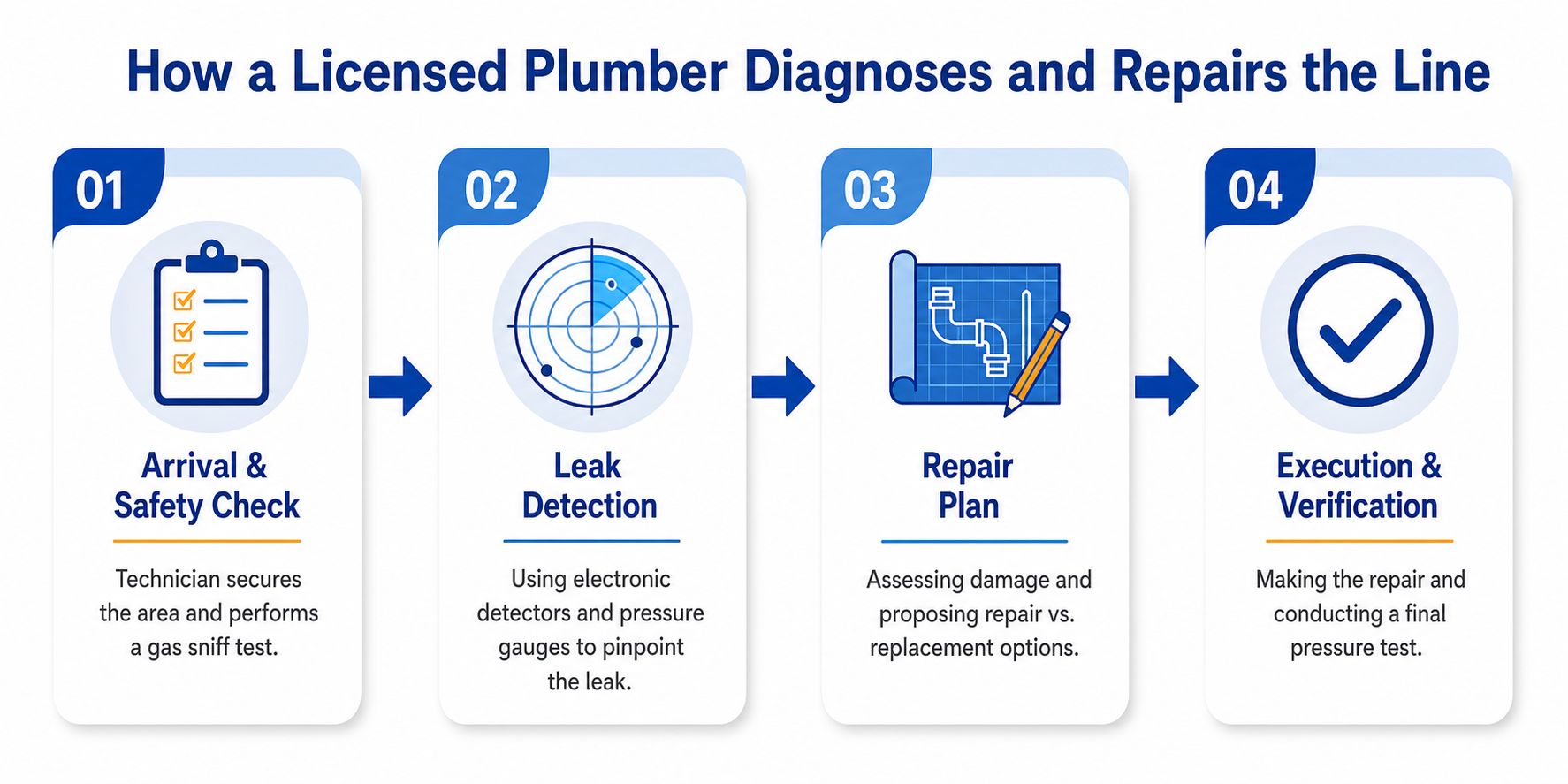
A gas line call starts at the meter boundary and works inward. A licensed plumber checks where the utility stops and the homeowner's piping begins, confirms the complaint, and looks for the pattern of failure before any cut is made. On older Southeast Michigan homes, that usually means tracing mixed materials, aging appliance connectors, and service lines that have seen repairs before.
The first pass is a safety check. The technician surveys the area, uses detectors and gauges, and decides whether the leak is at a fitting, a short branch, a buried run, or something closer to the meter. Federal distribution guidance also calls for leak surveys by a qualified person at intervals not exceeding 5 years, specifically not to exceed 63 months, and it requires records of the probable cause, repair method, materials used, date, and the person who performed the repair (federal distribution guidance summary).
What the technician is looking for
- Connection points: Loose fittings, failed seals, and worn flex connectors.
- Pipe condition: Corrosion, thread damage, or prior patching that did not hold.
- System behavior: Whether the line holds pressure once isolated.
- Location risk: Whether the issue is indoors, at the meter, or buried outside.
Buried or uncertain runs need a slower approach. The technician marks the route, checks the area around it before any digging starts, and stays alert for drawings that do not match what is in the ground. Safety guidance says buried gas lines should be clearly marked before excavation, and any mismatch between drawings and markings should be resolved with hand digging or potholing, especially within 5 feet of a marked gas line (excavation safety bulletin). On a lot of local calls, that step keeps a small leak from turning into a bigger mess.
Good gas work is measured twice, opened once, then tested again.
A proper repair can be a simple connector swap, a replaced fitting near the meter, or a damaged section cut out and reworked. The final step is verification. Pressure testing is not paperwork, it is the check that the repaired section can hold under operating conditions before service is restored. For homeowners who want a licensed crew that handles this kind of residential gas piping work as part of residential plumbing services, Jays Plumbing and Sewer fits that role without the sales pitch getting in the way of the job.
The quote that should make a homeowner pause is the one that skips the test. If the work description does not include isolation, repair, and verification, the job is not finished.
Repair or Replace How the Right Call Gets Made
Not every damaged line should be patched, and not every damaged line needs a full tear-out. The right answer depends on the pipe's age, the material, the number of problem spots, and whether the issue looks isolated or part of broader deterioration.
A single cracked fitting behind a range is one thing. A rubbed-through dryer connector is another. In those cases, a targeted repair can be the right move because the damage is localized and the surrounding line still makes sense to keep in service.
Where repair makes sense
A small, isolated fault is often the best candidate for repair when the rest of the system is sound. That's especially true for a single appliance connector, a loose union, or one damaged threaded fitting. The technician can replace the failed part, pressure test the line, and move on without disturbing healthy piping.
Where replacement starts to win
Replacement becomes more attractive when the line shows widespread corrosion, brittle joints, or repeated failures in different spots. Buried yard lines add another layer because excavation can expose more damage than the homeowner expected. In those cases, the first leak is sometimes just the warning sign that the rest of the line is aging out too.
That decision is where experience matters. A solid technician reads the pipe material, checks the pattern of wear, and uses the pressure test to judge whether the system still has life left in it. If the damage is cosmetic and contained, repair may be enough. If the pipe is failing in more than one place, replacement is usually the safer long-term choice.
The goal isn't to sell the bigger job. The goal is to avoid paying twice for the same compromised line.
In Southeast Michigan, older homes often have enough mixed piping history that a spot fix can reveal a larger maintenance problem. That doesn't mean panic. It means the homeowner gets an honest recommendation based on what is there, not a guess from the surface.
Gas Line Repair Costs and Responsibility Allocation
The cost question comes up fast, and it should. Independent cost guidance says gas line repairs commonly range from $120 to $5,000, with major buried-line repairs costing $2,000+ (independent gas line cost guide). Emergency service also tends to carry a premium, and the pricing often reflects how fast the crew has to respond, how much testing is needed, and whether the line can be isolated without opening walls or digging.
Those numbers still do not tell the whole story. A short flex connector swap is a different job from an indoor pipe section replacement, and a buried line adds excavation, access, and restoration work. A quote should match what the technician found after checking the meter boundary, testing the line, and deciding whether the damage is isolated or part of a larger failure. That is the kind of call Southeast Michigan homes with older service lines often force, because mixed materials, past repairs, and buried runs can turn a small leak into a broader repair plan.
Who usually pays for what
The meter boundary is the part many homeowners miss. In most cases, the utility handles the service line up to the meter, and the homeowner handles the side of the system on the property beyond that point. That dividing line usually decides who gets called first, who opens the work order, and who gets the bill for the repair itself.
If the leak shows up near the meter, the gas utility and a plumber may both get involved. If the problem is clearly inside the home or on private property piping, the homeowner usually needs a licensed plumber first. Insurance coverage can vary by policy and by the exact point of failure, so if there is any doubt, it makes sense to ask the carrier directly whether that specific repair is included.
For readers comparing gas line work with other home maintenance costs, drain cleaning pricing context gives a useful comparison for how access and complexity change the final bill. Gas piping follows the same basic principle. A job that is easy to reach stays simpler, and a job that involves testing, digging, or restoring finished surfaces costs more because the labor is broader and the risk is higher.
Permits Licensing and Why DIY Gas Work Is Never Worth the Risk
Gas line work isn't a place to test your own confidence. It often requires a permit, a post-repair inspection, and a technician who knows how to complete pressure testing and sign off the job correctly. In many jurisdictions, the repair can't proceed without permit approval before work begins, and the line can't be restored until the work passes inspection.
Michigan licensing matters here because it tells you the technician is trained for this exact kind of work, not just general plumbing. The technician needs the tools, the gas-specific process knowledge, and the working relationship with local inspection requirements to complete the job legally and safely.
There's a bigger reason to avoid DIY gas work. Unpermitted gas changes can become a problem during a home sale, create headaches with appliance warranties, and complicate insurance after a later incident. Even when a homeowner knows plumbing well, gas is different because the margin for error is so much smaller.
If the job needs a pressure test, it needs a professional who can read that test correctly.
The smartest move is simple. If you suspect a leak, need a repair, or are adding an appliance tied to gas piping, call a licensed plumber instead of trying to sort it out alone. That choice protects the house, the people in it, and the paperwork that follows the work.
Preventing Gas Line Problems and Knowing When to Call
The best prevention is boring, and that's a good thing. Keep the area around the meter clear, pay attention after freeze-thaw cycles, and have older piping checked before a new appliance gets installed. If the yard line shifts, the appliances act strange, or you smell gas even faintly, that's the time to act.
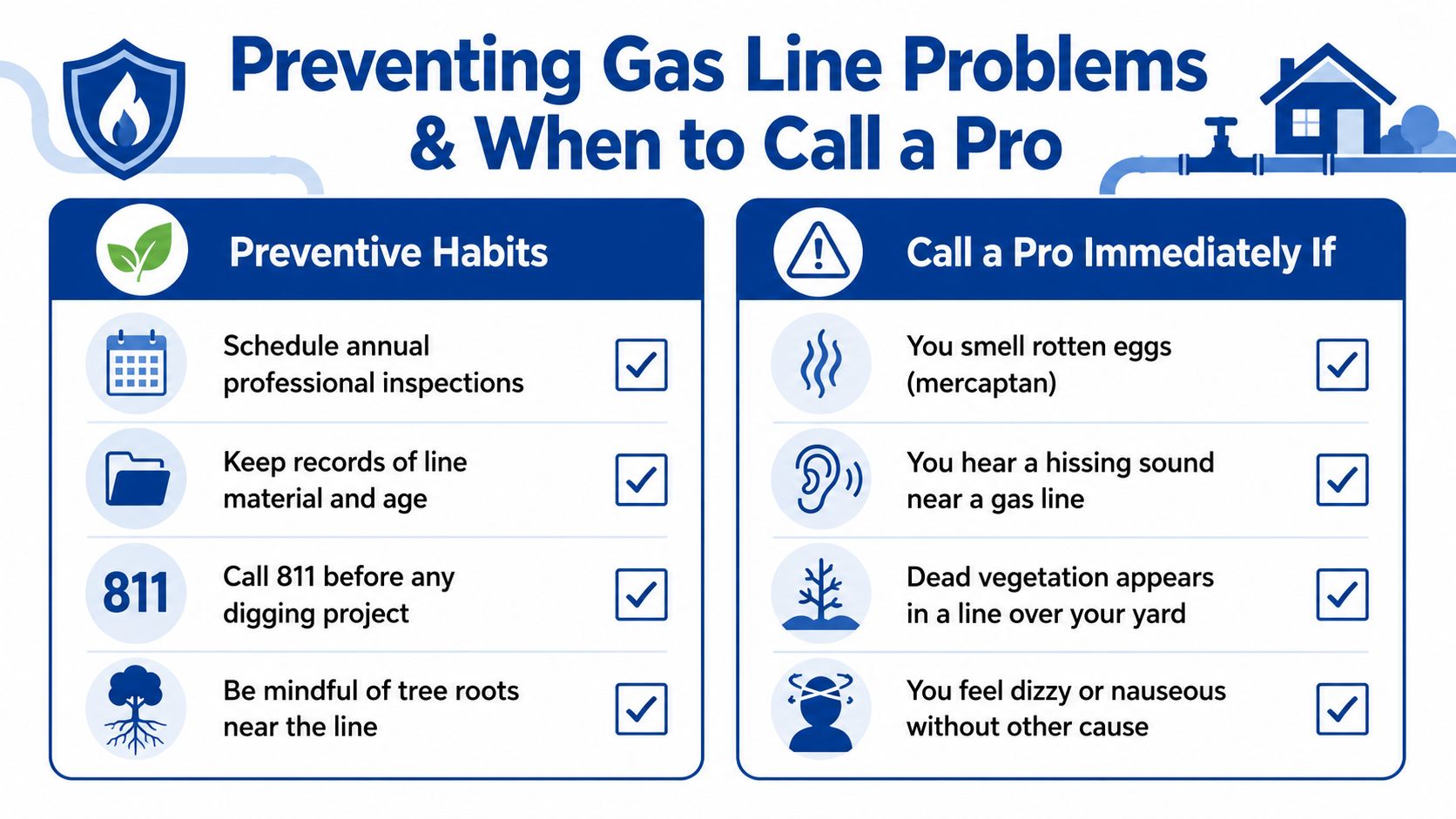
The three biggest call points are easy to remember. Call when you notice a warning sign, call when a gas appliance is being installed or replaced, and call when you're buying or selling a home with older piping. That's when a simple inspection can keep the job from turning into an emergency.
FAQ
Can I fix a gas line myself?
No. Gas line repair belongs with a licensed professional because the work needs isolation, testing, and safe reactivation.
How do I know if it's a real leak?
A rotten-egg smell, hissing, dead vegetation over a buried run, or repeated appliance problems are enough to call.
Do I call the utility or a plumber first?
If you suspect an active leak, call 911 and the gas utility first, then a plumber once the area is safe.
Should older homes be inspected even if nothing seems wrong?
Yes, especially if the home has older service lines or you're planning appliance changes.
Call Jay's Plumbing and sewer Now @ 586-634-3450 if you're dealing with gas line concerns in Fraser, Macomb County, or nearby Oakland County communities. The team handles residential and commercial gas line repair with the same practical approach homeowners need, from leak detection to replacement recommendations. You can also visit Jays Plumbing and Sewer to schedule service and get the right line checked before a small issue turns into a bigger one.
