
On a gray Sunday morning in Macomb County, the washing machine drains and the basement floor drain burps back at you. The bathroom sink gurgles, the kitchen is slow, and the main line has already been snaked twice this season. You're not dealing with a simple hair clog anymore. You're seeing signs that buildup, roots, or another restriction may be affecting the sewer line itself.
So, how does hydro jetting work? A plumber feeds a specialized hose and nozzle into the line, then uses pressurized water to break loose material and scrub the pipe walls. Unlike a cable that opens a narrow path through a blockage, hydro jetting can clean the pipe's interior along the jetted section. It's powerful, but it isn't a cure for every sewer problem. A sound pipe may respond very well, while a collapsed or shifted line needs sewer repair.
Table of Contents
- When Hydro Jetting Becomes the Right Call
- The Equipment That Makes Hydro Jetting Work
- How the Cleaning Process Unfolds Step by Step
- Hydro Jetting Compared to Snaking and Other Methods
- Common Reasons Michigan Homes and Businesses Need Jetting
- What Hydro Jetting Cannot Fix on Its Own
- Hydro Jetting Cost and What to Expect on the Bill
- Choosing a Hydro Jetting Service in Macomb and Oakland Counties
When Hydro Jetting Becomes the Right Call
A single slow bathroom sink usually doesn't justify hydro jetting. Hair, soap residue, or a small trap obstruction may respond to ordinary drain cleaning and a properly sized hand auger. The same is true for a kitchen sink that slows once because of a localized food blockage.
The decision changes when several fixtures show symptoms together. In that Macomb County kitchen, the washing machine, floor drain, sink, and bathroom fixtures are all connected to the larger drainage system. Repeated backups, slow drains that return soon after clearing, sewer odor near a floor drain, or water collecting around a basement cleanout suggest a restriction farther down the line.
Practical rule: If the same sewer line keeps failing after mechanical clearing, ask what remains on the pipe wall, not only where the latest hole was opened.
Hydro jetting makes sense when grease, sludge, mineral scale, sand, or soft root growth has narrowed the line. The process uses water pressure to loosen buildup and flow to carry it downstream, which is why professional sewer line cleaning can be more thorough than repeatedly punching through one blockage.
A plumber still needs to choose the method carefully. A single hair clog doesn't need a jetter, while a recurring mainline backup may need a camera inspection followed by jetting or sewer repair. The equipment and nozzle selection determine how the cleaning is performed, so it helps to understand what arrives at the property.
The Equipment That Makes Hydro Jetting Work
A hydro jetting setup has four working parts. The truck or trailer carries a water supply and pump, the engine powers the pump, the hose delivers water into the line, and the nozzle turns that water into a cleaning tool.
The four parts homeowners should know
- Water tank: The tank supplies water for the cleaning pass. The system needs enough water to keep the nozzle working while loosened material is flushed away.
- Engine and triplex pump: A gasoline or diesel engine drives the pump. The pump pressurizes the water before it enters the hose.
- Jetter hose: This flexible, heavy-duty hose travels through the drain or sewer line. Its markings help the technician track how far the hose has moved and relate that position to camera footage.
- Nozzle: The nozzle does the cutting and scrubbing. Forward-facing jets help penetrate a blockage, while rear-facing jets pull the hose forward and scour the pipe wall.
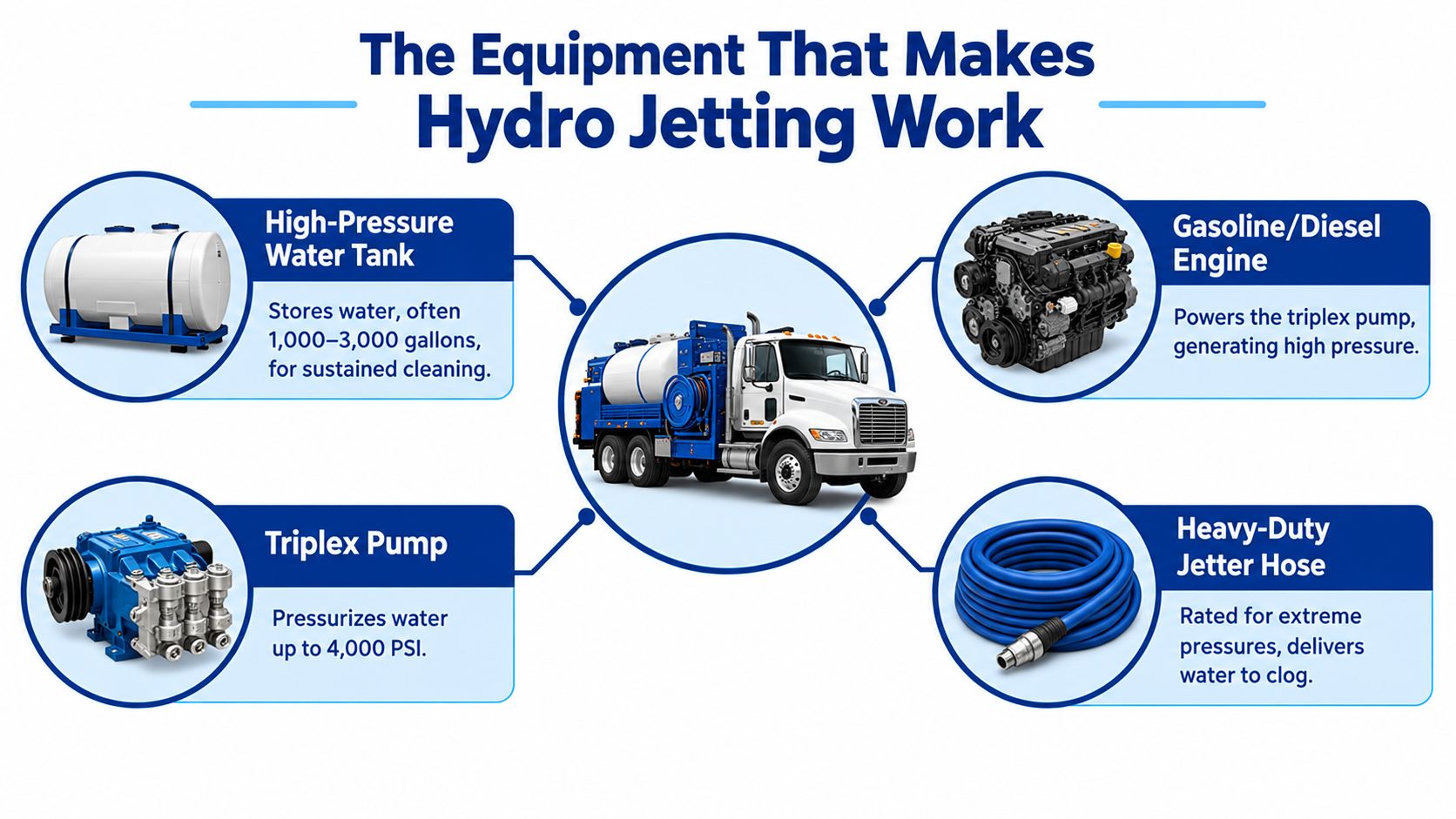
Technicians describe water performance using PSI and GPM. PSI means pounds per square inch, or the force concentrated at the nozzle. GPM means gallons per minute, or the amount of water available to carry loosened grease, scale, sand, and debris away. Residential lines commonly use about 1,500 to 4,000 PSI, with systems moving about 1.5 to 18 gallons per minute, according to this hydro jetting equipment explanation.
A chisel-style or root-cutting head may suit scale and soft roots. A rotating nozzle spreads the spray around a grease-coated line, while a penetrating nozzle helps the hose get through a soft blockage. The technician also uses protective clothing, gloves, eye protection, and controlled hose handling because the water stream can injure people and damage property if handled carelessly.
How the Cleaning Process Unfolds Step by Step
A professional visit starts with access, not with turning the pump to its highest setting. The technician may use a basement cleanout, yard cleanout, roof vent, or another suitable opening. If no usable cleanout is available, a pulled toilet may provide access, though that adds preparation and restoration work.
The camera inspection matters before the hose enters. It can show whether the line is PVC, cast iron, clay, or another material, and whether the pipe appears sound enough for the selected pressure and nozzle. A technician can then locate the restriction instead of guessing from the fixture that happens to be backing up.
- Locate the access point. The plumber identifies where the hose can enter and where flushed water and debris should travel.
- Inspect the line. A sewer camera helps identify grease, scale, roots, foreign material, offsets, or other concerns.
- Feed in the hose. The nozzle enters the line and travels toward the restriction. Forward jets help open a path, while rear jets help move the hose.
- Scour on the return pass. The technician pulls the hose back in controlled passes. Water directed backward and outward strikes the pipe wall and carries loosened material downstream.
- Verify and clean up. A final camera view confirms the result, the access point is resealed, and the work area is rinsed and left orderly.
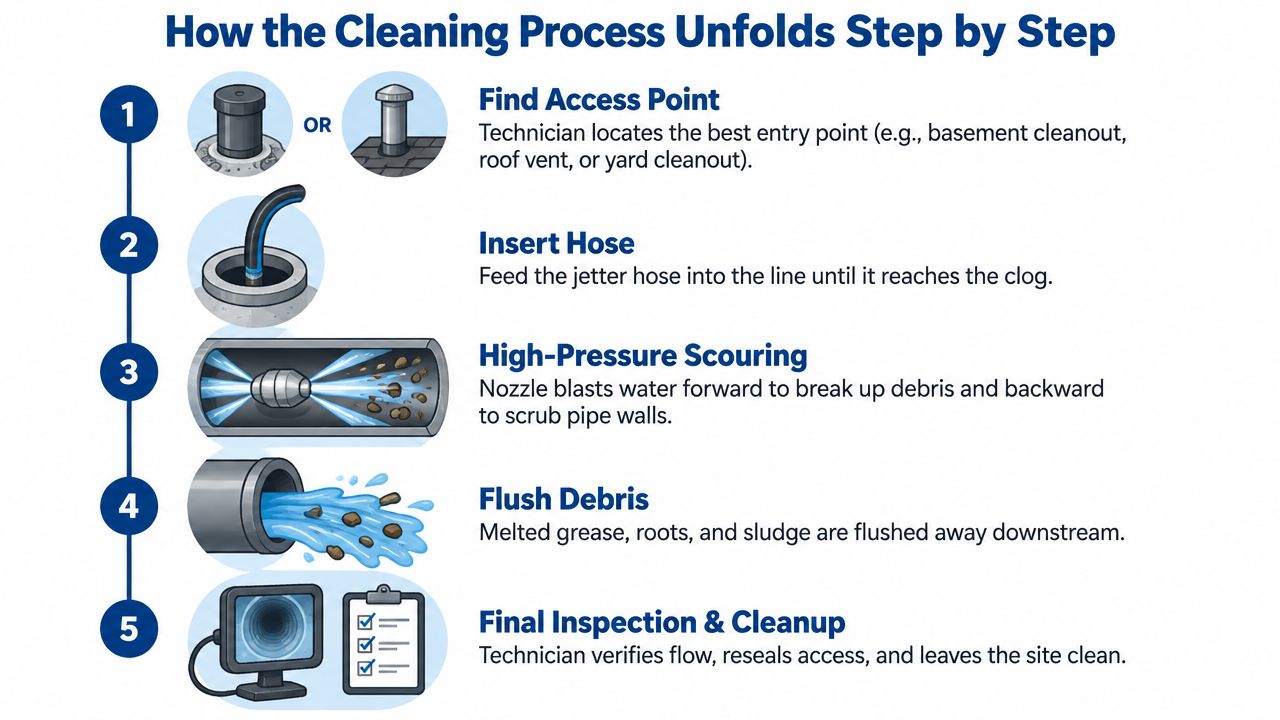
A typical description of the method places the process in a simple sequence: the nozzle's forward jets fracture or dislodge the blockage, while rear-facing jets pull the hose deeper and scrub the pipe wall. For additional visual context, this hydro jetting process video shows the type of equipment and movement involved.
The technician watches the reel, hose markings, water movement, and camera image during the job. Heavy sections may receive another pass, but the goal isn't to run water blindly. The homeowner should receive a plain-language recap explaining what was found, what was cleaned, and whether the line needs repair.
Hydro Jetting Compared to Snaking and Other Methods
A drain snake, chemical cleaner, and hydro jetter don't do the same job. Choosing among them depends on the type of obstruction, pipe condition, and whether the buildup is isolated or spread along the line.
| Method | What It Removes | Pipe Risk | How Long Results Last | Typical Cost |
|---|---|---|---|---|
| Drain snake | Opens or breaks through a localized clog | Depends on the tool and pipe condition | May be temporary when buildup remains | Varies by access, blockage, and service conditions |
| Chemical cleaner | May affect a small sink-side obstruction | Can be hazardous to people and hard on some piping | Often temporary for recurring buildup | Retail product cost, plus possible later service |
| Hydro jetting | Scours buildup from the pipe wall and flushes loosened material | Requires inspection and pressure selection | Can last longer when the pipe is sound and the cause is buildup | Varies by line, access, equipment, and diagnosis |
Snaking is useful for a straightforward obstruction. It can restore flow without setting up a water tank and pump, but the cable may leave grease, sludge, or scale attached to the pipe wall. Chemical products are a poor choice for a recurring mainline problem. They may reach a nearby sink obstruction, but they don't provide the controlled, full-line cleaning a professional jetter is designed to deliver.
Hydro jetting is the thorough middle-ground between a temporary opening and excavation. It doesn't replace a damaged pipe, and it isn't automatically safer because it uses water. The plumber must inspect the line and match the nozzle and pressure to the material and condition. A video camera sewer inspection helps make that choice based on evidence.
Common Reasons Michigan Homes and Businesses Need Jetting
Michigan properties see a mix of old piping, mature trees, hard-water scale, seasonal stress, and heavy household use. In Macomb County, a kitchen line may gradually narrow from cooled cooking grease. The homeowner may still have drainage, but the pipe has less usable space every time more residue sticks to the wall.
Bathroom and stack lines can collect soap residue, hair, sludge, and mineral scale. Older cast iron may develop rough interior deposits that catch additional debris. In older neighborhoods around Warren, St. Clair Shores, Fraser, Sterling Heights, Clinton Township, and nearby communities, the age and material of the sewer lateral can influence which cleaning method is appropriate.
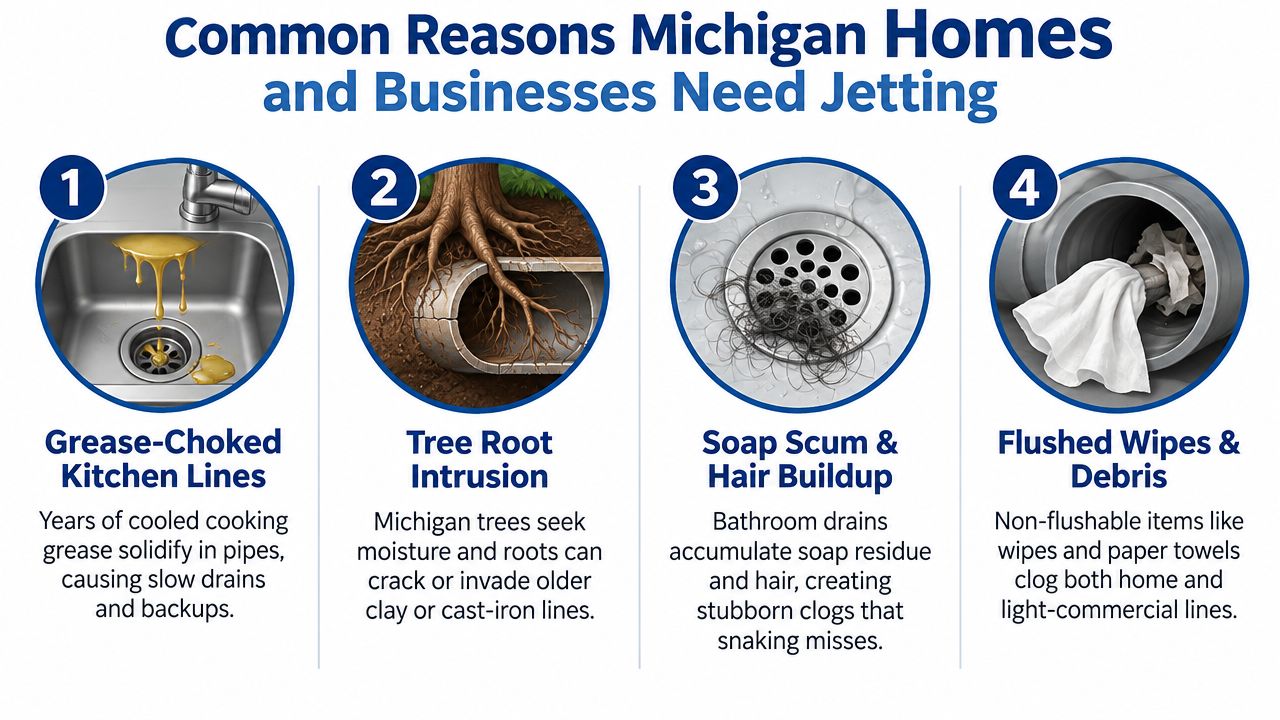
Soft root intrusion can also respond to a root-cutting nozzle when roots have entered through a joint or small opening but haven't caused major structural deformation. Jetting removes the growth inside the line, but it doesn't seal the opening that allowed the roots in.
Commercial properties have different pressure points. A restaurant may need grease-line cleaning after drainage slows during service, while a multi-unit building may have stack backups connected to repeated tenant use. Commercial plumbing demands scheduling, access planning, and equipment suited to a larger system.
The same logic applies in Oakland County communities such as Troy and northern Macomb County areas such as Shelby Township and Macomb Township. Hydro jetting works best when the pipe remains structurally sound and the restriction consists of grease, sludge, scale, sand, debris, or soft root growth.
What Hydro Jetting Cannot Fix on Its Own
A clean pipe isn't necessarily a sound pipe. Water can remove buildup from an offset joint, but it won't realign the joint. It can clear material from a bellied section, but it won't correct the sag created by soil settlement or frost movement.
Structural problems include:
- Offset joints: Sections have shifted and no longer meet evenly.
- Bellied lines: A low section holds water and debris because the pipe has settled.
- Collapsed pipe: A crushed or severely deformed line has lost its passage.
- Cracked or deteriorated pipe: Roots and soil can enter through openings that cleaning can't close.
- Heavy root intrusion: Roots may be a symptom of a damaged joint or wall, not the original cause.
The warning pattern is usually repetition. The same line backs up again after a complete cleaning, several fixtures gurgle when a nearby toilet runs, or a soggy patch appears over the sewer route. Those signs justify a camera inspection and a repair discussion, not another blind cleaning appointment.
A jet can restore flow through a damaged line, but restored flow isn't the same as restored pipe integrity.
Depending on what the camera shows, the solution could involve a targeted spot repair, pipe lining, excavation, or replacement. Jetting before repair may still be useful if debris blocks the camera view, but the homeowner should understand what the cleaning can and can't accomplish. A final camera verification helps confirm whether the line is merely clean or also structurally acceptable.
Hydro Jetting Cost and What to Expect on the Bill
Hydro jetting prices vary because the work varies. A short, accessible residential line with a cleanout is a different job from a long commercial run with heavy grease, difficult access, or emergency timing. Local weather can also affect scheduling and access when heavy rain, frozen ground, or basement flooding complicates the visit.
No verified price data is available for Michigan hydro jetting, so a responsible estimate should be based on the actual property rather than an invented price band. Ask for a written quote that identifies the line being cleaned, access method, inspection work, equipment, and any conditions that could change the price. A drain cleaning price guide may help you prepare questions, but the technician still needs to evaluate the specific line.
What can change the charge
- Line length and size: Larger or longer lines require different equipment and more flushing capacity.
- Access: An open cleanout is usually simpler than removing a toilet or creating access.
- Buildup: Grease, scale, sand, and roots may require different nozzles or additional passes.
- Inspection: Before-and-after camera work adds diagnostic value and documents the condition.
- Timing: Emergency plumber service outside normal scheduling may be priced differently.
- Repair needs: Jetting may expose a structural issue that requires separate sewer repair.
A clear invoice should separate the base cleaning, camera inspection, and any approved add-ons. Be cautious if someone recommends root cutting, replacement, or repeated treatments without showing you the condition of the line. The lowest quote may not include camera work, proper equipment, cleanup, or a realistic plan for the debris.
Ask one direct question before authorizing the work: “Will I get a video of my line before and after?” A reasonable service should explain the expected result without promising that a cleaning will permanently correct a failing pipe. In many cases, thorough diagnosis costs less than repeated emergency snaking or an unnecessary excavation.
Choosing a Hydro Jetting Service in Macomb and Oakland Counties
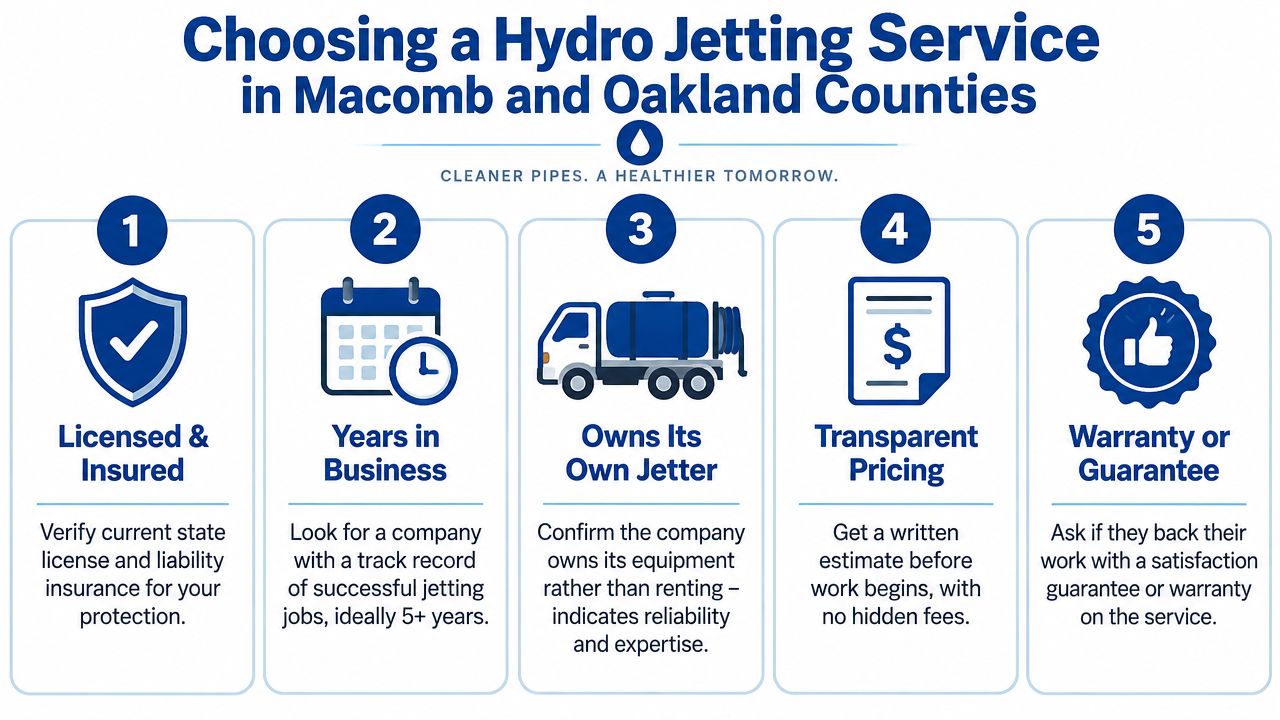
The right contractor should explain the process before starting the pump. Look for a licensed and insured company that performs its own diagnostic work, brings appropriate equipment, and gives you a written scope of service.
A practical screening checklist
- Confirm licensing and insurance. Ask for current documentation and verify that the company can work on residential and commercial plumbing systems.
- Ask who owns the jetter. A company that owns and maintains its equipment may have more direct control over scheduling and setup than one relying on a rental or subcontractor.
- Request camera inspection. The technician should discuss the pipe condition before choosing pressure and should offer post-cleaning verification.
- Ask about nozzles and hose. A flexible hose and multiple nozzle types allow the operator to match the tool to grease, scale, roots, or a soft obstruction.
- Get written pricing. The quote should explain access, inspection, cleaning, possible add-ons, and what happens if the camera finds structural damage.
A truck-mounted system capable of operating around 3,500 PSI or higher may be appropriate for stubborn mainline buildup, but higher pressure isn't automatically better. Residential lines commonly fall within the broader 1,500 to 4,000 PSI range described in this trade explanation of hydro jetting pressures. The operator should select pressure based on pipe material, blockage type, and camera findings.
Watch for flat-rate quotes offered without inspection, contractors who don't offer a camera, door-to-door solicitations after storms, or anyone pushing full sewer replacement without showing evidence. A plumber familiar with older clay tile laterals, cast iron buildup, shifting soil, and tree-root patterns around Macomb and Oakland Counties can explain the difference between a cleaning problem and a pipe problem.
Jays Plumbing and Sewer provides sewer camera inspections, high-pressure water jetting, drain cleaning, sewer repair, residential plumbing, and commercial plumbing service for properties in Macomb County, Oakland County, Wayne County, Fraser, Sterling Heights, Clinton Township, Troy, Macomb Township, and Shelby Township. For a camera-and-jet assessment, call 586-634-3450 and ask what the technician expects to find before work begins.
If your concern turns out to be a different plumbing issue, the same diagnostic approach can lead to leak detection, pipe repair, sump pump repair, garbage disposal repair, bathroom plumbing, kitchen plumbing, water heater repair, water heater replacement, or emergency plumbing service. That keeps the recommendation tied to the condition of the system instead of forcing every backup into the same solution.
Jays Plumbing and Sewer offers camera-guided hydro jetting and sewer cleaning for homeowners, property managers, restaurants, and other commercial properties across Macomb, Oakland, and Wayne Counties. Call 586-634-3450 to discuss recurring backups or schedule an inspection, then visit Jays Plumbing and Sewer to request service or an estimate.
