
A slow kitchen sink, a toilet that gurgles after the washing machine runs, or water rising in a basement floor drain can feel like an ordinary clog. In a Michigan home with mature trees, though, the blockage may be farther outside, where roots have entered the buried sewer line through a crack, loose joint, or failed seal.
That distinction matters. Tree roots in sewer line removal can restore flow for a while, but cutting roots alone doesn't repair the opening that attracted them. The right answer may be mechanical cutting, hydro-jetting, spot repair, trenchless lining, or full replacement, depending on what a camera finds in the pipe.
Table of Contents
- Why Tree Roots Target Your Sewer Line
- Warning Signs You Have Roots in Your Sewer
- How Plumbers Diagnose Roots With Camera Inspection
- Professional Tree Roots in Sewer Line Removal Methods
- When Cleaning Is Not Enough and Repair or Replacement Is Needed
- Prevention Tips and When to Call Jays Plumbing and Sewer
Why Tree Roots Target Your Sewer Line
A homeowner in Sterling Heights might first notice a shower draining slowly. A homeowner in Troy might hear a basement toilet bubble when the laundry empties. In Shelby Township, a recurring main-line clog may seem unrelated to the mature tree near the sidewalk, until a sewer camera shows roots packed into a pipe joint.
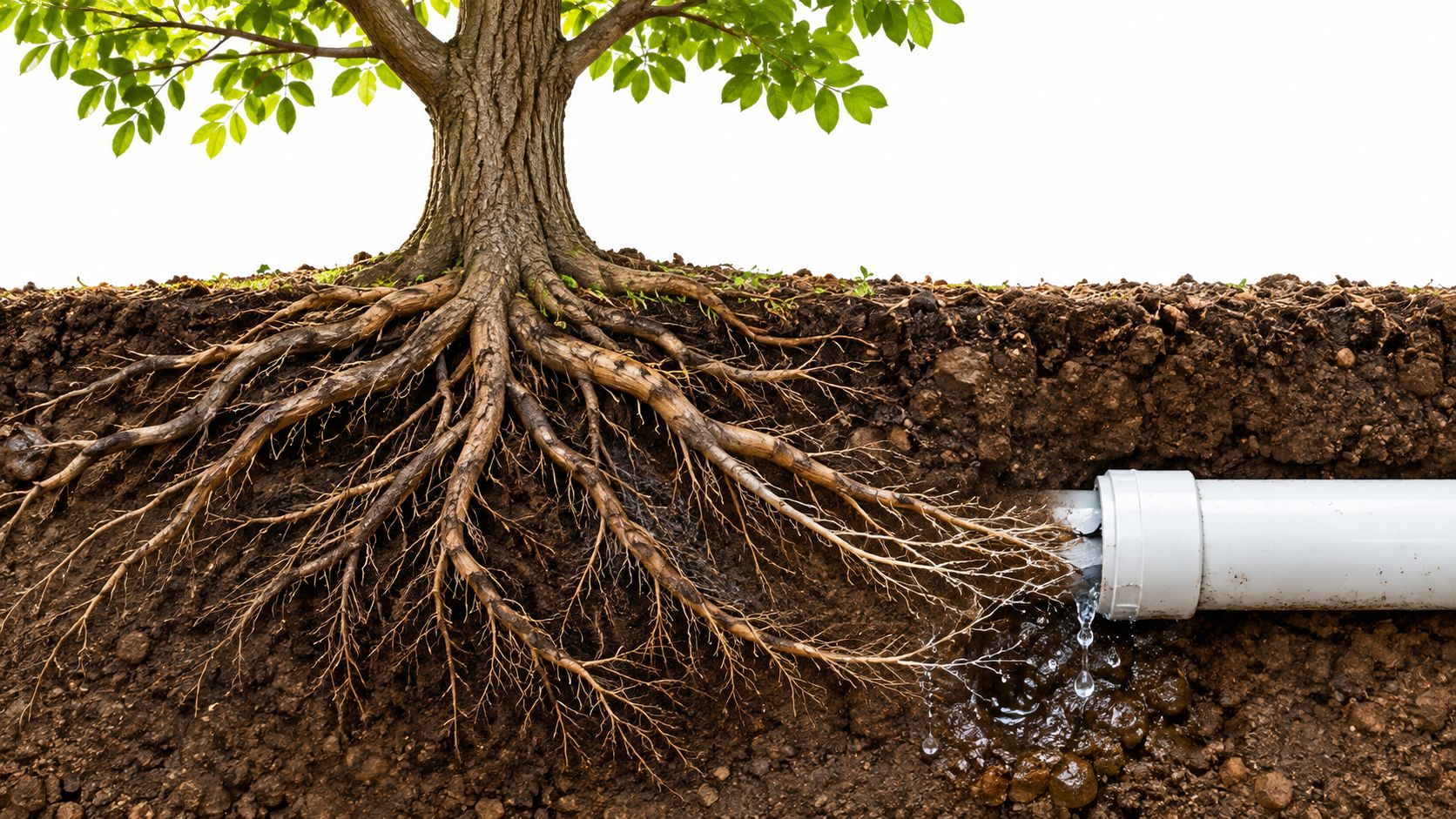
Roots aren't looking for a sewer line because they're trying to break a healthy pipe. They follow moisture escaping from hairline cracks, loose or offset joints, deteriorated seals, and porous pipe walls, then grow through the defect into the pipe. A municipal explanation of root intrusion describes the same process, including how roots can expand inside the line and partly or completely restrict wastewater flow. Traverse City's tree-root sewer FAQ provides a clear overview of these entry points.
Why older Michigan lines deserve attention
Older neighborhoods in Macomb County, Oakland County, and Wayne County often have mature landscaping and aging buried infrastructure. Clay-heavy soil can shift as moisture changes, while Michigan winters bring freeze-thaw movement that puts stress on pipe joints. That doesn't mean every older line has roots, but it does mean a recurring blockage deserves more than another chemical treatment.
The U.S. Forest Service review of root intrusion reports that roots are associated with more than 50% of sewer blockages. The review also connects root removal costs to structural failures caused by corrosion, soil movement, and poor construction, not just temporary obstructions. The Forest Service review supports a practical conclusion: roots often reveal an existing pipe defect.
A Swedish CCTV study inspected 33.7 kilometers of pipe and recorded 2,180 distinct root intrusions. It also found root intrusion reported by 97% of municipalities in Denmark and 99% in Sweden, showing that this is a system-wide issue in mature sewer networks, not merely a problem in one local yard. The Swedish urban sewer study found that material and joint design influenced risk.
Practical rule: If roots keep returning, ask what opened the pipe in the first place.
Warning Signs You Have Roots in Your Sewer
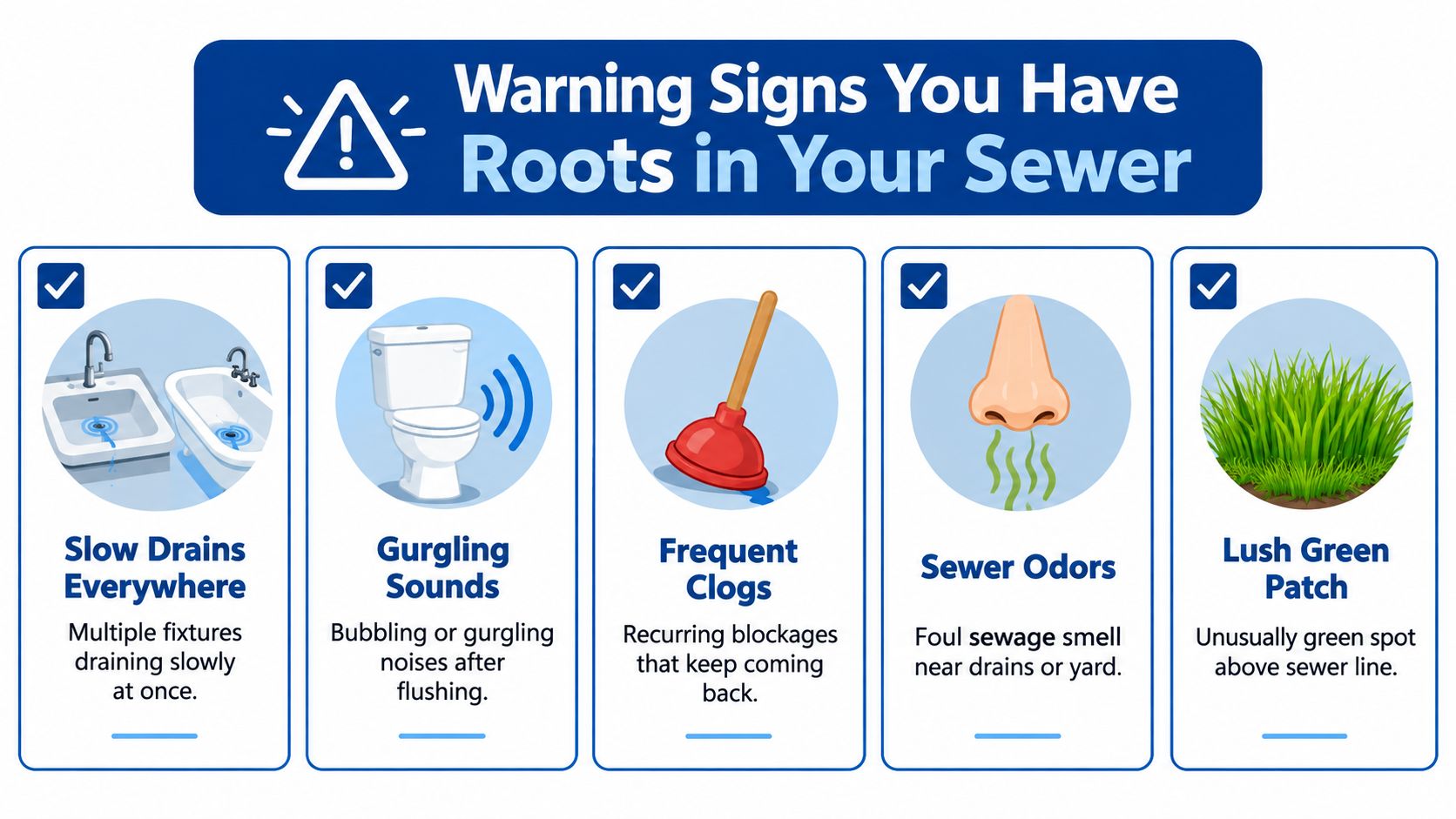
Root intrusion usually announces itself through a pattern, not one isolated symptom. A single slow bathroom sink may have a fixture-level clog. Several slow drains, a gurgling toilet, and a basement backup point more strongly toward the main sewer line.
Watch for these signs:
- Slow drains throughout the home: Multiple fixtures draining poorly at the same time can indicate restricted flow in the main line.
- Gurgling toilets: Bubbling or gurgling after flushing or after the washing machine drains can occur when air and water move past a partial obstruction.
- Recurring clogs: If plunging clears the problem and the same backup returns, the obstruction may still be inside the buried line.
- Sewer odors: A persistent sewage smell near a floor drain, foundation, or section of yard can signal a leak or damaged connection.
- Unusually lush grass: A greener patch above the sewer route can indicate moisture escaping into the soil, although only an inspection can confirm the cause.
- Basement drainage problems: Water backing up through a floor drain is urgent because the basement is often among the lowest points in a home's drainage system.
What to do before calling
Stop running unnecessary water if sewage is backing up. Don't pour chemical drain opener into a line that may have a damaged pipe or a full obstruction, and don't keep forcing a rental machine into an unknown sewer line.
Write down which fixtures are affected, when the symptoms began, whether rain or dry weather changed them, and how often the clog returns. That information helps a plumber distinguish a single-fixture issue from a main-line restriction.
Call promptly if wastewater is entering the basement, several fixtures are affected, or a blockage returns after drain cleaning. A professional can inspect the line before recommending excavation, sewer repair, or replacement.
How Plumbers Diagnose Roots With Camera Inspection
A camera inspection is the decision point between guessing and knowing. The plumber first needs safe access through a sewer cleanout or another suitable entry point, then checks whether water can move through the line well enough to advance inspection equipment.
The camera travels through the sewer pipe and sends live video to a monitor. A technician can identify the root location, estimate its distance from the access point, observe the pipe material, and look at joints, cracks, offsets, corrosion, sagging, or collapse. That record helps determine whether the line needs cleaning only or whether the defect calls for repair.
For homeowners in Fraser, Clinton Township, and Macomb County, the most useful inspection is one that connects the footage to a clear recommendation. A video camera sewer inspection can help locate the obstruction and assess the condition of the line before anyone digs.
What the camera changes
Root mass can hide the actual opening. After clearing the obstruction, a follow-up view may show whether roots entered through one vulnerable joint or through several damaged sections. That difference affects the scope of work and gives a homeowner something concrete to review before approving an excavation.
| Camera Finding | What It Means | Recommended Next Step |
|---|---|---|
| Roots at one accessible joint, pipe otherwise sound | A localized entry point may be driving the recurring clog | Discuss root removal and a targeted repair or lining option |
| Roots with cracks or several damaged joints | Cutting may reopen flow but won't resolve repeated entry | Compare spot repair, trenchless rehabilitation, and replacement |
| Heavy buildup along the pipe wall | Roots may be mixed with grease, sand, or settled debris | Consider mechanical cleaning or hydro-jetting, followed by another camera view |
| Offset, sagging, or collapsed section | The line has a structural or alignment problem | Request a repair plan based on the affected section and surrounding conditions |
| Clear pipe with no root intrusion | Symptoms may come from another drain or sewer issue | Investigate fixture clogs, damaged connections, or other restrictions |
A camera also protects against unnecessary digging. Instead of replacing a whole line because roots were found somewhere, the contractor can identify the actual defect, explain its position, and provide a job-based estimate that matches the footage.
Professional Tree Roots in Sewer Line Removal Methods
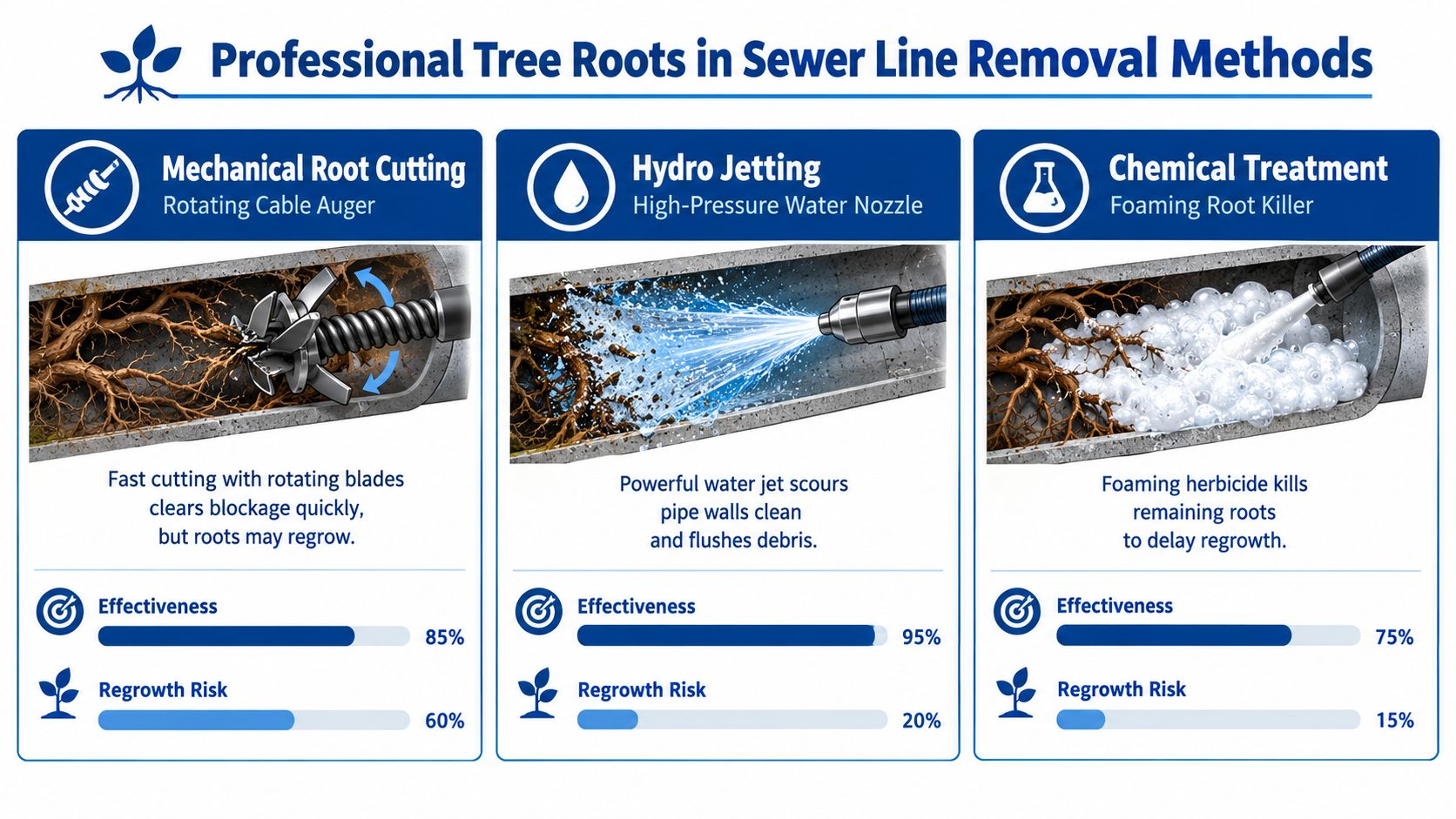
The right removal method depends on the pipe's condition, the amount of root growth, and what else is blocking the line. Mechanical cutting is often the first response because it can reopen a restricted sewer quickly. It isn't a structural repair.
Mechanical root cutting
A rotating cable or cutting head breaks through the root mass. Industry guidance identifies mechanical root-removal tools as a standard approach for severe root activity, while also making clear that cutting doesn't fix the damaged pipe. Oatey's guidance on removing and preventing roots explains that the tool clears growth without repairing the underlying line.
This is reasonable for an urgent backup, a limited intrusion, or a line that needs temporary flow restored while the owner considers repair. It becomes a poor long-term plan when the same roots return repeatedly through the same crack or joint.
Hydro-jetting
Hydro-jetting uses a specialized nozzle and high-pressure water to scour the interior and flush loosened material downstream. It can be useful when root growth is mixed with grease, sand, detergent residue, or mineral buildup. A commercial line in Troy, for example, may need more than a cable if kitchen grease has coated the pipe wall around the roots.
Jetting requires judgment. A plumber should understand the pipe material and condition before using aggressive pressure, especially in an older or fragile line. After cleaning, another camera inspection can reveal the defect that was hidden behind the root mass.
The cleanest line isn't necessarily a healthy line. The camera has to show what remains after the obstruction is gone.
For a closer look at when water jetting fits a clogged drain, see this guide to sewer jetting.
Chemical treatments
Chemical root treatments may delay regrowth in some situations, but they don't remove the root mass or close the pipe defect. They also shouldn't replace a camera-based diagnosis. Homeowners should follow product directions carefully and ask a plumber before using chemicals in an older, cracked, or repeatedly backing-up line.
A Macomb ranch with the same backup after every cutting visit needs a different conversation from a first-time clog. The first may need lining or replacement planning. The second may only need appropriate cleaning and monitoring, provided the camera shows a sound line.
Expect a professional crew to protect the property with drop cloths and shoe covers, then clean the work area. Ask whether pricing is job-based and whether the estimate includes the inspection findings, cleanup, and any follow-up camera work.
When Cleaning Is Not Enough and Repair or Replacement Is Needed
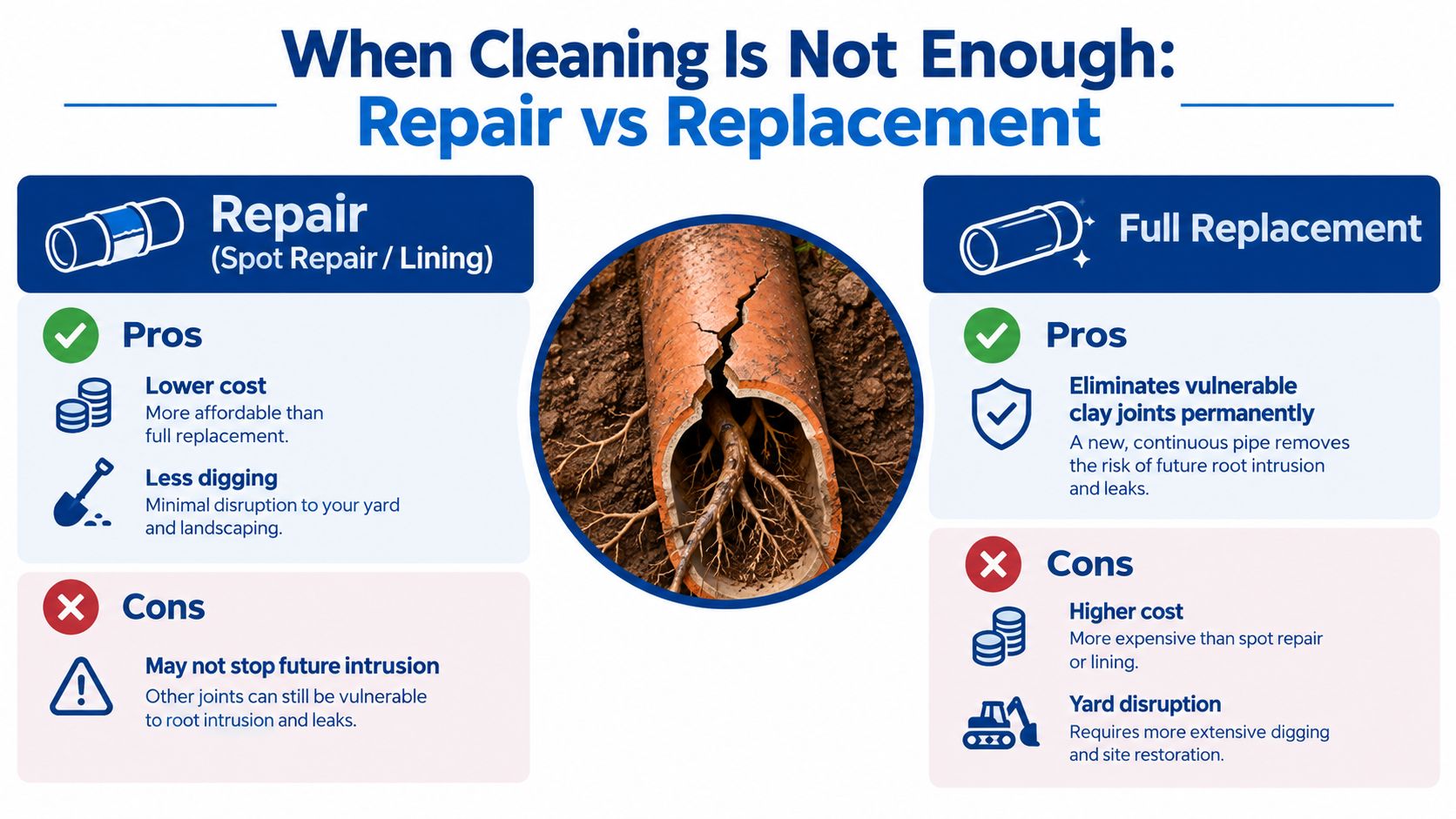
Cleaning is enough when the camera shows a limited obstruction and the pipe remains structurally sound. It isn't enough when roots have entered through several failing joints, a cracked clay section, a deteriorated pipe wall, or an offset that continues to collect debris.
The U.S. Forest Service benchmark shows why older, smaller sewers deserve close attention. Pipes built after 1970 had about two intrusions per 1,000 meters, while pre-1970 pipes had 6 to 11 Class I intrusions per 1,000 meters. The Forest Service PDF also reports annual sewer repair costs ranging from $0.11 to $6.39 per tree, with a mean of $1.66 per tree, across several U.S. and Canadian cities. These figures reinforce why repeated cutting is generally a short-term tactic.
Choosing the repair path
A spot repair can make sense when one joint or short section is defective and the rest of the line is in good condition. It limits the work area, but it won't protect other failing joints elsewhere in the run.
Traditional excavation exposes the damaged pipe so the crew can remove and replace it directly. This is disruptive to landscaping, driveways, and established surfaces, but it may be necessary when the pipe has collapsed, shifted badly, or lacks enough structural integrity for lining.
Cured-in-place pipe lining, or CIPP, creates a new pipe inside the old one after root intrusion damage. It can reduce digging where the existing pipe is suitable for rehabilitation. Hathorn's explanation of root-removal solutions describes the choice between excavation and trenchless rehabilitation, including CIPP lining.
Climate belongs in the decision
South Australian utility reporting linked a spike in sewer blockages to prolonged dry conditions, with tree roots again identified as the dominant cause. SA Water's report on prolonged dry conditions is a useful reminder that root activity isn't only about tree species or pipe age. Water-stressed soil can change the urgency of inspection, especially after unusual heat or drought.
For a property in Wayne, Oakland, or Macomb County, ask whether the recommendation accounts for pipe material, previous blockages, soil movement, and the section's overall condition. A second opinion before excavation is sensible when the proposed work doesn't clearly match the camera findings. Information about trenchless sewer repair can help homeowners compare disruption and long-term options.
Prevention Tips and When to Call Jays Plumbing and Sewer
Prevention starts with the pipe, not panic about every tree in the yard. Avoid placing new water-seeking trees directly over the sewer route, keep cleanouts accessible, and consider a camera inspection when a property has a history of recurring backups or after an unusual dry spell or heavy-rain period.
A simple seasonal plan works well for homeowners, property managers, and buyers reviewing a home:
- Before Michigan winter: Address slow drains and damaged cleanouts before frozen ground makes access harder.
- During heavy rain: Watch basement floor drains and low fixtures for backup, especially if the line has previous problems.
- After dry weather: Schedule an inspection sooner if a mature-tree property develops repeat clogs.
- For property transactions: Request sewer camera footage before buying or selling an older home with large trees.
- For businesses: Arrange commercial plumbing maintenance when grease and root growth appear in the same line.
Don't attempt root removal with an unfamiliar cutting machine, and don't keep using chemical products when wastewater is backing up. A licensed plumber can perform drain cleaning, leak detection, sewer repair, pipe repair, and camera inspection, while the same company may also handle water heater repair, water heater replacement, garbage disposal repair, sump pump repair, bathroom plumbing, kitchen plumbing, and broader commercial plumbing needs.
Jays Plumbing and Sewer provides residential and commercial service from Fraser across Macomb and Oakland County, including Fraser, Sterling Heights, Clinton Township, Troy, Macomb, Shelby Township, and nearby Wayne County communities. For an emergency plumber, a sewer evaluation, or a planned repair, call 586-634-3450.
Call Jays Plumbing and Sewer at 586-634-3450 for sewer camera inspection, root removal, hydro-jetting, sewer repair, or replacement planning before a recurring clog becomes basement flooding. You can also visit Jays Plumbing and Sewer to schedule service or request an estimate for your home or commercial property.
