
You hear it at the worst time, usually when the house has gone quiet. A toilet starts hissing, refilling, or making a soft running sound even though nobody used it, and suddenly you're wondering if something is broken, leaking, or just acting up for no reason.
In most homes around Macomb County, that sound usually means the toilet is slowly losing water inside the tank. The fill valve senses the drop and tops the tank back off, so what sounds like a toilet flushing on its own is often a small internal leak doing the work in the background. That's why this problem deserves attention, even when the bathroom floor looks dry.
Table of Contents
- Why Your Toilet Seems to Flush by Itself
- The Most Common Causes of Ghost Flushing
- How to Diagnose the Problem Yourself
- Practical Fixes You Can Try at Home
- How Much Water and Money Ghost Flushing Wastes
- When to Call a Professional Plumber
Why Your Toilet Seems to Flush by Itself
The call usually comes from a homeowner who heard the toilet kick on at 2 a.m. and thought someone had flushed it. In the morning, the bowl looks normal, the handle feels fine, and the only clue is that the tank refilled without warning. That's the part that makes people call it ghost flushing.
What's happening is simpler. The tank is losing water into the bowl little by little, then the fill valve opens when the water level drops enough to refills it again. That refill cycle is the hissing or running sound people notice, and it points to a leak path inside the tank rather than a random mechanical event.
The tank is doing the work, not the handle
If the handle isn't being touched, the handle usually isn't the problem. The toilet can still refill because the tank water level dropped on its own, and the fill valve did exactly what it was designed to do. That's why a homeowner may swear the toilet flushed by itself, even when the issue started hours earlier inside the tank.
Practical rule: treat the sound as a symptom, not the cause. The cause is usually water sneaking past a seal or creating an unwanted siphon.
That distinction matters in older homes across Fraser, Sterling Heights, Warren, and nearby communities. A toilet with a worn tank seal, an aging fill valve, or a refill tube set wrong can act up repeatedly without showing an obvious spill. The repair starts with the leak path, not with the handle.
The Most Common Causes of Ghost Flushing
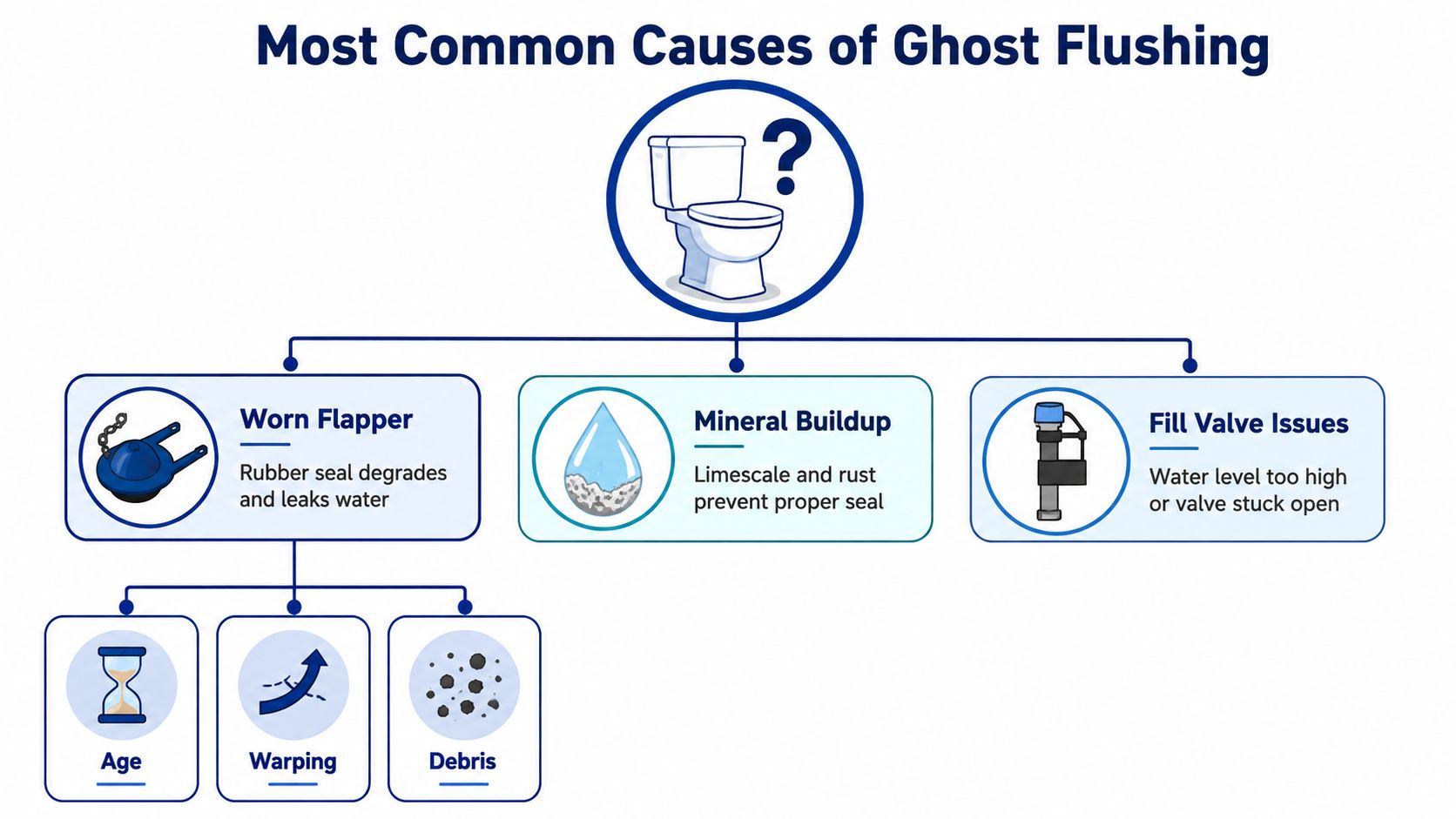
The two parts I check first are the flapper and the fill valve. That matches what most plumbing guides point to as the common failure points, and it fits what we see in real homes with mineral buildup, older tank parts, and tank water that won't stay put. A bad seal is often enough to start the whole cycle.
The flapper usually comes first
The flapper is the rubber seal that keeps water in the tank until the toilet is flushed. If it's worn, warped, cracked, mineral-coated, or not sitting squarely on the flush valve seat, water slips past it and empties into the bowl. Once that happens, the fill valve tops the tank back off, and the cycle repeats.
The fill valve and setup errors matter too
A fill valve can fail by sticking, shutting off late, or cycling more often than it should. That doesn't mean the toilet is “flush-happy,” it means the tank level isn't holding where it should. Small setup mistakes can do the same thing, especially a flapper chain that's too tight, a water level set too high, or a refill tube shoved too far into the overflow pipe.
The refill tube is a sneaky one. If it discharges into or below the overflow pipe, it can create a siphon effect that behaves like a leak even when the toilet doesn't have a cracked part. That's why we don't just swap parts at random.
A toilet that keeps refilling is usually telling you one thing, the tank isn't sealing or feeding correctly.
For homeowners in Macomb County and Oakland County, that usually means the answer is inside the tank, not in the drain line. If the tank hardware looks old, the odds go up that you're dealing with wear, mineral deposits, or an adjustment issue rather than something exotic.
How to Diagnose the Problem Yourself
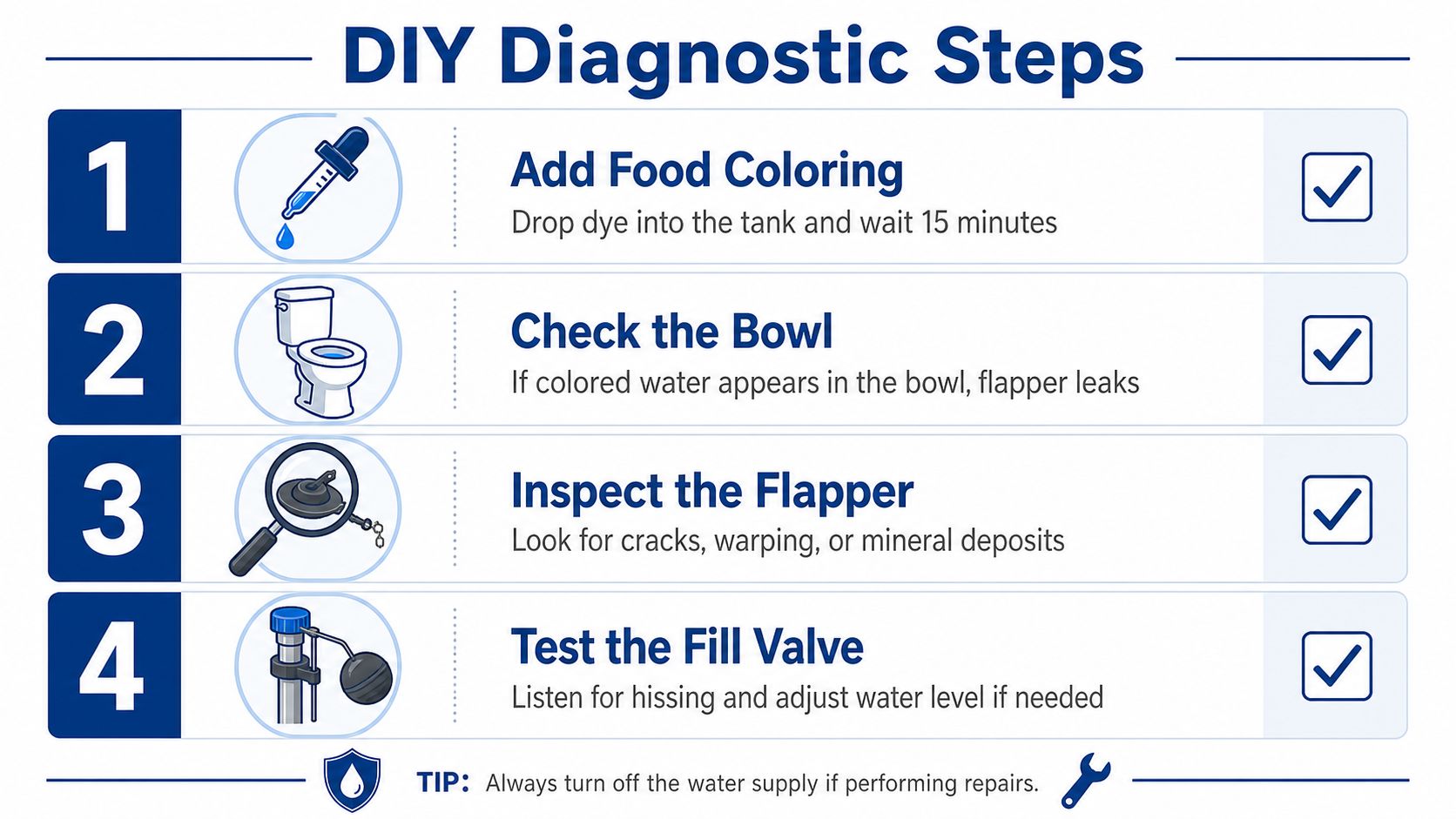
Start with the easiest confirmation test, the food coloring test. Put a few drops of dye in the tank, wait a bit without flushing, then check the bowl. If the color shows up in the bowl, the leak is moving from tank to bowl and not coming from the supply line.
Check the seal and the chain
If dye appears in the bowl, lift the lid and inspect the flapper. Look for a bent edge, stiffness, cracks, or a rough mineral coating where it meets the flush valve seat. Then check the chain, it should have a little slack, not be pulled tight when the flapper is closed.
Confirm the water level and refill tube
The tank water level should sit about 1/2 inch to 1 inch below the overflow tube. If it's higher, the toilet may be trying to run too close to the overflow and never fully settle. Also look at the refill tube, it should not be shoved too far into the overflow pipe, because that can create siphoning or refill trouble.
If you want a deeper visual on a tank-to-bowl leak path, this guide on how to spot a toilet leak between the tank and bowl lines up with the same diagnostic logic.
The point of this workflow is to avoid guessing. If the dye test shows an internal leak, you're not chasing the supply line. If the chain is right and the refill tube looks fine, the flapper or fill valve becomes the more likely culprit.
Practical Fixes You Can Try at Home
Once you know the leak is inside the tank, the repair usually gets simpler. Start with the parts that fail most often, but test them in a useful order. A dirty or worn flapper is usually first on the list because it is easy to see, cheap to replace, and often the part that lets water seep past the seal. If mineral buildup is light, cleaning the seal can help. If the rubber is warped or stiff, replacement is the better fix.
The small adjustments that matter
A few fixes are reasonable for a homeowner with basic hand tools, as long as you work one change at a time and retest the toilet after each adjustment:
- Replace the flapper: If it is cracked, stiff, or not laying flat, install the correct size for your toilet. If you want a walk-through that covers the common setup mistakes too, see how to fix a running toilet without leaving home.
- Add chain slack: A chain that is pulled too tight can hold the flapper open just enough to keep water moving into the bowl.
- Lower the water level: Adjust the float so the tank settles where it should instead of sitting too high near the overflow tube.
- Move the refill tube: Keep the tube positioned so it is not shoved down into the overflow pipe, since that can create siphoning or refill trouble.
These changes often stop the running sound without tearing into the whole toilet. The value is in checking one likely cause at a time, then watching whether the tank holds steady. That approach works well in a home bathroom, a kitchen-adjacent powder room, or a rental unit where you want a quick fix without unnecessary parts.
Know where DIY stops
If the flush valve seat is corroded, cracked, or rough, a new flapper may still leak past the seat. The same issue comes up on older toilets where replacement parts are harder to match, especially some older one-piece fixtures. A plumber can tell the difference between a part that needs changing and a toilet that has a larger wear problem inside the tank.
I have also seen homeowners replace one part after another while the problem was an aging fill valve or a tank setup issue. A slow tank leak, a siphon from the refill tube, and a fill valve that will not settle can all sound similar, but they do not get fixed the same way. A methodical check beats random part swapping every time. In the right case, a local plumber like Jays Plumbing and Sewer can handle the repair, inspect the tank parts, and make sure the fix holds.
How Much Water and Money Ghost Flushing Wastes
A toilet that keeps cycling costs more than it sounds like it should. Even a small leak can keep sending water down the drain between flushes, so the tank is never really settling the way it should. That constant refill cycle wears on the fixture and wastes water in the background. Home Water Works on toilet water use
The cost depends on what is leaking and how often the toilet runs. In a ghost-flushing setup, water can move out of the tank in short bursts or slow, repeated losses that add up over time. A separate leak-detection cost guide can help homeowners think through the repair side of the problem. our leak detection cost page
Older toilets waste more when they malfunction
Older fixtures used more water with every flush than modern toilets. U.S. toilets are federally limited to 1.6 gallons per flush, WaterSense models use 1.28 gallons or less, older toilets from the early 1980s to 1992 typically used 3.5 gallons per flush or more, and pre-1980 models often used 5.0 to 7.0+ gallons per flush.
That matters when an older tank starts acting up. A small leak on a higher-volume toilet can waste more water before anyone notices, and the running sound tends to come back faster after each cycle. If you manage property in Macomb or Oakland County, or you just want to stop paying for water that never served a purpose, it makes sense to address the leak path early.
When to Call a Professional Plumber
Call a plumber when the same toilet keeps acting up after you've checked the flapper, chain, water level, and refill tube. That usually means the problem is deeper than a simple adjustment, or the parts you replaced aren't sealing against the old hardware the way they should. Older tanks can be stubborn like that.
Situations where a pro makes sense
- The problem returns after a flapper or fill valve change. That points to a bad seat, hidden wear, or a parts mismatch.
- The flush valve seat is damaged. A rough or corroded seat can keep a new flapper from sealing.
- Parts are hard to source. Older toilets can need specific components that aren't sitting on a shelf at the hardware store.
- Multiple toilets act up. When several fixtures show similar symptoms, it can be a broader water pressure or maintenance issue.
Commercial restrooms need a different approach. Self-flushing flushometer toilets in offices, stores, and other commercial spaces often need specialized service, especially when the symptoms show up in multiple stalls or high-use areas. That's where experience with commercial plumbing, bathroom plumbing, and diagnostics saves time.
Jay's Plumbing and Sewer handles 24/7 emergency response, upfront pricing, and camera inspections when the issue goes beyond the toilet tank. If you're in Fraser, Warren, Sterling Heights, or anywhere across Macomb and Oakland County, call Jay's Plumbing and Sewer Now @ 586-634-3450 for a free estimate or to schedule service.
If your toilet keeps refilling or making that strange running sound, don't ignore it. Jay's Plumbing and Sewer handles toilet repair, leak detection, drain cleaning, and other residential and commercial plumbing work across Macomb County and Oakland County. Visit Jays Plumbing and Sewer to schedule service, and get the problem checked before a small tank leak turns into a bigger repair.
