

If your toilet flushes on its own in the middle of the night, or you walk past a quiet bathroom and hear the tank refill for no clear reason, you're probably dealing with ghost flushing, not a haunted toilet. Around Fraser, Clinton Township, Sterling Heights, and the rest of Macomb County, I hear this complaint a lot, and the story is usually the same, a slow leak inside the tank drops the water level until the fill valve kicks on again.
That matters because toilets already account for 24% of daily residential water use, and the average American flushes 5 times per day (Home Water Works). A single leaking toilet can waste up to 200 gallons per day, which is how a “small” problem turns into a real utility bill problem fast (Home Water Works). Most of the time, the parts involved are the flapper, the refill tube, or the fill valve, and the right fix depends on which one is at fault.
Table of Contents
- What It Means When Your Toilet Flushes on Its Own
- Run a Quick Diagnosis Before You Touch Anything
- How to Tell Which Part Is Really Causing the Flush
- Simple Fixes You Can Do Without a Plumber
- When the Fill Valve Needs Attention
- When It Is Time to Call a Licensed Plumber
- A Short Homeowner Checklist and Next Steps
What It Means When Your Toilet Flushes on Its Own
A homeowner in Fraser once described it to me as “the toilet sneezing in the night.” That's a pretty good way to put it. The toilet wasn't flushing from the handle, it was refilling because water had slowly leaked out of the tank, and the fill valve kept reopening to top it off.
Ghost flushing usually means a leak
That slow leak is the issue. Water moves from the tank into the bowl in tiny amounts, and once the tank level drops enough, the refill system wakes up again. It can sound like a random flush, but it's really a toilet telling you something inside the tank is not sealing the way it should.
The stakes aren't small. Toilets account for a big share of indoor residential water use, and one leaking toilet can waste a lot of water depending on how bad the leak is (Home Water Works). In a house with older bathroom plumbing, that kind of waste can hide for a long time before anybody notices.
Practical rule: if the sound keeps coming back after the room has been quiet for a while, think slow leak, not a one-time flush.
The three usual suspects
The three parts I look at first are the flapper, the refill tube, and the fill valve. The flapper is the seal at the bottom of the tank, the refill tube should return water to the tank without siphoning it into the overflow pipe, and the fill valve controls when the tank stops filling.
If you live in Macomb or Oakland County and the toilet has started acting up in one bathroom, you can usually narrow it down without tearing the whole fixture apart. A refill tube shoved too far into the overflow pipe can create a siphon and keep the tank from behaving normally. A worn fill valve can also let the tank drift low enough that it keeps topping itself off. If it's hard to tell what you're hearing, or the tank parts look worn and brittle, that's where a local plumber in Fraser, Warren, or Clinton Township can save you from buying parts you don't need.
Run a Quick Diagnosis Before You Touch Anything
A toilet that flushes on its own usually gives you a few clues before you ever pull a part. Start by confirming whether water is moving from the tank into the bowl on its own. The food-coloring test is the fastest way to check that. Add a few drops of food coloring to the tank, wait about 10 to 15 minutes, and look in the bowl. If colored water shows up without a flush, the leak is happening between the tank and bowl. If you want a second set of eyes on that kind of failure point, this tank-to-bowl leak guide explains the same problem from the plumbing side.
What to look at inside the tank
Lift the lid carefully and look at the parts you can see without forcing anything. Check for a warped flapper, a flapper coated with mineral buildup, or a chain that is pulled too tight and holding the seal open. Look at the refill tube too. If it is shoved too far into the overflow pipe, it can siphon water and make the tank behave strangely.
The water level matters as well. If it sits above or below the marked line, the tank may keep trying to correct itself. That can show up as refill sounds every few minutes or every few hours, depending on how much water is leaking away. A toilet that goes quiet for a while is not necessarily fixed.
If the tank looks fine and the water level still drifts, do not assume the problem is over. A refill tube that is positioned wrong can act like a hidden drain, and a fill system that does not shut off cleanly can keep the toilet in a cycle of topping itself off. A quick look can rule out a simple problem, but brittle plastic and old rubber can break fast once you start moving parts around.
If you're not comfortable taking the tank lid off, or the parts inside look fragile, stop there. A clean look is useful, but forcing old plastic and brittle rubber usually creates a second problem you didn't have before.
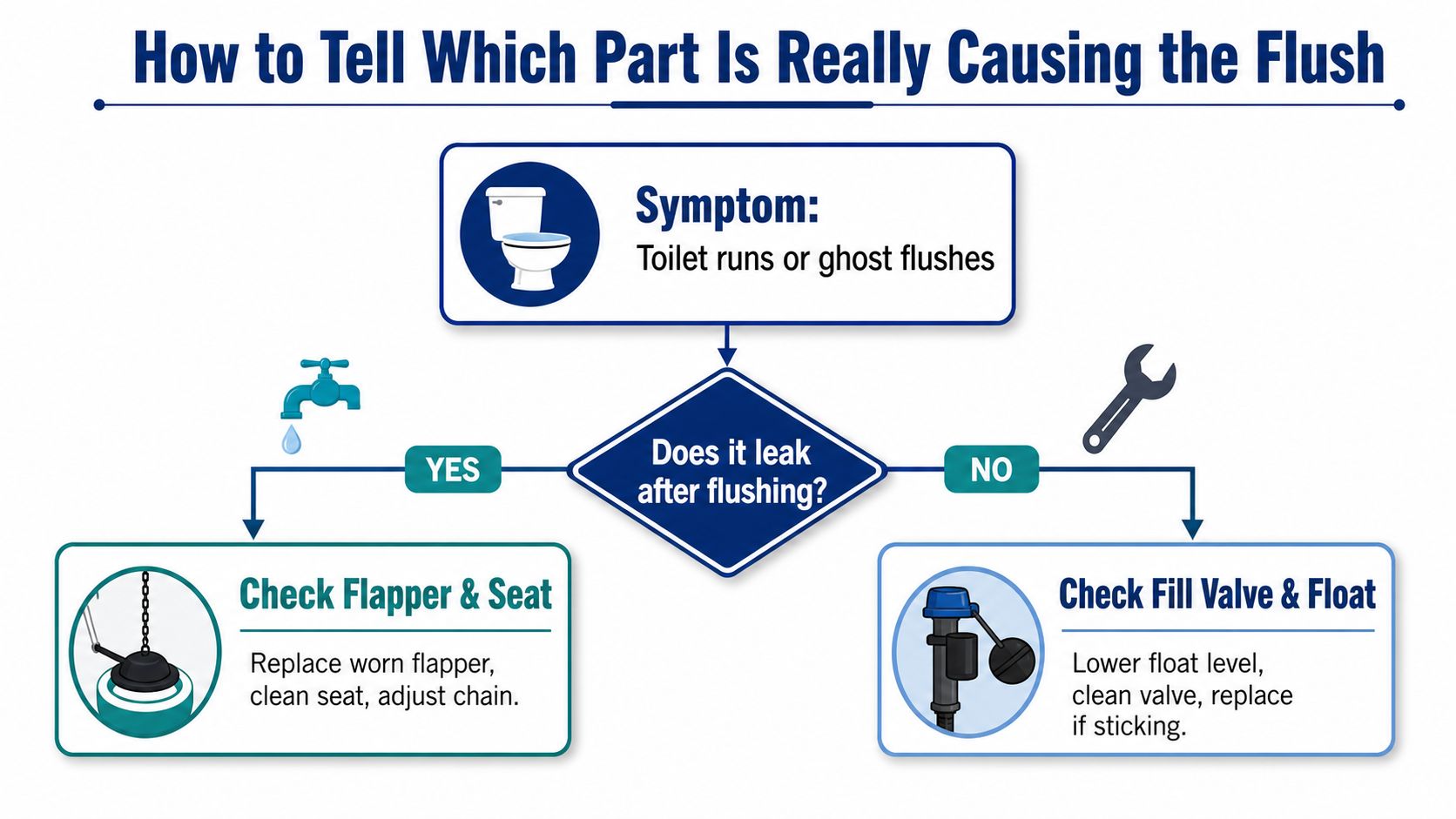
How to Tell Which Part Is Really Causing the Flush
Most bad advice starts with “replace the flapper.” That's fine when the flapper is the issue, but it's not a smart way to diagnose a toilet that flushes on its own. A better approach is to follow the symptom and let it point you toward the part.
Start with the tank-to-bowl leak
If dye appears in the bowl, the flapper or flush valve seat is the first place to look. That's the cleanest sign that water is slipping past the seal when it shouldn't. The fix might be a tired flapper, or it might be a rough seat that doesn't let the flapper close evenly.
Then check the refill tube and fill valve
If the tank level looks right but the toilet still refills, check the refill tube placement next. When that tube sits too far down inside the overflow pipe, it can siphon water and make the system behave like it has a hidden leak. That problem gets missed a lot because the toilet still looks “full.”
If the tank is full, the dye test doesn't show a leak, and the refill keeps cycling anyway, the fill valve moves higher on the list. Some troubleshooting guidance notes that 20% to 30% of ghost flushes can trace back to a fill valve, which is why a flapper-only mindset misses a meaningful share of cases (Fluidmaster).
For a separate look at the tank-to-bowl leak question, see this guide on a toilet leak between the tank and bowl.
Simple Fixes You Can Do Without a Plumber
If the toilet is ghost flushing and the diagnosis points to the flapper or the refill tube, those are usually the easiest repairs a homeowner can handle. I'd still tell you to work slowly, because the goal is a tight seal and the right tank water level, not just swapping parts and hoping for the best.
Replacing the flapper the right way
Turn off the water supply, flush the toilet, and hold the handle down until most of the tank drains. Unhook the old flapper, then take it with you so you match the size and style instead of guessing. When the new one goes on, leave the chain with a little slack, about half an inch of play, so the flapper can seat properly without hanging open.
Don't overtighten the chain. I see that mistake all the time, and it turns a simple repair into a toilet that still won't seal.
Adjusting the refill tube
If the refill tube is shoved too far into the overflow pipe, pull it back so it sits just above it. In many cases, that stops the siphon effect. It's a small adjustment, but toilets are sensitive to water movement inside the tank.
After either fix, retest using the dye method described above. If the color stays in the tank and the toilet stays quiet, you've likely solved it. If it still refills, the part you changed probably wasn't the problem, and the next move is to look at the fill valve instead of stacking repairs on the wrong diagnosis.
For homeowners who want parts in hand before starting, the right toilet parts matter more than fast guesses, and you can compare options in Jays Plumbing and Sewer's toilet parts selection. For a simple at-home walkthrough, the earlier guide on fixing a running toilet without leaving home fits this kind of repair well.
When the Fill Valve Needs Attention
If the flapper test comes back clean and the toilet still makes periodic refill noises, the fill valve deserves a closer look. That part shuts the water off at the right tank level, and when it starts failing, the toilet can hiss, trickle, or sound like it is topping off for no reason.
Signs the valve isn't shutting down cleanly
A bad fill valve may shut off slowly, or not shut off fully. You might hear hissing after the tank should be full, or notice water trickling into the overflow tube even though the level looks normal. In some houses, that symptom points straight to the valve itself, and in older homes around Fraser, Sterling Heights, and Warren, I've also seen supply-side behavior make the issue harder to read.
A valve problem isn't always dramatic. Sometimes it just sounds like the toilet can't make up its mind.
Replacing a fill valve takes more work than a flapper change, but it is still a normal repair for a licensed plumber. The job usually means shutting off water, draining the tank, removing the old valve, and setting the new one to the right height and shutoff point. If the same refill issue shows up across multiple units in a building, I'd treat it as a broader maintenance issue, since repeated phantom flushing can point to a pattern instead of one isolated fixture.
For readers sourcing parts before a repair, a dedicated parts page like Jays Plumbing and Sewer's toilet parts category can help avoid buying the wrong valve twice. In a commercial setting, that matters even more because recurring ghost flushing can turn into service calls that never get to the underlying cause.
When It Is Time to Call a Licensed Plumber
DIY makes sense when the issue is a tired flapper or a refill tube that was sitting in the wrong place. It stops making sense when the toilet keeps coming back with the same symptom after you've already done the obvious work.
If the toilet starts ghost flushing again within weeks, the water bill keeps climbing, or there's water on the floor around the base, I'd call that professional territory. The same goes for older fixtures that may be more sensible to repair once or replace cleanly, especially in a house with aging bathroom plumbing in Macomb or Oakland County.
Property managers and landlords should pay attention when the same symptom shows up in more than one unit. Repeated phantom flushing can mean worn tank hardware across the property, and that's a sign to think in terms of maintenance planning, not just isolated fixture repair. For homeowners and commercial property owners who want the issue diagnosed once and handled by a local crew, that's the point where Jay's Plumbing and Sewer becomes a practical next step.
A Short Homeowner Checklist and Next Steps
Keep this simple checklist handy:
- Confirm the leak: Use the food-coloring test and watch the bowl for color.
- Check the flapper and chain: Look for warping, mineral buildup, or a chain pulled too tight.
- Inspect the refill tube: Make sure it isn't shoved into the overflow pipe.
- Retest: Run the coloring test again after any change.
- Move to the fill valve only if needed: Don't swap parts blindly.
The big lesson is straightforward. Small toilet leaks can waste a lot of water, and ghost flushing usually gets worse when it's ignored. If the diagnosis is unclear, the repair doesn't hold, or you just want a professional set of eyes on it in Fraser, Warren, Sterling Heights, Clinton Township, or nearby Oakland County neighborhoods, call Jay's Plumbing and sewer Now @ 586-634-3450.
Jay's Plumbing and Sewer handles toilet repair, leak detection, bathroom plumbing, and commercial plumbing across Macomb and Oakland County. If your toilet flushes on its own, their team can trace the cause, fix the right part, and help you avoid repeat water waste. Visit Jays Plumbing and Sewer to schedule service or ask a local plumber near me about the next step.
